Home Blog Page 1690

15 year old girl from Bihar gets the attention of Ministers

When Jyoti Kumari started cycling all the way from Gurugram in Haryana to Darbhanga in Bihar with her father riding pillion, she must not have thought that she would be grabbing the attention of Union Ministers Ravi Shankar Prasad and Kiren Rijiju.

Mr. Ravi Shankar Prasad tweeted that he was moved to see the girl paddling over 1000 kms with her father as a pillion rider. He said that he has spoken to Minister of State for Youth Affairs and Sports Kiren Rijiju to identify her talent and give her full support through scholarship and train her to become a cyclist.

Following this Minister Rijiju tweeted that would ask Sports Authority of India officials and Cycling Federations of India to report to him after conducting the trials of Jyoti Kumari. He assured Minister Prasad that if found potential, she would be taken in as a trainee at National Cycling Academy in Indira Gandhi Arena in New Delhi.


Blasphemy Laws and Nehru’s Insecurities

The Arya Samaj was a Hindu Reformist Movement or a sect carved out of the Hindu Fold taking birth on 10th April, 1875 founded by Shri. Dayanand Saraswati. During the early 1920s, the leader of the sect Swami Shradhanand was engaged in re-conversion (“Shuddhi” as they called it) of Muslims through the organisation he founded by the name “Bhartiya Hindu Shuddhi Mahasabha”. It is believed that the organisation managed to convert 7,815 erstwhile Muslims back to the Hindu fold simply by means of debate and deliberation.

The conversion activities caused a lot of tension between the two communities leading to a chain of events, primary of which was the assassination of Swamy Shradhanand on December 23, 1926. But apart from this, the immediate reaction to the mass conversion of the Muslims was that of highly defamatory pamphlets of Goddess Sita being distributed among the masses that questioned her fidelity and integrity.

The slanderous contents of the pamphlets triggered the Arya Samaj to come out with a book named “Rangila Rasul” in the year 1927, which was believed to have depicted the Islamic Prophet in bad light. This triggered the arrest of the publisher of the book, Mahashe Rajpal in 1927. Rajpal was later acquitted by the court due to the absence of a law against insult of religion.

Following the case, under intense duress from the Muslim community, the colonial regime was forced to pass a legislation in the form of Section 295(A), coloquially called the “Blasphemy law” that goes as follows:

“ Whoever, with deliberate and malicious intention of outraging the religious feelings of any class of citizens of India, by words, either spoken or written, or by signs or by visible representations or otherwise, insults or attempts to insult the religion or the religious beliefs of that class, shall be punished with imprisonment of either description for a term which may extend to three years, or with fine, or with both.” 

For the first time in the history of the nation, the postulation of “blasphemy” which was alien to the land in social, civilizational, and jurisprudential parameters was introduced. Also, this marked the beginning of an era of what we know today as blatant “minority appeasement”

Despite the introduction of the new law, the violence and obstructionism from one side alone ceased to come to a halt.

On 6th April, 1929, Mahashe Rajpal was stabbed to death in cold blood by a 19 year old carpenter, Ilm-Ud-Din in a marketplace in Lahore. Later that year, the perpetrator was sentenced to the death.

It is to be noted that close to 6,00,000 people had attended the funeral procession of Ilm-Ud-Din and he was put to his grave by the National Poet of Pakistan, Allama Iqbal. To this date, Ilm-Ud-Din is celebrated as a national hero in the Islamic Republic of Pakistan and mass gatherings and events take place on the day of his hanging.

Post-independence, Pakistan adopted the Section 295(A) of the Indian Penal Code as such and also strengthened the Blasphemy Laws with the introduction of 295(B) and 295(C) which are as follows:

Section 295(B):

“Whoever willfully damages, desecrates or defiles the Holy Quran, or uses it in a derogatory manner for any unlawful purposes shall face imprisonment for life.”

Section 295(C):

Whoever by words, either spoken or written, or by visible representation or by any imputation, innuendo, or insinuation, directly or indirectly, defiles the sacred name of the Holy Prophet Muhammad (peace be upon him) shall be punished with death, or imprisonment for life, and shall also be liable to fine.

What was the case with India with regards to blasphemy laws post-independence? Well, it remained the same. But there was room for easy abrogation of Section 295(A) until the coming of the First Amendment to the Indian Constitution in 1951. Until 1951, Article 19(1)(A) promised absolute right to free speech for all citizens of India. Therefore, due to the presence of an absolute right to free speech, Article 295(A) would have had no teeth to it thus making it vulnerable enough to repeal.

But ill-fatedly, through the First Amendment came the Article 19(2) which gave the State the right to restrict the free speech in the interest of “public order, decency or morality or in relation to contempt of court, defamation or incitement to an offence”.

But what triggered this amendment between the years from 1947 to 1951 is something that is worth looking into.

Crossroads, a magazine which was headed by a gentleman named Romesh Thapar was a portal which in those days was extremely critical of Nehru’s economic and political policies. The magazine is believed to have made enough noise to worry the then Prime Minister Nehru himself because of its contents.

In 1950, when the magazine wanted to move its base of operations permanently to the Madras Presidency, the government of the day blocked such a move by means of  “Maintenance of Public Order Act, 1949”, a legislation that gave the government to prevent the magazine from entering the region under the pretext of “public order”

Romesh Thapar decided to take the matter to the courts appealing against the government’s move, which eventually went on to become the landmark judgement of “Romesh Thapar vs State of Madras”

It was held by the Madras High Court that the magazine had complete and absolute freedom of expression under Article 19(1)(A) and hence curtailing its general mode of operation is a violation of its rights under the provisions of free speech. The Court also struck down the Maintenance of Public Order Act, 1949 in the case.

This judgement, immediately was followed by the Prime Minister with the correspondence of the Cabinet moving a draft bill in the floor of the Parliament to bring in “reasonable restrictions” to free speech, which was quite telling of the fears and insecurities of the then government and Prime Minister of the day, by whom the champions of free speech and dissent swear today, with regards to increased rights in the hands of the citizens to criticise the government.

It is to be noted that the only voice of opposition for this proposal by the government came from that of Shyama Prasad Mukherjee and the Hindu Mahasabha.

Shyama Prasad questioned the state’s right to place arbitrary restrictions on free speech.

But nevertheless, the First Amendment was passed successfully in 1951 thus introducing Article 19(2) among other things thus successfully curtailing the citizens’ absolute right to free speech.

The events leading up to the First Amendment establish abuse of power, circumvention of landmark judgements and fear of empowered citizens on the part of the erstwhile government.

The First Amendment also puts an end to the prospects of repealing Section 295(A) of the IPC and hence explains its existence to this date.

It is important for us to look at the historical background of Section 295(A) to understand the overt appeasement politics behind it and how it was the result of a legislation formulated by an oppressive colonial regime under pressure from an aggressive mob.

6 lakh people served at Amma Canteens in 58 days

Since the lockdown was imposed due to COVID, the Trichy Corporation has been serving free food at 11 Amma Canteens for 58 days from March 25 to May 21, feeding nearly six lakh people.

The New Indian Express reported, Amma Canteens delivered free food with the help of former MP P Kumar, Ministers Vellamandi Natarajan and S Valarmathi. Banana farmers in the region have also donated about 60 bunches.

Although there are more relaxations in lockdown 4.0, it has not affected the crowd visiting Amma Canteens. Some feel that the footfall would reduceif public transport is resumed.

The affordable Amma Canteens opened by the Chennai Corporation in 2013 had only 73 canteens initially. They are now present across Tamil Nadu. These canteens have helped people from across the sections – from working bachelors to daily wage labourers – to have free hot meals. Inspired by Tamil Nadu, similar kind of canteens were also introduced in other states like Karnataka and Rajasthan.

“Desecration of Bharat Mata Staue will not be tolerated”- BJP leaders Tarun Vijay and KJ Alphons write to TN CM

Reacting sharply to the incident in Kanyakumari where a Bharat Mata statue was covered by the police citing complaints from local Christians, BJP leaders Tarun Vijay and K.J Alphons have written to the Tamil Nadu Chief Minister Edappadi K. Palaniswami to take action regarding the same.

The statue of Bharat Mata was installed by a daily wage earner named Muthu Kumar at his ancestral temple who was then subsequently asked by the local police to remove the statue citing complaints from Christians. The police then covered the statue with a white cloth and took Muthu Kumar into custody.

The letter addressed to CM Palaniswami states that “Bharat Mata is an icon of faith and a symbol of devotion to India, that has inspired millions of revolutionaries during freedom struggle and still is an icon of inspiration for soldiers and common people alike. In Corona times we must stand united and defeat the deadly virus with solidarity.”

Mr. Tarun Vijay added “We, Hindus and Christians are one people, all children of Bharat Mata and those who try to divide us must be defeated.”

Tarun Vijay, an RSS ideological  thought leader and a former BJP MP and KJ Alphons currently a Rajya Sabha MP who was also the former Union Minister of State for Culture and Tourism have signed the letter.

They have demanded that the daily wage earner Mr. Muthu Kumar be helped, uphold the dignity of Bharat Mata and the respective police officers be punished.

Earlier today, members from a few Hindu organizations restored the statue. However, the statue was immediately covered again and those who tried to restore the statue have been arrested by the police.


https://twitter.com/iamashu123/status/1264178376585207814

Berlin church turns into Namaaz room during the end of Ramadan

In a goodwill gesture, a church in Berlin, opened its doors to Muslims who were unable to offer their prayers in their neighbourhood mosque.

The German government allowed religious gatherings from May 3, but under the conditions of maintaining social distancing at 1.5 m apart. Because of this, the Dar Assalam mosque in the city’s Neukölln district was unable to contain all those who had come to offer their Ramadan prayers, due to limited capacity. Throughout the month of Ramadan, Muslims abstain from eating, drinking, smoking and sex from dawn to dusk.

Following this, the Martha Lutheran in Kreuzberg, Berlin offered to help, and allowed several Muslims to conduct their Friday prayers, as the end of Ramadan was near. The Church’s pastor also took part in the prayer proceedings and delivered a sermon in German.

Ramadan celebrations all over the world have taken a hit because of the COVID-19 pandemic.

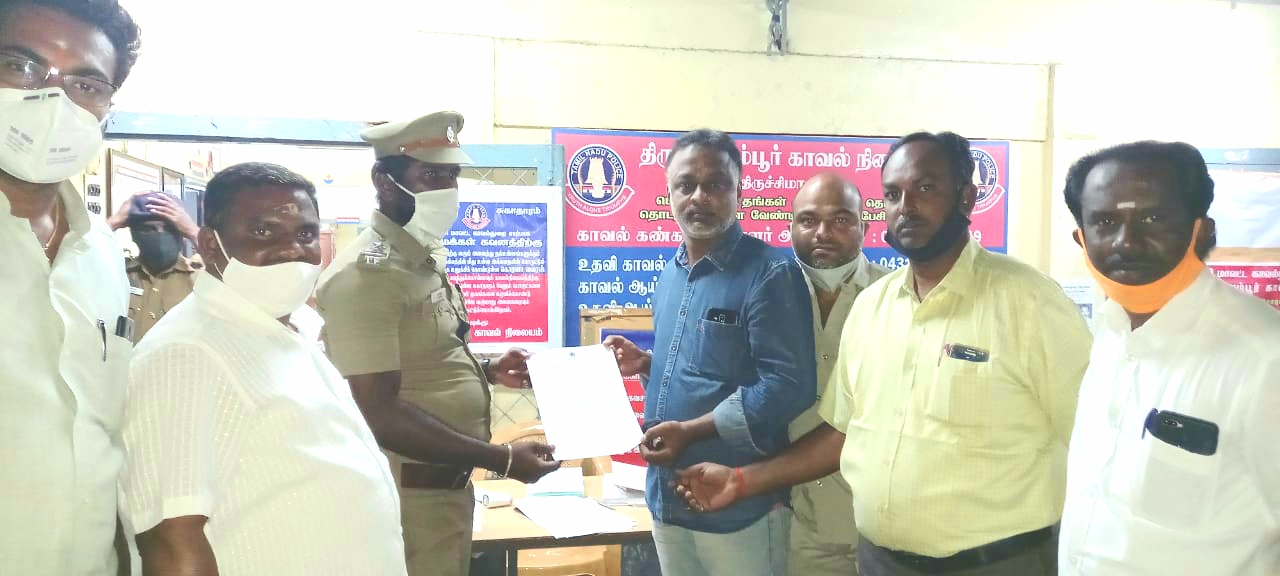
Minister Udhayakumar helps affected hygiene workers, temple priests, weavers near Madurai

Minister for Revenue and Disaster Management R.B. Udhayakumar who is currently engaged in relief works in and around his constituency, Tirumangalam in Madurai district distributed relief materials to those affected by the lockdown imposed due to COVID19.

The Minister distributed relief kits to nearly 1400 people living in Peraiyur and other surrounding villages of the T. Kallupatti block.

The beneficiaries included hygiene workers, temple priests, weavers, electricity board workers, barbers, and other small businessmen.

Autorickshaws start plying in TN from today

Tamil Nadu government on Friday decided to let autorickshaws ply in the state from Saturday except in the region that falls within the Greater Chennai Police limits and containment zones.

Not more than one passenger would be allowed and they can operate only from 7 AM to 7 PM, the statement issued by the Chief Minister said.

Drivers should have sanitizers kept in their vehicles for use by passengers and both the passenger and the driver are to wear masks compulsorily. The statement said that the vechicle should be sanitised atleast 3 times a day and drivers should wash their hands with soap regularly.

Vikatan Award Wapsi : Tamil film director Lenin Bharthi returns award

With the economy coming to a standstill due to COVID, its impact can be felt across industries with the media industry being no exception. Many people who work in the media are losing their jobs. In light of this, news have surfaced in social media that the Tamil media house Vikatan has fired hundreds of its employees. This has made filmmakers like Lenin Bharati to register their protest and has said that he would return the award given to him by Vikatan.

Lenin Bharathi won the Vikatan Best Director Award for the movie, Merkku Thodarchi Malai. In a tweet Mr. Lenin said, “In condemnation against the Vikatan group for firing 176 employees, I am sending back the Vikatan Award which was received for Best Film Merkku Thodarchi Malai & Best Male Debut Director.”

Following this, many started tweeting about Vikatan with the hashtag #stopvikatanlayoff trending on Twitter.

SASTRA University delivers 20 robots to serve COVID patients

Tanjore based SASTRA University has developed new robots for the treatment of patients in corona ward. These robots are set to be helpful in providing medicines, food and clothing to the patients. Each robot is worth around ₹1.5 lakhs, weighs around 3.2 kilograms and is designed to run up to one and a half kilometers.

Two robots were first delivered to the Madurai Government Hospital. The inaugural event was held at the Madurai Hospital on May 14. TN Minister RB Udayakumar who was the special guest at the event inaugurated these 2 robots as reported by Tamil daily Maalaimalar. Subsequently, a total of 20 robots have now been delivered to Government hospitals in Chennai, Tanjore, Trichy, Theni and Tirunelveli.

Each robot is capable of carrying food items up to 15 kg. The cameras in robots can talk to patients and send information to the medical department. Similarly, doctors and nurses can convey the message to the patient by verbally telling the robot what they want to say to the patients.

The butterfly effect of ₹200

Many will be aware of what Butterfly Effect is. It’s a chain of events that gets triggered by one incident in the past and the impact of that one original incident wouldn’t have been fathomed initially. This is about one such butterfly effect moment in India.

In 1978, a man called Mohammad Ahmed Khan, a very affluent and well to do lawyer in Indore stopped giving the alimony money of ₹200 per month to his divorced wife Shah Bano. His wife was 63 years old and had five children. He had infact lived with two wives for many years and then divorced Shah Bano who was his first wife. Shah Bano then approached the local court. Mr. Khan argued that since he had divorced his wife, under the Muslim Personal Law, he was not under obligation to pay for maintenance or alimony. But the local court directed him to pay ₹25 per month to Shah Bano. The cases then went to High Court. High court directed him to pay ₹179 per month to Shah Bano as alimony. The case then went to Supreme Court. The Supreme Court in a landmark judgement asked him to pay ₹200 per month to his old divorced wife for herself and her children’s maintenance.

This caused a huge uproar and protests from the Muslim community who saw the Supreme Court as interfering in their personal laws while actually, it was not. Maintenance is not personal law whereas divorce is. However the All India Muslim Personal Law Board and other groups started applying pressure on the then Central Government. Prime Minister Rajiv Gandhi who had a whopping 413 seats in Lok Sabha was under pressure from his “advisors” and inner circle to bring a law to overturn the Supreme Court judgement. He was advised that if this was not done, then the party would lose in the next Lok Sabha elections as Muslims won’t vote for the Congress. The Rajiv Gandhi government brought an amendment to law through an act of Parliament that over turned the Supreme Court’s judgement of paying a monthly maintenance amount to divorced Muslim women. The Congress still lost the Lok Sabha elections in 1989 is a different matter.

This over turning of Shah Bano Supreme Court judgement by the ‘secular’ Congress government created another furore and uproar in the country, but this time, it was from the Hindus, civil society, women groups and others. The ‘secular’ Congress government was seen as caving to fundamentalists and playing open and active minority appeasement politics. Hence, once again Rajiv Gandhi’s advisors advised him, now to placate the Hindus, to open the doors of the locked Babri Masjid and allow daily shilanyas to be performed. The ‘secular’ Congress government did the same. Till then the Ayodhya movement hadn’t gathered much steam as BJP did not involve itself directly into the movement. It may sound quite unbelievable now. But then BJP had no high stake Hindu cause in its manifesto till then. Uniform Civil Code was more of a constitutional and legal reform and the abrogation of Article 370 was more of a nationalist position.

Seeing the blatant interference of the ‘secular’ Rajiv Gandhi government into religious affairs of the citizens in Shah Bano case and then in Babri Masjid, BJP picked up the cause of Ram Mandir as part of its political agenda and manifesto in the 1989 elections. BJP was pushed into doing this because, the Hindus were repeatedly being taken for a ride on the Ayodhya issue due to the interference of a certain section of politicians, self-proclaimed intellectuals and historians with ulterior motives who were twisting and turning at every point to conceal the truth. Rajiv Gandhi commenced his 1989 election campaign from Ayodhya promising Ram Rajya. He did this to placate the anger of Hindus triggered by overturning of Shah Bano judgement. This is the misunderstanding that our politicians, media and even most citizens have on being neutral or secular. Being neutral means being objective. It does not mean doing something for one group to compensate for what was done to another group. Being secular means the government not interfering in the religious affairs of anyone. It does not mean appeasement. Playing appeasement is neither secularism nor neutrality.

Thus, it is this non-payment of a meagre amount of ₹200 a month by a man to his divorced wife that paved the way for a chain of events to happen – Congress’s over turning the judgement, Congress opening the locks of Babri Masjid for Hindus to pray there, BJP taking Ram Mandir as an election issue, BJP growing strong and big in North India and winning a lot of seats in 1989 and 1991 elections, VP Singh government going back on its word to solve the dispute, Advani commencing Rath Yatra, Advani being arrested by Lalu Prasad in Bihar, VP Singh government falling, Chandrashekhar government trying to solve the issue, Congress toppling his government, Mulayam Singh Yadav government firing and killing Kar Sevaks in UP, BJP under Kalyan Singh winning a majority in UP, Babri Masjid being demolished, Bombay riots, Bombay blasts by Dawood group, a Hindutva government forming for the first time in Maharashtra, Vajpayee becoming Prime Minister courtesy Ram Temple movement, Godhra train burning of Hindus, Gujarat riots, Modi becoming the leader and becoming Prime Minister twice, a strong Ram Mandir propenent Yogi Adityanath becoming CM of Uttar Pradesh, Shri Parasaran representing Ram Lalla in court and finally Lord Ram returning back to his throne from exile.

In a way, it looks as if Lord Ram chose to return from exile through a Muslim woman, thus standing as a testimony to the ethos of this great land.