Home Blog Page 156

Dravidian Model Tamil Nadu: 85000 Teachers Fail In Tamil

More than 85,000 postgraduate teacher in Tamil Nadu have failed the mandatory Tamil language eligibility test conducted by the Teachers Recruitment Board (TRB), raising serious alarm over the quality of prospective teachers in a state that prides itself on linguistic identity.

The exam—introduced in 2022 as a compulsory qualifying test for all state competitive exams—required only 20 out of 50 marks and is widely considered equivalent to a Class 10–level Tamil paper. Despite this low bar, an overwhelming number of candidates, including many native Tamil speakers, failed to clear it.

The recruitment drive aimed to fill 1,996 PG teacher posts, with more than 2.2 lakh applicants appearing for the examination. Those who failed the Tamil eligibility paper were disqualified outright, as their primary subject answer sheets were not evaluated.

Educationists have expressed shock, calling the mass failure a reflection of deeper systemic problems in teacher training, linguistic proficiency, and academic standards in the state.

This mass failure is seen as a worrying indicator for Tamil proficiency and has prompted broader questions about the future quality of teaching and learning in government schools across the state, as many candidates had studied Tamil as their mother tongue throughout schooling but still failed to meet the minimum standard required for the teaching profession.

Source: Dinamalar

Subscribe to our channels on WhatsAppTelegram, Instagram and YouTube to get the best stories of the day delivered to you personally.
Madras High Court Madurai Bench Allows Karthigai Deepam To Be Lit At The Original Spot At Thirupparankundram Hill

Madras High Court Madurai Bench Allows Karthigai Deepam To Be Lit At The Original Spot At Thirupparankundram Hill

In a significant ruling, the Madurai Bench of the Madras High Court has permitted the lighting of the Karthigai Deepam at the original summit-lamp pillar atop Thirupparankundram hill on December 3, reviving a tradition that was halted during World War II under British-imposed safety restrictions.

The order was delivered while hearing a batch of petitions filed by Hindu Makkal Katchi members Rama Ravikumar and Solaikannan, who sought revival of the traditional ritual at its historic hilltop location.

For decades, the Deepam has been lit on a lower pillar near the Thirupparankundram temple, even though the historic “Deepa Thoon” at the hill’s summit was the traditional site.

The restriction dates back to 1912, when a legal case led to a prohibition on Hindus lighting the ceremonial lamp at the peak. Since then, the Deepam has been lit at an alternate spot known as the Moksha Deepam, a deviation that has long angered devotees who view it as a violation of their religious rights and an erosion of an ancient custom.

The petitions challenged the Subramaniya Swamy Temple administration’s decision to light the Deepam at the Deepa Mandapam, arguing it violates Agama Shastra principles and lacks historical precedent for that location. Petitioners claimed the summit pillar offers better visibility for devotees and aligns with ancient customs, citing 1862 and 1912 magistrate orders that restricted lighting elsewhere due to non-customary practices and potential law-and-order issues. They emphasized no communal risks, as the site is protected and monitored.

The court’s decision came in response to a petition seeking restoration of the original practice, arguing that no legal prohibition exists and that lighting the Deepam atop the hill carries greater spiritual significance and wider visibility.

The petitioners also highlighted that the summit pillar stands over 15 metres away from the nearby dargah, addressing concerns about religious sensitivities.

Temple authorities, supported by the Hindu Religious & Charitable Endowments Department and the Tamil Nadu Waqf Board, argued in favour of continuing the ritual at the lower pillar, citing logistical challenges and established practice.

After conducting a site inspection and hearing submissions from all sides, the High Court ruled that the centuries-old tradition should be restored. The bench held that there was no legal impediment to lighting the Deepam at the summit pillar and directed that the ritual be carried out there on December 3.

The order marks the reinstatement of a revered custom at one of Tamil Nadu’s oldest and most important Murugan shrines, ending a decades old dispute in the hilltop lighting of the Karthigai Deepam.

In October 2025, the Madras High Court – Madurai Bench issued a landmark order banning the sacrifice of goats and chickens, and prohibiting the cooking or serving of non-vegetarian food on Thiruparankundram Hill. The court also declared that the hill should no longer be referred to as “Sikandar Hill.”

Source: Dinamalar

Subscribe to our channels on WhatsAppTelegram, Instagram and YouTube to get the best stories of the day delivered to you personally.
India’s Diplomacy Of Restraint: The Global Outlier In A Zero-Sum World

In an era marked by geopolitical instability, nations increasingly resort to aggressive tactics, ranging from economic sanctions to outright military conflict, to assert dominance. This environment has eroded trust in concepts such as global peace and mutual cooperation, replacing traditional international relations with a zero-sum power dynamic.

Negotiations are often reduced to ultimatums, with weaker states subjected to exploitation and engineered dependencies as instruments of coercion. Powerful actors pursue disproportionate responses without restraint, driven by bloc formations centered on trade, commerce, and technological leverage.

National progress is frequently motivated by fear of vulnerability rather than shared aspirations for peace, prosperity, and human solidarity. Even advancements in science and technology, once dedicated to human betterment, have been repurposed as tools of suppression. Historically, diplomatic alliances resemble survival pacts in a predatory ecosystem, prioritizing short-term instincts over enduring partnerships grounded in common values.

Amid this landscape, India emerges as an outlier: a nation pursuing self-development without infringing on others’ sovereignty. Its growth model emphasizes domestic abundance and global prosperity, unencumbered by sectarian, religious, or economic biases. India’s actions reflect a deep civilizational ethos, exemplified by Operation Sindoor.

Despite enduring Pakistan-sponsored terrorism since independence, with the Pahalgam attack as a recent manifestation, India’s retaliation targeted only terrorism’s infrastructure and perpetrators, avoiding civilian casualties or escalation. This measured approach echoes the Mahabharata episode where Sage Vyasa intervened to prevent Arjuna from unleashing the Brahmastra against Ashwatthama, averting needless destruction.

In contrast, responses by other powers such as Israel’s against Hamas or Russia’s in Ukraine have drawn criticism for excess. While ancient civilizations like these retain historical legacies, their handling of adversarial interests often lacks restraint, bordering on the unrestrained. India, however, garners international acclaim for its firm yet proportionate stance against Pakistan, without leveraging geostrategic or economic influence to solicit approval.

India’s diplomatic engagements are fundamentally rooted in cultural foundations, evolving gradually unlike those of other nations, which prioritize security, finance, and trade. Prime Minister Narendra Modi’s personal outreach to global leaders fostering broad, informal connections stems from his formative experience as a swayamsevak in the Rashtriya Swayamsevak Sangh, the world’s largest sociocultural organization.

This contrasts with counterparts whose interactions are formal and tethered to immediate national interests. Such proactive engagement proved instrumental in countering provocations during India’s responses to the Uri and Pulwama attacks, by preemptively shaping global narratives on Pakistan-backed terrorism.

India consistently supports allies without endorsing violence. It has refrained from backing Russia’s invasion of Ukraine, advocating instead for regional peace, yet maintained ties with Moscow despite Western pressures – a testament to prioritizing enduring trust over transient alliances. During Sri Lanka’s economic crisis, precipitated by overreliance on China, India extended timely aid without retribution or demands for concessions, honoring ancient civilizational bonds. This mirrors Lord Rama’s post-victory conduct in the Ramayana: after defeating Ravana, he restored the kingdom to Vibhishana without annexation or expectations.

Prime Minister Modi’s diplomatic strategy is principled rather than opportunistic, aligning with the conventional imperatives of global politics. India views its historical resilience amid invasions as a mandate to advance humanity’s collective mission. While international relations often remain shortsighted and exploitative, India extends aid even to adversaries like Türkiye, despite its criticisms and support for India’s detractors.

The “Brand Bharat” embodies trust, mutual respect, and broader human goals. No other nation matches India’s reputation for reliability. Balancing power with self-respect underpins Indian diplomacy, promoting peace, development, and welfare. Its paramount aspiration envisions a global architecture grounded in universal Dharma; wherein sovereign interests converge in symbiotic harmony rather than antagonistic collision – a paradigm aptly designated as “Hindu Diplomacy.”


Subscribe to our channels on WhatsAppTelegram, Instagram and YouTube to get the best stories of the day delivered to you personally.
“DMK Opened 2 Chairs For Karunanidhi, None For Bharathi”: Tamil Nadu Governor RN Ravi Says

In a recent interview, Tamil Nadu Governor RN Ravi launched a scathing critique of the state’s ruling DMK government, questioning its commitment to the Tamil language and culture.

Governor Ravi pointed to the condition of state-run Tamil institutions as primary evidence of governmental neglect. The flagship example is the Thanjavur Tamil University, established in 1981 by former Chief Minister Dr. M.G. Ramachandran to promote Tamil language and heritage.

“Over 40 years down the line, this university is in the most pathetic condition,” Ravi stated. He revealed that the university struggles to even muster 1,000 students, a benchmark required by the UGC for central scheme benefits. “They are just adding up the PhD scholars somehow to reach the 1,000 mark.”, he noted.

The problems run deeper than enrollment numbers. The Governor highlighted a 50% vacancy in faculty posts, a complete lack of state-funded research grants for students, and a tragic situation where priceless Tamil heritage, over 11 lakh palm leaf manuscripts, is “rotting, getting destroyed” with no funds allotted for their preservation.

Political Patronage Over Cultural Icons

The critique then shifted from institutional neglect to a question of political priorities. Ravi contrasted the treatment of Dravidian political icons with that of Mahakavi Subramania Bharathi, a towering figure of Tamil literature and pride.

“There is not one chair in the name of Subramania Bharathi in our 20 state universities,” he asserted. Revealing a four-year personal struggle to establish such a chair, Ravi alleged that Vice-Chancellors are threatened by ministers and are “genuinely scared” of potential harassment and false police complaints.

This stands in stark contrast, he claims, to the establishment of “more than 15 chairs in our universities in the name of just three Dravidian icons.” Specifically, he noted that the current Chief Minister has established “two chairs in his father’s name [Kalaignar Karunanidhi] and two more chairs are coming up.”

For the governor, this disparity is telling. “This tells you their love for Tamil.”

The Central Government’s Initiatives: A Contrasting Narrative

To further underline the state government’s alleged failures, Ravi presented initiatives by the Central Government under Prime Minister Narendra Modi as a proactive force for Tamil culture.

He credited the Modi government with revitalizing the Central Institute of Classical Tamil (CICT) with a state-of-the-art building and taking the language to non-Tamil audiences. This includes:

  • A running diploma course in Tamil at Banaras Hindu University (BHU), which also hosts a Subramania Bharathi Chair.
  • A Tamil diploma course initiated at Guwahati University.
  • Promoting Tamil literature globally by setting up a Thiruvalluvar centre in Singapore, a Thiruvalluvar chair in a Malaysian university and at Boston University in the USA.
  • Funding Tamil language teachers in countries like Fiji.

“At this point of time,” Ravi concluded, “if I say that no leader has done as much service for Tamil language and culture than Prime Minister Modi.”

Subscribe to our channels on WhatsApp, Telegram, Instagram and YouTube to get the best stories of the day delivered to you personally.
Fact-Check: BJP Govt Did Not Reduce Tamil Nadu’s Tax Share, Here’s The Proof

The DMK and its alliance parties have been relentlessly campaigning in Tamil Nadu that the BJP-led central government is siphoning off tax money from Tamils and giving it to North Indian states, particularly claiming that Bihar is being funded by Tamil Nadu’s taxes.

They use this narrative to:

  • Hide their political defeat,
  • Divert attention from the law and order problems under DMK rule,
  • Distract from the failures and ineptitude of their own administration.

The only weapon they wield is the claim that the BJP is betraying Tamil Nadu.

For example, when asked why the state has borrowed about ₹4.5 lakh crore in the last four years, the DMK says the Centre isn’t releasing Tamil Nadu’s rightful share and blames the BJP. Tamil Nadu Finance Minister Thangam Thennarasu stated that the Centre had reduced Tamil Nadu’s share in central taxes, dropping it from 7.931% to 4.079%.

As always, DMK mixes in a little truth with its lies. Yes, at one time Tamil Nadu’s tax devolution share was 7.9%. Yes, it is now 4%. However, what the finance minister did NOT explain is when and how this reduction occurred as distorting or hiding the truth is also a lie.

The Illusion Created By The DMK

The DMK attempts to create an illusion that it was only after the BJP came to power that Tamil Nadu’s share was reduced. But when was Tamil Nadu’s share really 7%? During the 9th Finance Commission, between 1990 and 1995.

Since then, the proportion has steadily decreased:

  • 12th Finance Commission (2005–2010): 5.3%
  • 13th Finance Commission (2010–2015): 4.97%
  • 14th Finance Commission (2015–2020): 4.02%
  • 15th Finance Commission (2020–2025): 4.08%

That is, even before the BJP came to power, the rate had dropped from 7% to around 5%. It sits at about 4% during BJP rule.

So, Who Is Responsible For The Reduction?

It is the Congress and DMK themselves, especially the DMK, which was in power at the Centre for nearly 25 years, including 15 consecutive years from 1999 to 2014. Yet, not once in that period did they raise their voice or protest about the reduction in Tamil Nadu’s share.

In fact, during the Congress regime, the overall percentage of tax devolution to states was lower. The Modi government raised it from 30.5% to 41%. In a recent finance commission meeting, Chief Minister Stalin himself cited the increase and requested that it go higher to 50%. DMK, once silent when the share was 30%, now attacks the BJP after a historic increase to 41%.

The claim that Tamil Nadu’s taxes are being diverted to Bihar or Uttar Pradesh is false—even under Congress rule, these states received their constitutionally mandated shares. Not just Tamil Nadu, but states like Bihar, Uttar Pradesh, Madhya Pradesh, Gujarat, Maharashtra, Karnataka (many BJP-ruled) have all seen their shares decrease over successive commissions—yet DMK only mentions Bihar and UP for their anti-Hindi propaganda.

During the DMK and Congress coalition, Bihar’s share was 11.03% and Uttar Pradesh’s was around 19%—and no one complained then. The overall rate for all states was lower under Congress.

Let’s Look At Some Facts

The Modi government raised state devolution from 30.5% to 41%.

This year, Tamil Nadu’s budget notes a record ₹80,000 crore is being transferred from the Centre, more than even what was projected.

These figures are found in the Tamil Nadu budget documents themselves.

The DMK’s narrative that the BJP government is cheating Tamil Nadu is a baseless political story:

The reduction from 7% began long before the BJP came to power.

The BJP government has raised, not reduced, the overall allocation to states.

The share for all southern and some northern states, including BJP-ruled states, has decreased.

The often-quoted “1 rupee given, only 29 paise returned” is a misleading statistic. When Finance Minister Nirmala Sitharaman challenged the DMK to explain how that number was calculated, they had no answer. Karnataka, also ruled by the BJP, claims it only gets 15 paise – that’s the narrative politicians resort to.

If the DMK argues that Tamil Nadu is being cheated, they should release data on what Congress provided when DMK was an ally. Show, with evidence, the percentage under Congress and BJP. Show, with proof, that the BJP is giving Bihar or UP more than Congress did.

Stop deceiving the public with manipulated statistics and false narratives. Don’t peddle lies for divisive politics.

Conclusion

The history and data reveal that the reduction in Tamil Nadu’s tax share began decades ago and continued under Congress-DMK regimes. The Modi government increased overall state allocations, and Tamil Nadu itself is receiving record sums. The DMK’s relentless campaign blaming BJP and the North is a calculated political strategy that does not match the facts.

Ideaman Mahadevan is a writer and political commentator.

Subscribe to our channels on WhatsAppTelegram, Instagram and YouTube to get the best stories of the day delivered to you personally.
DMK Honors A Soros-Backed ‘Breaking India’ Agent: The Foreign-Funded Network Behind Thenmozhi Soundararajan And Her Equality Labs

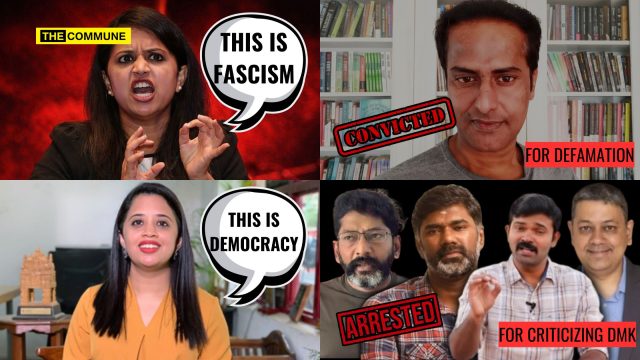
In October 2025, the DMK government in Tamil Nadu announced its decision to confer the prestigious Vaikom Award for Social Justice on Thenmozhi Soundararajan, a US-based ‘activist’ whose organization has documented ties to Khalistani extremists and anti-India networks. The same Soundararajan who runs Equality Labs.

Though publicly positioned as a Dalit-rights and civil-rights collective, the organisation has been repeatedly flagged by researchers for its alliances with groups such as the Indian American Muslim Council (IAMC), Hindus for Human Rights (HfHR), and OFMI, all of which later formed the Alliance for Justice and Accountability (AJA), a coalition whose structure mirrors recommendations once issued by Pakistan’s Senate for creating NGO fronts to lobby against India.

Equality Labs’ credibility has been further questioned due to its reported association with individuals like Huma Dar, a Pakistani national with links to the Pakistani Army, and its founder’s past collaboration with Gurpatwant Singh Pannun of Sikhs for Justice, a pro-Khalistani outfit designated for extremist activity in India.

The organisation has also generated controversy through its influential DEI training programmes and its role in the Cisco caste-discrimination case – both of which drew sharp criticism from Hindu organisations and U.S. researchers for promoting divisive rhetoric and amplifying allegations that were later dismissed for lack of evidence.

Equality Labs: A Ghost Organization with Major Backing

Equality Labs — founded by Thenmozhi Soundararajan and Bangladeshi national Sharmin Hossain, — has been active since 2014 but was formally registered only in 2022, first in Delaware (File No. 6687031) in March and later in California (File No. 202251715748) in July. Although the organisation presents itself as a “civil rights” group and raises funds for nonprofit initiatives, it is structured as a for-profit entity that sells caste-equity training services to corporations, academic institutions, and government bodies. The group also advocates for ‘caste-related policy changes’ while simultaneously offering paid training on the same issues.

This arrangement allows Equality Labs to receive tax-deductible donations and large grants without the regulatory and administrative burden of maintaining its own non-profit status. Fractured Atlas, in turn, assesses an 8% administrative fee on all donations directed to Equality Labs.

Equality Labs has been the recipient of significant funding from a consortium of major American philanthropic foundations, whose grants are funneled through Fractured Atlas.

In her own website, Thenmozhi says that she founded an entity called “Third World Majority” (a media related entity) soon after graduation from UC Berkeley.

She goes on to add that in 2003, she was featured in Utne Reader as “Top Visionaries Under 30”.

Until 2015, Thenmozhi was known only as a media artiste, documentary film maker etc. Only in 2015, was ‘Equality Labs’ founded (if at all founded). Note that in 2014, she was touring India along with AIDMAM and made a documentary about it (which was later shown in all US cities, where the duo spoke).

Following the Money: A Consortium of Foundation Funders

Documented grants from foundation tax filings (Form 990s) reveal a steady flow of funds to Equality Labs:

Luminate Group: Equality Labs received $50,000 from the Luminate Group in 2017, routed through Fractured Atlas Inc., a New York–based nonprofit that provides fiscal sponsorship and fundraising infrastructure for arts and activist projects. The grant, meant to support work on “ending caste apartheid” and combating Islamophobia and religious intolerance, was channelled via Fractured Atlas because Equality Labs is not a registered 501(c)(3) entity and relies on fiscal intermediaries for funding.

Open Society Foundation: Equality Labs became a significant recipient of Open Society Foundations (OSF) funding beginning in 2018. After securing seed support from the Luminate Group in 2017, the organisation received a USD 25,000 OSF grant in 2018 routed through its fiscal sponsor, Fractured Atlas. The funding was designated for Equality Labs’ survey on caste-based discrimination in the United States – the same report the organisation published on 19 March 2018.

Source: Disinfo Lab

The Ford Foundation: Granted $39,500 in 2019 and $125,000 in 2020.

The Novo Foundation: Provided $175,000 in 2019, with the grant managed through the Tides Foundation.

They also received $127,500 in 2021.

The San Francisco Foundation: Awarded $124,000 in 2018 for “self-defense for activists in the digital age.”

The previous year, they also received $140,500 from the same organization via Fractured Atlas.

The Nathan Cummings Foundation: Granted $50,000 in 2019.

2019

Then till the year 2023, it has consistently received grants via Fractured Atlas, as below:

2020
2021
2022
2023

The General Service Foundation: Provided a substantial $110,000 in 2019.

2019

It also received funds in the years 2021 and 2023.

2021
2023

The Tides Foundation: Served as an early seed funder, granting $60,000 in 2017 specifically to help Equality Labs “establish a Dalit women-led office in the NYC tri-state area.”

Tides Foundation

New York Women’s Foundation: $20,000 in 2018, explicitly naming Equality Labs.

2018

Weissberg Foundation: $16,000 in 2018.

2018

Hidden Leaf Foundation: $5,000 in 2019.

2019

Additionally, co-founder Sharmin Hossain received $39,500 in 2016 from George Soros’s Open Society Foundations for a separate project (Historical Memory Project), while Thenmozhi Soundarrajan received smaller amounts from OSI and a fellowship from the Robert Rauschenberg Foundation.

Dalit Diva is the social media handle name of Thenmozhi Soundararajan

Soundararajan has also received some other independent grants and fellowships as below:

GrayCenter For Arts & Enquiry University of Chicago

Robert Rauschenberg Foundation

Since 2018/19, Equality Labs is being funded via Fractured Atlas (FA), a 501c(3).

Wikipedia on Fractured Atlas says “Fractured Atlas’s fiscal sponsorship programs allows non-commercial art-related projects to be supported through grants and tax-deductible donations without the project having to maintain independent 501(c)(3) status.

The Indian Nexus: Ties to NCDHR and AIDMAM

Let us now take a look at Thenmozhi Soundararajan’s activist roots back to long-standing collaborations with Indian NGOs, primarily the National Campaign for Dalit Human Rights (NCDHR), which operates in India under the FCRA name ‘Swadhikar’. This takes us to a The Guardian article, which was probably her first “report” on Dalits in 2015.

A key wing of NCDHR, the All India Dalit Mahila Adhikar Manch (AIDMAM), is identified as an early and consistent collaborator. As early as 2014, AIDMAM’s social media accounts tagged Thenmozhi’s handle, “dalitdiva.” The two were partners in a “Dalit Self Respect Yatra” across India, which was documented by Thenmozhi and later showcased in a tour across the United States in 2015, sponsored by organizations like the Association for India’s Development (AID-USA).

The Tides connection is particularly significant due to its extensive history of funding FCRA-registered NGOs in India. Tides’ Foreign Contribution (FCRA) disbursements can be traced to Indian organizations over more than a decade.

2006 – None
2007 – None
2008 – India HIV/AIDS Alliance, Indian School of Business
2009 – Mobile Creches, Parivaar, Operation Smile India
2010 – Naz Foundation, Parivaar, Bharti Foundation, Public Health Foundation of India
2011 – India HIV/AIDS Alliance, Samarpan Foundation
2012 – Vikas Society for Peoples Development, Samarpan Foundation
2013 – Street Survivors India, India HIV/AIDS Alliance, Samarpan Foundation
2014 – Apne Aap Women Worldwide (FCRA license cancelled in 2022, on violation; Unkil Project), Goonj
2015 – Apne Aap Women Worldwide (FCRA license cancelled in 2022, on violation; Unkil Project), PHFI, Swadhikar/NCDHR (Paul Namala)
2016 – Sama -Resource Group for Women & Health, Centre for Health and Social Justice, Control Arms Foundation of India Trust
2017 – Navdanya Trust (LOL), Popular Education & Action Centre (PEACE), (Anil K Chaudhary), Naz Foundation, Goonj, Sama-Women & Health, Swadhikar/NCDHR
2018 – PEACE, Naz Foundation, Sustainable Environment & Ecological Development (SEED), Goonj, Centre for Health & Social Justice, Samarpan Foundation, Central Square Foundation (Ashish Dhawan)
2019-Naz Foundation, Goonj, Swadhikar/NCDHR, CSF
2020 – Swadhikar/NCDHR received 1.1 Crore from Tides Foundation, towards ‘Dalit Women Empowerment’

While initially focused on health and women’s groups, a notable shift occurred in 2015, when Tides began funding Swadhikar – National Campaign for Dalit Human Rights (NCDHR).

This funding to NCDHR, led by founder Paul Divakar Namala, continued in 2017, 2019, and 2020, with a sum of 1.1 Crore INR (approximately $140,000) granted in 2020 alone for ‘Dalit Women Empowerment.’ This establishes a clear financial link between a primary funder of Equality Labs in the US and a major Dalit rights organization in India.

Paul Divakar Namala was a Board Member of Amnesty-USA in 2016.

In 2018, a new 501c(3) was started called ‘The Inclusivity Project’. Paul Divakar Namala is its executive Director.

The partnership was highlighted on international stages, including a 2014 appearance by Thenmozhi and AIDMAM’s then-General Secretary, Asha Kowtal, at the “Women in the World Summit” in New York, moderated by NBC’s Cynthia McFadden.

Long before Equality Labs was founded, Thenmozhi was deeply embedded in the Dalit rights movement through her collaboration with the All India Dalit Mahila Adhikar Manch (AIDMAM), a project of the NCDHR. As early as February 2014, AIDMAM’s X handle (@dalitwomenfight) was publicly engaging with Thenmozhi’s handle (@dalitdiva).

The Asha Kowtal Nexus and the “Self-Respect Yatra”

A key figure bridging the US and Indian spheres is Asha Kowtal, the former General Secretary of NCDHR. In 2014 and 2015, Kowtal and Thenmozhi were inseparable collaborators:

In 2014, they spoke together at an event in New York City organized by the South Asia Solidarity Initiative (SASI), founded by Prachi Patankar. Patankar is the daughter of the late Gail Omvedt and is now the Director of Social Justice at the JM Kaplan Fund, which had a revenue of $67 million in 2019.

In September 2014, they were featured at the high-profile Women in the World Summit in New York, moderated by NBC’s Cynthia McFadden. Thenmozhi’s documentary on a “Dalit Self-Respect Yatra” in India was screened, and both activists spoke.

At the 2014 Women in the World Summit, patroned by Hillary Clinton, actress Uma Thurman introduced a segment featuring Asha Kowtal and a documentary by Thenmozhi Soundararajan. The session, moderated by NBC investigative correspondent Cynthia McFadden, included brief remarks from Asha, while the majority of the discussion was led by Thenmozhi. The full conversation is available across four video segments.

In 2015, Kowtal led a “Dalit Self-Respect Yatra” across the United States, starting at the University of Pennsylvania. She was accompanied by Thenmozhi, and the tour’s sponsors included the Association for India’s Development (AID-USA).

This pre-2015 collaboration demonstrates that the core network and activist agenda of Equality Labs were active years before the organization began receiving substantial grants through Fractured Atlas.

Additional Actors: Sanghapali Aruna and Jai Bhim International

The investigation also uncovered details on Sanghapali Aruna (full name Sanghapali Aruna Komana), another activist associated with the “Smash Brahminical Patriarchy” slogan. Aruna is a Director of Jai Bhim International (EIN: 26-3130349).

The organization is a registered 501(c)(3) that receives funding from entities like Fidelity Investments and the Harold Gullivan Jr. Family Foundation.

Harold Gullivan Jr. Family Foundation 2018

This indicates a broader, multi-organizational ecosystem operating in the same sphere.

A Coordinated, Well-Funded Ecosystem

The evidence compiled in this report paints a clear picture.

Equality is a project fiscally sponsored by Fractured Atlas, which skims an 8% fee from all donations.

It is funded by millions of dollars from major US foundations, with the Tides Foundation acting as its seed funder.

There is a direct financial link between this funding stream and Indian FCRA NGOs, specifically the NCDHR, via the Tides Foundation.

The founders and key figures of Equality Labs have had long-standing, deep organizational ties to NCDHR and its leaders like Asha Kowtal and Paul Divakar Namala, dating back to at least 2014.

This network, from funders like Ford and Novo, through fiscal conduits like Tides and Fractured Atlas, to the Equality Labs and its formally recognized partner NCDHR in India, represents a sophisticated and well-financed transnational activist pipeline. The legal and financial structures indicate problems with accountability, transparency, and the flow of foreign funds into specific social and political movements in India.

Equality Labs — A Missionary-Backed Dalitstan Experiment in Balkanizing India?

Dalitstan was a US-based initiative launched in 1999 by American citizens, primarily devout Christians, who envisioned the division of India into multiple separate territories, including a Dalit homeland. Key figures behind the project included Kermit Northcutt, Debra Schwartz, George Schwartz, Helen Eklund, and Andy Moore. The organisation functioned as a platform to promote separatist narratives while seeking Indian collaborators to lend legitimacy to its agenda.

Helen Eklund, who registered and led the Dalitstan website, and Kermit Northcutt, a member of the missionary-linked Antioch Christian Academy in Mississippi, exemplify how international religious networks were involved in backing the project. The initiative highlights a pattern of foreign actors attempting to influence Indian social and political issues by exploiting existing societal divisions.

To expand its reach, Dalitstan recruited prominent Indian Dalit voices. One notable collaborator was VT Rajshekar, founder of the now-defunct magazine Dalit Voice in Bangalore. Rajshekar, a journalist with a long career at Indian Express, was known for his anti-establishment writings and faced multiple arrests under TADA and the Sedition Act. Dalitstan used his work to bolster its separatist messaging.

The content promoted by Dalitstan targeted multiple fault lines within India, including Khalistan, Kashmir, and Dravidstan, framing the country as fragmented and oppressed. The project serves as an early example of how foreign-backed initiatives have sought to manipulate caste and regional tensions to advance separatist and anti-India objectives.

DisinfoLab’s “Cost of Caste” report argues that an older online project called “Dalitstan,” which pushed separatist and Balkanizing narratives about India, was later “rebooted” as Dalit Nation and then “metamorphosed” into Equality Labs, now funded by Western philanthropies. This report frames Equality Labs’ caste survey, US lobbying, and networks as part of a broader geopolitical “Breaking India” strategy.

What DisinfoLab Found

A detailed investigation by DisinfoLab titled “The Cost of Caste: Equality Labs, Caste Binary & BLM” highlights that Equality Labs operates as part of a foreign-funded, politically motivated advocacy network, rather than a grassroots civil-rights organisation. Key findings include:

Imported Caste-Apartheid Narrative

Equality Labs’ framework transplants the U.S. Black–White racial binary onto India, constructing a rigid “Dalits vs. Upper Castes” narrative designed for international audiences.

This oversimplifies Indian caste realities and amplifies conflict for political and funding purposes.

Flawed 2018 Caste Survey

Relied on self-selecting online respondents and unverified submissions.

Contained pre-scripted questions designed to produce predetermined results.

Formed the evidence base for DEI programs, corporate caste policies, and legal cases like Cisco.

Foreign-Funded Advocacy Pipeline

Operates through Fractured Atlas to avoid nonprofit compliance.

Funded by OSF, Ford, Luminate, Tides, Novo, San Francisco, Nathan Cummings, and others.

Receives millions annually, creating a politically leveraged lobbying apparatus.

Links to Anti-India Lobby Groups

Collaborates with IAMC, OFMI, HfHR, and the Alliance for Justice and Accountability (AJA), mirroring structures recommended by Pakistan for anti-India advocacy.

Transnational Ecosystem

Combines ideological narratives, flawed surveys, foreign funding, allied Indian NGOs, and media amplification to project India as a caste-apartheid state globally.

Political, Not Social-Justice, Objectives

Operates as a political lobbying outfit rather than a community-led reform group.

Targets U.S. policy, corporate behaviour, academic discourse, and global media narratives.

DisinfoLab concludes that Equality Labs functions as a central node in a coordinated transnational pipeline, shaping perceptions of caste in India while evading transparency and regulatory scrutiny.

Last Word

The DMK government’s decision to honour Thenmozhi Soundararajan signals more than a misguided award—it legitimises an organisation whose funding, alliances, and activism are deeply enmeshed in foreign-backed networks. Equality Labs, far from being a grassroots Dalit-rights group, operates as a well-funded lobbying outfit built on flawed surveys, ideological imports, and collaborations with groups repeatedly flagged for anti-India activity.

What emerges is not social justice but narrative engineering. By celebrating Equality Labs, the state is not uplifting marginalised voices—it is endorsing an agenda shaped abroad and aimed at recasting India through a divisive, destabilising lens.


Subscribe to our channels on WhatsAppTelegram, Instagram and YouTube to get the best stories of the day delivered to you personally.
LRPF Flags Alleged Illegal Sale Of Akhada Land In Guntur; Seeks Immediate Government Intervention

NGO watchdog Legal Rights Protection Forum (LRPF) has petitioned senior officials in Andhra Pradesh and Uttar Pradesh, alleging an attempted illegal registration of a sale deed involving land belonging to Sri 108 Pujyapad Advait Punch Parameshwar Panchaiti Akhara Bara Udasin Nirwan (Panchaiti Bara Udasin) in Survey No. 352, Budampadu village, Guntur district.

In a detailed representation addressed to the Commissioner & Inspector General of the AP Registration and Stamps Department, the AP Special Chief Secretary (Land and DM, Registration and Stamps), and the UP Chief Secretary, the LRPF has sought immediate intervention to prevent what they termed an “illegal alienation” of institutional property.

According to the representation, the Akhada, registered under the Uttar Pradesh Societies Registration Act, 1860, cannot sell or transfer its immovable property without prior permission from a competent civil court. Sections 5 and 5A of the Act prohibit any such transfer without judicial approval and state that transactions in violation of these provisions are void.

They said no court permission has been obtained for the proposed sale of over three acres of the Akhada’s land in Budampadu. It noted that a resolution dated 26 July 2025, allegedly passed at the Akhada’s Prayagraj premises to authorise the sale, is itself disputed for its validity and compliance with statutory requirements.

The representation states that, based on this resolution, a sale deed dated 10 November 2025 was purportedly executed by Shri Mukami Mahant Hanuman Das Ji in favour of a buyer from Guntur. The claimed sale consideration amounts to ₹1.06 crore, including multiple cash components and several cheques. LRPF argued that the heavy reliance on cash required strict scrutiny.

The LRPF said the Sub-Registrar in Guntur kept the sale deed pending when it was first presented. It alleged that “certain persons” were now attempting to register the same document at another Sub-Registrar office to bypass territorial jurisdiction, terming the move an abuse of the registration process.

The petition further claimed that previous transactions involving Akhada properties in Guntur were executed without mandatory court approvals, resulting in disputes, financial losses and litigation.

The LRPF has urged the authorities to prohibit registration of the sale deed at any Sub-Registrar office in Andhra Pradesh, issue directions preventing any jurisdictional shift, initiate an inquiry into the attempted transaction, and take steps to safeguard the Akhada’s properties from further illegal alienation.

The Forum said that without immediate intervention, the institution risked “irreversible loss” and the creation of third-party rights based on an allegedly void and unenforceable transaction.

Subscribe to our channels on WhatsAppTelegram, Instagram and YouTube to get the best stories of the day delivered to you personally.
“DMK Govt Prevented Linguistic Minorities To Learn Their Mother Tongue In Schools, They Hate All Languages Other Than Tamil” Says TN Governor RN Ravi

Tamil Nadu Governor RN Ravi has alleged that the DMK government denied linguistic minority communities the right to teach their children their mother tongues in schools, arguing that this suppression continued until the Supreme Court intervened in 2023. In a recent interview with a private news channel, the Governor linked this issue to what he described as a broader ideological framework of “Tamil exceptionalism” driving the state’s politics.

Responding to questions about the political hostility directed at him, Ravi said that the anti-Hindi or anti-north narrative alone does not explain Tamil Nadu’s political character. Instead, he argued, “It is essentially Tamil exceptionalism that Tamil people and Tamil Nadu are distinct from the rest of the country… they call Dravid is a separate race… and Tamil language is a language which has nothing to do with any Indian languages.”

He said both these ideas were rooted in “European origin”, specifically “German Nazis” and “Robert Caldwell” and were used in modern times to justify hostility toward other linguistic groups.

“They hate all other languages other than Tamil”

Ravi said that linguistic minorities—who constitute over 35% of Tamil Nadu’s population—have faced systemic barriers to mother-tongue education.

“In our state, there are over 35% people living of linguistic minority but they are not allowed to teach their mother tongue to their children in schools run by them,” he said. He pointed to events from 2022, claiming the state government “didn’t allow them to do” so even in schools run by minority communities.

According to the Governor, these communities were forced to approach the Supreme Court. “In September 2023 Supreme Court gave a verdict and in that case a state government fought it very strongly to hold their position but Supreme Court said no, linguistic minorities have their constitutional fundamental rights to teach their children their mother tongue.”

Ravi added that the issue extended beyond Hindi: “The reality is they hate all other languages other than Tamil. Linguistic minorities here they are afraid beyond their house to talk in their mother tongue.”

Supreme Court Verdict: Minimum Marks for Mother Tongue Subjects

The case cited by the Governor relates to a 2023 Supreme Court ruling on a petition filed by the Linguistic Minorities Forum of Tamil Nadu.

The Court held that minority schools must prescribe minimum qualifying marks in mother tongue subjects including Urdu, Kannada, Telugu and Malayalam, treating them on par with Tamil and English. This was to ensure genuine proficiency and prevent optional language subjects from being reduced to formality.

The ruling drew upon earlier circulars from 1965, 2010, and 2011 that Tamil Nadu had not fully implemented. The bench emphasised that linguistic minorities’ rights under Articles 29 and 30 include the right to meaningful mother tongue instruction.

The judgment built upon ongoing matters from 2022 (SLP(C) 16727/2022) and earlier orders that extended exemptions from compulsory Tamil papers for minority schools.

Government Resistance and Compliance

The Tamil Nadu government argued that compulsory minimum marks were unnecessary within the state’s two-language policy (Tamil and English). However, the Supreme Court disagreed and directed the state to implement the measures “in letter and spirit.”

Following the ruling, the state revised the Class 10 marks pattern in 2024 to bring minority mother-tongue subjects on par with core languages.

Governor Ravi cited the verdict as proof that the DMK government had withheld minority language rights. He framed it as part of a larger ideological hostility: “So when you talk about Hindi… they hate all other languages other than Tamil.”

Subscribe to our channels on WhatsApp, Telegram, Instagram and YouTube to get the best stories of the day delivered to you personally.
How Foreign Missionaries Misuse Visas For Proselytization: 14 Cases Of Covert Conversion Operations Across India

Proselytisation haryana madhya pradesh children attempting to convert christianity sultanpur forced conversion missionary

On 25 November 2025 in Hyderabad, Telangana, Immigration officials stopped Nigerian evangelist Chris Oyakhilome and his foreign associates from entering a Christian event at LB Stadium after the LRPF alleged that the programme was a covert evangelism and conversion drive presented as a “Christian Leaders Conference” to evade visa rules prohibiting preaching. Authorities barred their participation, while the LRPF asked FRRO Hyderabad and the Union Home Ministry to take action under the Foreigners Act, 1946.

In this report, we look at 14 documented cases from 2017 to 2025 in which foreign nationals were found engaging in religious conversion activities in India in violation of visa rules or local anti-conversion laws. The incidents span multiple states across the country and involve evangelists, missionaries, foreign NGOs and groups accused of proselytising under the guise of conferences, healing sessions or community gatherings. In each case, police or immigration authorities initiated action under relevant provisions of the Foreigners Act, anti-conversion laws or visa regulations.

#1 Nigerian Evangelist Stopped for Visa Misuse in Hyderabad – 25 November 2025 – Hyderabad, Telangana

The Immigration Department in Hyderabad prevented Nigerian evangelist Chris Oyakhilome and his associates – Ose Oyakhilome, Chiwetal Mokeme and others – from entering an event at LB Stadium after a complaint by LRPF alleged that the programme, labelled a “Christian Leaders Conference,” was intended for covert evangelism. Authorities said visa conditions prohibit foreign nationals from preaching or conducting conversion activities. Immigration officials blocked their participation, while LRPF requested the FRRO Hyderabad and Union Home Ministry to initiate punitive action under the Foreigners Act, 1946.

#2 Three Arrested in Maharashtra for Conversion Attempt Through Books and Healing Claims – 4 October 2025 – Chimbipada, Maharashtra

American citizen James Watson, along with Sainath Ganpati Sarpe and Manoj Kolha, allegedly organised a gathering outside Kolha’s home to influence villagers toward Christianity. The group reportedly distributed Christian books to adults and children, conducted prayers, and told locals their illnesses would be cured if they converted. The police complaint said the accused intentionally targeted residents using false promises to induce religious conversion. All three were arrested, with cases registered under BNS Sections 299 and 302, the Foreigners Act and the Maharashtra Anti-Superstition and Black Magic Act. Police stated that further investigation is underway.

#3 Foreign Missionary Caught Running Conversion Operation in Indore Mall – 5 June 2025 – Indore, Madhya Pradesh

In Vijaynagar, Indore, foreign missionary Stephen Vijupal and eight foreign nationals were found conducting Christian conversion activities inside Malhar Mega Mall. He allegedly attempted to convert locals Shyam Verma and Rajesh Patel by criticising Hindu beliefs, offering financial inducements of ₹10,000–₹20,000, and promising help with education and medical expenses. He also gave them “holy water” and threatened them with false cases and death for refusing. Police later recovered Bibles and conversion literature from their hotel. A case was registered against Vijupal, while the other foreign nationals were questioned and released.

#4 American Missionary Detained for Conversion Attempt on Bhil Community in Kota – 22 April 2025 – Kota, Rajasthan

American citizen Colin Mitchell and associate Joy Mathew were detained for attempting to convert around 50 members of the Bhil tribal community at Charan Chowki in Motipura. They allegedly held a prayer gathering, made derogatory remarks about Hindu deities, distributed cross lockets and served non-vegetarian food as part of their effort to influence the group. Bajrang Dal members intervened after receiving a complaint, triggering a public confrontation. Police detained the duo, registered a case against Mitchell under the Foreigners Act and initiated further action based on findings from the Joint Interrogation Cell.

#5 Canadian Missionary Deported from Assam for Proselytising on Expired Visa – 7 February 2025 – Jorhat, Assam

A Canadian citizen residing in Jorhat since 2021 was deported after authorities found he was involved in Christian proselytising despite his visa having expired. During verification for renewal, police discovered that he had been influencing locals toward conversion, which they said constituted misuse of visa privileges. The FRRO issued a “Leave India Notice,” and Jorhat Police handed him over to FRRO Kolkata. He was deported to Canada through New Delhi. Officials stated that his activities violated Indian visa rules, which forbid foreign nationals from engaging in religious propagation without a missionary visa.

#6 Taiwanese Citizen Among Several Detained Over Conversion Allegations in Mathura – 21 September 2024 – Mathura, Uttar Pradesh

A Taiwanese national, along with a house owner, his wife and around a dozen people, was detained after complaints alleged they were conducting religious conversion meetings. Police found around four dozen men and women gathered in two houses with food and religious pamphlets. Officers said no objectionable material was recovered and that evidence of conversion would determine further action. Highway Police questioned all detained individuals. Authorities emphasised that foreign nationals cannot participate in religious propagation on tourist visas, and the inquiry would proceed based on findings.

#7 Two US Citizens Fined for Engaging in Religious Activities in Assam – 1 February 2025 – Sonitpur, Assam

US nationals Jon Matthew Boone and Michael James Flinchum were fined for participating in a religious meeting at the Baptist Christian Mission Hospital while on tourist visas, which prohibit involvement in proselytising activities. Police received information about their participation and, after inquiry, confirmed that they had taken part in the event. Both were fined $500 (approximately ₹41,500) each for violating visa conditions and were permitted to leave. Authorities reiterated that missionary or religious activity requires specific visa categories under Indian law.

#8 Canadian Missionary Accused of Attempting Conversion of Minors in Odisha – 24 June 2023 – Jagatsinghpur, Odisha

Canadian citizen Eapen Mohan Kidangalil and two missionaries from Tirtol allegedly attempted to convert around 11 Hindu minors during a “Prarthana Sabha” in Katesingpur. The group transported about 40 tribal people, including minors, in a non-registered vehicle, where police said religious influence was exerted.

Authorities seized a Bible, tourist visa, cash and medicines suspected to be intended for drugging children. NCPCR directed the District Administration to ensure the minors’ safety. An FIR was lodged under Section 4 of the Odisha Freedom of Religion Act, 1967. The accused were released after notice under CrPC Section 41.

#9 US Evangelist Nick Vujicic Accused of Proselytisation in Hyderabad – 30 January 2023 – Hyderabad, Telangana

The Legal Rights Protection Forum filed a complaint alleging that US evangelist Nick Vujicic used motivational sessions at Malla Reddy University as a cover for Christian evangelism. LRPF claimed his activities violated visa regulations, which prohibit foreign nationals from preaching or conducting religious propaganda while on non-missionary visas. Vujicic, founder of Life Without Limbs Ministries, is known for promoting born-again Christianity globally. LRPF submitted the complaint to FRRO Hyderabad seeking action for visa violations. Authorities initiated verification of the allegations.

#10 Seven German Nationals Detained for Attending Church Events in Assam – 28 October 2022 – Golaghat, Assam

Seven German nationals, Christian Reiser, Michael Erich Schaper, Merten Asmus, Cornelia Von Oneimb, Hinrich Luppen-Von Oneimb, Christa Olearius and Lisa Aimee Bloem were detained near Kaziranga for engaging in church-sponsored religious events while on tourist visas. Police said they delivered speeches and attended functions across multiple districts, violating visa rules requiring missionary visas for religious work. They were detained at a Kaziranga resort and fined $500 each. Police cited violations under Section 14 of the Foreigners Act and warned against misuse of tourist visas for conversion activity.

#11 Three Swedish Missionaries Arrested for Illegal Preaching in Assam – 27 October 2025 – Dibrugarh, Assam

Swedish nationals Hannah Mikaela Bloom, Marcus Arne Henrik Bloom and Susanna Elisabeth Hakanason were arrested in Naharkatia for conducting religious preaching at a “Peace and Healing Prayer Festival” under the banner of United Churches Fellowship and Bless Assam Mission Network. Police said the event attempted to convert locals and violated visa rules. A suo motu case under Section 14 of the Foreigners Act was registered. The trio was convicted by a local court, and the administration was instructed to deport them to Sweden.

#12 US National Accused of Visa Violations Through Missionary Work in Andhra Pradesh – 15 July 2022 – Guntur, Andhra Pradesh

US citizen Scott Alan Norling, co-founder of Bethel Bible College, was accused of conducting religious preaching and soliciting foreign funding while on a visa not permitting missionary activity. He participated in events such as the inauguration of the “Well of Life” in Hyderabad and attended multiple Christian ceremonies linked to Gospel Mission of India. LRPF alleged that Norling may be staying on a business or employment visa while violating Indian visa rules. A petition was submitted to the Ministry of Home Affairs seeking action under Section 14(b) of the Foreigners Act.

#13 South Korean National Arrested for Pressuring Families for Conversion in Greater Noida – 19 December 2020 – Greater Noida, Uttar Pradesh

South Korean national Mu Cu Lee and three Indian accomplices were arrested for pressuring two families for Christian conversion over six months. Police said the accused provided financial incentives, urged families to attend church and asked them to remove religious idols. Lee had previously converted three individuals. On the day of the incident, the group gathered at a home and chanted religious verses, leading to confrontation with locals. Police registered a case under IPC Section 295-A and the Uttar Pradesh Prohibition of Unlawful Conversion of Religion Ordinance, 2020. All suspects were sent to judicial custody.

#14 Foreign Nationals Detained for Secret Conversion Effort in Saharanpur – 6 September 2017 – Saharanpur, Uttar Pradesh

Seven foreign nationals from South Korea and Malaysia were detained in Saharanpur after intelligence agencies uncovered a covert Christian conversion campaign. The group, visiting on tourist visas, allegedly held late-night gatherings and attempted to persuade non-Christian families to convert. The operation came to light after a complaint by Father John Wesley of a local church. Police detained the seven individuals from a house near Shanidev Mandir in Naveen Nagar. Officers stated that their activities violated visa norms prohibiting religious propagation on tourist visas.

Subscribe to our channels on WhatsApp, Telegram, Instagram and YouTube to get the best stories of the day delivered to you personally.
DMK Speaker Appavu Calls Tamil Nadu Governor RN Ravi A Terrorist, BJP Leader Annamalai Hits Back

Tamil Nadu Assembly Speaker M. Appavu on Friday, 28 November 2025, launched a sharp attack on Governor R.N. Ravi, calling him a “terrorist” and alleging that he was attempting to bring terrorism into the state. His remarks came in response to the Governor’s recent observations suggesting a decline in Tamil Nadu’s law-and-order situation.

Appavu said, “In a way, what he says is true. The only terrorist is him and there is no one terrorist here. That is his mindset, he is referring to himself when he talks about a terrorist, there is no one else here,” claiming that the Governor’s comments reflected “his own thoughts” rather than the reality on the ground. He asserted that Tamil Nadu had no terrorism issue and alleged that the Governor was attempting to “instigate” unrest. “In this state, there is no terrorism and there are no law and order issues. He is simply hoping that terrorism will emerge here, that’s all. He was in places where terrorism prevailed, and he wants to instigate that here, but it will not happen,” he said.

Taking aim at the Governor’s background, Appavu remarked, “Tamil Nadu people are educated and not like in his place,” and stated that the state continued to remain safe under the Chief Minister’s leadership. “Everyone here is safe and the Chief Minister is doing safe governance,” he added.

 Governor Ravi has in recent weeks intensified his criticism of the DMK government, claiming Tamil Nadu’s politics is driven by “Tamil exceptionalism” and accusing political leaders of promoting hatred against other languages.

(Source: India Today)

Subscribe to our channels on WhatsAppTelegram, Instagram and YouTube to get the best stories of the day delivered to you personally.