A personal memory of Kolkata’s shutdown culture reveals a deeper civilisational crisis and a narrowing window for revival.
Bengal holds a special place in my heart. It was in Kolkata that I began my professional journey, full of hope and expectation. Yet one of my earliest memories from March-April 2003 remains etched in my mind not for its personal inconvenience, but for what it revealed about the deeper malaise gripping Bengal’s political culture.
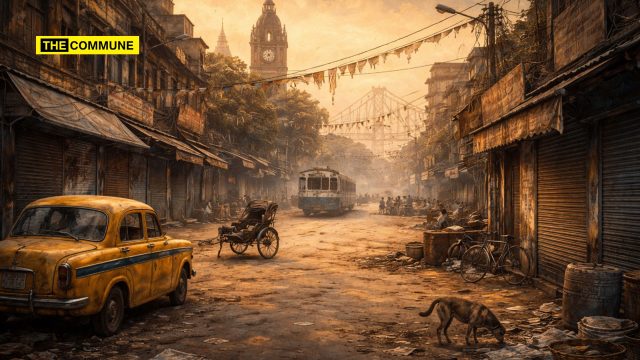
The Left Front government had approved a modest 10 per cent hike in bus fares, translating to a mere 25-paise increase. In a surreal display of political theatre, the same Left parties called a strike against their own government. The city came to a grinding halt. Shops were shuttered, transport vanished, and fear of violence kept people indoors. I walked to my office one of the few who did but found no breakfast, no lunch, and only managed a cup of tea late in the evening.
What stayed with me was not hunger. It was the absurdity. A megacity paralysed over 25 paise. And more importantly, the silent suffering of daily wage earners who lost a day’s income not because of market forces or natural calamities, but because politics demanded paralysis.
This memory encapsulates Bengal’s tragedy. A land that once stood at the forefront of India’s intellectual, cultural, and economic awakening gradually succumbed to a political culture that normalised disruption, stagnation, and ideological rigidity.
There was a time when Bengal was synonymous with excellence. The region led what historians call the Bengal Renaissance a period that reshaped India’s intellectual and cultural trajectory. Figures like Swami Vivekananda inspired global spiritual awakening. Rabindranath Tagore redefined literature and became Asia’s first Nobel laureate. Subhas Chandra Bose embodied militant patriotism. Scientists such as Jagadish Chandra Bose, Satyendra Nath Bose, and Prafulla Chandra Ray laid the foundations of modern science. Bankim Chandra Chattopadhyay gave India “Vande Mataram,” a song that stirred a civilisation.
Few regions in world history have produced such a concentration of brilliance in such a short span. Bengal was not just India’s intellectual capital it was among the world’s most vibrant centres of thought.
And yet, the trajectory since then has been one of decline.
The seeds of this decline were sown during colonial rule. The Partition of Bengal fractured society along communal lines, while political violence became normalised as a tool of mobilisation. These were not temporary distortions they became embedded in Bengal’s political DNA.
Independence should have healed these wounds. Instead, post-independence politics deepened them. The Indian National Congress, which governed Bengal in the early decades, failed to dismantle these toxic legacies. Instead, it absorbed elements shaped by pre-partition communal politics, blurring moral lines and institutionalising opportunism.
The real structural decline, however, unfolded under the long rule of the Communist Party of India (Marxist)-led Left Front. From 1977 to 2011, Bengal witnessed one of the longest uninterrupted democratic regimes in the world. What could have been an era of consolidation became one of erosion.
The rise of the Naxalite movement originating in Naxalbari symbolised this shift. Instead of channelling youth into innovation and enterprise, generations were drawn into ideological extremism and violence.
Economically, the consequences were devastating. In the 1950s and early 1960s, West Bengal was among India’s most industrialised regions, and Kolkata stood tall as one of Asia’s premier commercial hubs. But by the 1990s and early 2000s, industrial stagnation had become entrenched.
The numbers tell the story starkly. West Bengal made for 10.5% of the country’s GDP in 1961. By 1977, at the advent of Left rule, this had reduced to 8.8%. By 2011, at the end of Left rule, it had further declined to 6.7%. In 2026, after 15 years of rule by the All India Trinamool Congress, it stands at a mere 5.6%.
Nearly all economic statistics show the same calamity. In terms of per capita income, Bengal was ranked 10th among Indian states in 1977. By 2011, it had slipped to 18th, and by 2026, it stands at 27th.
Industrial output as a share of national output has collapsed from 27% in 1951 to 11% in 1977, to about 5% in 2011, and to a mere 3–3.5 per cent in 2026.
The fiscal picture is equally grim. The debt-to-GDP ratio has risen from roughly 20% in 1977 (around Rs 6,000 crore) to nearly 39% in 2026 (approximately Rs 7.9 lakh crore).
These are not just numbers. They represent lost decades, lost opportunities, and a steady erosion of Bengal’s economic foundations.
Parallel to economic decline was the persistence and amplification of identity politics. The legacy of Direct Action Day and Partition-era mobilisation was never fully dismantled. Instead, successive regimes cultivated vote banks, prioritising electoral arithmetic over governance.
This created a predictable outcome: when economic opportunities shrink and governance weakens, informal power structures rise. Local strongmen, political intermediaries, and patronage networks begin to dominate. Merit is replaced by proximity to power.
When the All India Trinamool Congress, led by Mamata Banerjee, came to power in 2011, there was hope for change. Instead, much of the underlying ecosystem persisted. The instruments of control street power, patronage, and identity mobilisation remained intact.
The result is a state caught in a vicious cycle: economic stagnation fuels political patronage, and patronage entrenches stagnation.
Contrast this with developments in states like Gujarat under Narendra Modi, Uttar Pradesh under Yogi Adityanath, and Assam under Himanta Biswa Sarma where governance reforms, law and order, and infrastructure development have driven economic revival.
Bengal today stands at a similar inflection point.
The stakes are not merely electoral they are civilisational. Will Bengal reclaim its historic role as a hub of ideas and enterprise, or will it continue down a path of decline?
For the Bengali bhadralok, this moment demands introspection. The cost of decades of ideological complacency is now visible in declining incomes, migration of talent, and diminished national relevance.
The geopolitical environment adds urgency. Developments in Bangladesh including rising instability have direct implications for Bengal’s future.
History does not offer endless chances. Bengal once led India’s awakening. Today, it must decide whether it wishes to rediscover that role.
The memory of a shutdown over 25 paise is more than an anecdote it is a warning. A warning of how low expectations can fall when political culture loses its way.
Bengal stands at a crossroads. One path leads to renewal. The other to irreversible decline.
The choice is now.
Dr. Prosenjit Nath is a techie, political analyst, and author.
Subscribe to our channels on WhatsApp, Telegram, Instagram and YouTube to get the best stories of the day delivered to you personally.