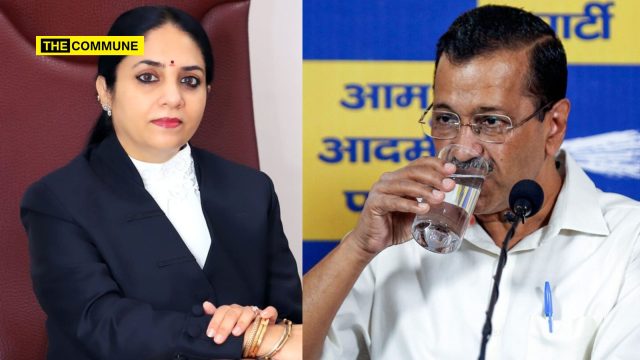
Arvind Kejriwal’s dramatic boycott of Justice Swarana Kanta Sharma’s court, framed as “Satyagraha”, is less about judicial ethics and more about evading accountability in the Delhi Excise Policy case. After personally arguing (and losing) his recusal plea on 20 April 2026, Kejriwal’s April 27 letter and video conveniently ignore the affidavit’s glaring weaknesses while amplifying unproven inferences through leftist and AAP-aligned voices masquerading as journalists like Saurav Das. This isn’t constitutional courage; it’s a calculated sympathy play ahead of political battles.
In all humility and with complete respect for judiciary, I have written the following letter to Justice Swarna Kanta Sharma, informing her that pursuing Gandhian principles of Satyagraha, it won’t be possible for me to pursue this case in her court, either in person or through a… pic.twitter.com/HmyOyNYug8
— Arvind Kejriwal (@ArvindKejriwal) April 27, 2026
जस्टिस स्वर्णकान्ता शर्मा जी से न्याय मिलने की मेरी उम्मीद टूट चुकी है।
अपनी अंतरात्मा की आवाज़ सुनते हुए, गांधी जी के सिद्धांतो को मानते हुए और सत्याग्रह की भावना के साथ, मैंने फ़ैसला किया है कि मैं इस केस में उनके सामने पेश नहीं हूंगा और कोई दलील भी नहीं रखूँगा। pic.twitter.com/vhTSEZabqa
— Arvind Kejriwal (@ArvindKejriwal) April 27, 2026
Affidavit’s Core Flaws Exposed
Kejriwal’s argument hinges on Justice Sharma’s children’s empanelment as Central Government panel counsel and Solicitor General Tushar Mehta’s role in case allocation. But it leaps from structure to conflict without evidence: no proof that Ishaan or Shambhavi Sharma handled any CBI/Delhi Excise matters before their mother, let alone cases linked to Kejriwal. RTI figures (2,487 cases for Ishaan in 2023) span all government departments across courts – zero tie to this prosecution. Group C empanelment for Shambhavi is routine admin work, not a “financial nexus.”
Courts demand direct apprehension of bias, not vague “proximity.” In Ranjit Thakur v. Union of India (1987), the Supreme Court held the test is “reasonableness of apprehension in the mind of the party” based on objective facts, not subjective fear. In Supreme Court Advocates-on-Record Association v. Union of India (2015), the Court ruled pecuniary interest requires automatic disqualification, but only when a judge has direct financial stake in the case outcome, like shareholding in a litigant company. Kejriwal admits no actual bias, only “perception”, yet boycotts anyway, reducing a serious doctrine to forum-shopping.
Justice Sharma’s April 20 Judgment Destroys Kejriwal’s Case
In her detailed 20 April 2026 judgment refusing recusal, Justice Sharma systematically dismantled every claim. She held, “Recusal would not be prudence but abdication of duty”, citing constitutional obligation to decide without fear or favor.
“The test of apprehension of bias cannot rest entirely upon the subjective perception of a litigant who merely fears that the Judge may not grant him relief in view of adverse orders suffered by him in the past”
“Appearance of justice must not be seen through the eyes of the applicant, but on the standard of a reasonable and informed person”
“The litigants have put me and the [judicial] institution on trial”
She rejected Kejriwal’s claims about her 9 March 2026 prima facie observations (standard in revision petitions), her alleged RSS event participation (unproven), and procedural complaints about IO stay orders (which didn’t affect accused rights). The judgment exposed Kejriwal’s real motive: avoiding unfavorable rulings by attacking the judge, not presenting facts.
Procedural Claims Overstated
Kejriwal gripes about leaving court at 3:45 PM while CBI argued till 7:00 PM, denying his rejoinder. Fair point, but the order records his exit and closure, a standard procedural call in high-stakes hearings. No evidence of malice; former CMs don’t get veto power over schedules. Justice Sharma noted this “grave denial” narrative pads a weak hand when Kejriwal personally argued for 90 minutes before leaving with leave.
Saurav Das: Leftist/AAP Propagandist, Not Independent Reporter
Crediting “legal reporter” Saurav Das whitewashes his documented AAP ecosystem bias; extensive pro-Kejriwal coverage, opinion-laced “reports,” and selective activism. Das is a propagandist masquerading as journalist who frames opinions as facts and builds prosecutorial-style narratives against judges using selective facts and biased interpretation.
Key revelations:
Das routinely avoided public criticism of Delhi CM Arvind Kejriwal or Punjab government over pollution/stubble burning while attacking UP CM Yogi Adityanath
His “shocking allegations” against Justice Sharma rest on inference, not proof: comparing her rulings in opposition vs BJP cases “ignores basic legal reality: no two cases are identical”
His central claim of “reasonable apprehension of bias” is itself an opinion, not established conclusion that “a different observer could look at the same material and see nothing unusual at all”
Kejriwal shared Das’s post to win brownie points and prove loyalty, raising questions about coordinated narrative-building
Kejriwal’s team relied on Das’s 9 April post (with annexed RTI) without disclosed verification. Government can rightly probe: Was the RTI Das’s solo effort, or fed by interested parties? Sourcing via a partisan X thread undermines court exhibits; neutral filers face no such scrutiny.
Legal Doctrine Confirms Kejriwal Lost
The Supreme Court’s recusal framework is clear:
- Financial interest = automatic disqualification (SC Advocates-on-Record, 2015)
- Other interests require “real danger” or “reasonable apprehension” inquiry – tested objectively, not by litigant’s subjective fear
- Recusal cannot be forced; rests on judge’s conscience (Subrata Roy Sahara v. Union of India, 2014)
- Bias from prior adverse orders alone insufficient – else every losing litigant could demand new judges
Kejriwal presented zero evidence of pecuniary nexus to this case, only structural proximity. Courts reject that leap. Justice Sharma correctly applied Ranjit Thakur and SC Advocates-on-Record tests and Kejriwal now manufactures a constitutional crisis because he lost on law.
The Ecosystem’s Orchestrated Push: Amplifying Kejriwal’s Flawed Narrative
The moment Kejriwal announced his judicial boycott on 27 April 2026, a well-oiled ecosystem swung into action to legitimize what Justice Sharma herself called an attempt to “put the judge and institution on trial”. Leftist and AAP-aligned “journalist” Saurav Das, whose RTI data formed the affidavit’s backbone, immediately hailed it as “something to watch,” praising Kejriwal for “not budging” against a judge where “conflict-of-interest is as clear as daylight” despite providing zero evidence of actual case linkage.
Woah! Is this the first time a litigant has publicly boycotted a judge and their courtroom? In his letter to Justice Swarana Kanta Sharma, Kejriwal states that not only will he not be participating in the present CBI Discharge case, but also not appear in any case related to BJP,… https://t.co/sm52DtAGJk
— Saurav Das (@SauravDassss) April 27, 2026
Senior lawyer Prashant Bhushan, a longtime AAP ally, declared the boycott “correct & justified” and the apprehension of bias “reasonable,” offering no legal analysis of why the April 20 judgment was wrong but lending institutional heft to political theatre.
The decision of Kejriwal not to participate in the CBI appeal challenging his discharge,before Justice Swarna Kanta Sharma is a correct & justified decision. Undoubtedly,in the facts of this case, he has a reasonable apprehension of bias. I would say his apprehension is justified https://t.co/4mecfWjXLm
— Prashant Bhushan (@pbhushan1) April 27, 2026
Congress-supporting handles erupted with “Checkmate by Kejriwal” posts, falsely claiming he was “clean bowled” the judiciary when in fact he lost the recusal plea on law, not drama. Blue-tick accounts fabricated figures—”10 crores from 5,900 dockets!”—conflating empanelment with corruption, while others recycled debunked claims about Justice Sharma attending “RSS events” (never proven) and “magical” case allocation (standard roster procedure).
Very bold move by former Delhi CM Arvind Kejriwal to take this step.
Glad to see that the details from my tweet about judges who had sought transfers in the past have been mentioned in the letter. https://t.co/vg28hZ5o4Z
— Ratna Singh (@whattalawyer) April 27, 2026
Justice Swarna Kanta Sharma’s son got 5900 central govt case dockets in last 2 years
If on average he appears for 2 days for each of them- he makes more than 10 crores!!! https://t.co/mGhROXVdUr
— Tarishi Sharma (@tarishi_sharma) April 27, 2026
BJP minister Vijay Shah can choose judge by transferring out Justice Atul Sreedharan. BJP minister Kapil Mishra can choose judge by transferring out S Muralidhar. Arvind Kejriwal can’t seek valid recusal? No theatrics from S Muralidhar or Justice Sreedharan unlike Justice Sharma
— Ashish Goel (@ashish_nujs) April 27, 2026
Opinion pieces from SC advocates suddenly flooded platforms calling for recusal guidelines – sensible in isolation, but timed to suggest Kejriwal exposed a systemic flaw rather than lost a legal argument.
Das himself was lauded for “shining light” on judicial ethics, with Kejriwal’s letter citing past judges who recused themselves, conveniently ignoring those involved actual conflicts like family litigation, not structural proximity.
Well done on shining light on the cases of judges with high judicial ethics now referred in Kejriwal’s letter! 👏🏻👏🏻 https://t.co/ljOnmQ8H0e
— Saurav Das (@SauravDassss) April 27, 2026
The ecosystem’s playbook was transparent: convert a rejected recusal plea into a constitutional crisis, frame a former CM’s courtroom walkout as Gandhian resistance, and drown Justice Sharma’s detailed, precedent-backed judgment under a flood of emotive posts, manufactured statistics, and coordinated outrage, ensuring the public never scrutinizes the affidavit’s central void: no proof Ishaan or Shambhavi Sharma touched a single CBI case, let alone this one. When facts fail, activate the narrative machine.
Following Kejriwal, Sisodia has also decided to ‘boycott‘ the case proceedings.
Bench Hunting, Contempt Risk, and the Social Media Weapon
Kejriwal’s boycott is, at its core, a textbook case of bench hunting – the practice of pressuring a court into reconstituting a bench by making adjudication before the existing judge politically untenable. The Supreme Court explicitly warned against this in Indore Development Authority v. Manoharlal (2020), holding that recusal cannot be converted into “a device for bench hunting or forum shopping merely because a judge had expressed a prior view on law.”
Kejriwal lost the recusal plea on 20 April 2026. Rather than pursuing the only legitimate remedy available, an appeal to the Supreme Court, he chose a public theatrical boycott. Manish Sisodia has since joined the bandwagon, signalling that this is not a matter of individual conscience, but a coordinated political strategy dressed in Gandhian language. Both acts, on their face, risk crossing into Contempt of Court – specifically, scandalising the court and lowering the authority of the judiciary in the eyes of the public. When a litigant publicly declares a sitting judge unfit via social media videos and open letters after losing a formal legal challenge, it does not become protected speech merely because the word “Satyagraha” is attached to it.
The appropriate and constitutionally prescribed course was clear: file a Special Leave Petition before the Supreme Court challenging Justice Sharma’s April 20 order. That remedy exists, is accessible, and is specifically designed for situations where a litigant believes a High Court judge has erred. Kejriwal himself acknowledges this option remains open. Yet he refuses to use it while simultaneously refusing to participate in proceedings – having it both ways, keeping the legal door ajar while maximising political optics at the judiciary’s expense.
Most dangerously, this episode has normalised social media as a tool to browbeat the judiciary. Kejriwal’s video, Das’s amplification, Bhushan’s endorsement, fabricated financial calculations, and coordinated hashtag campaigns all served a single purpose: to make Justice Sharma’s continued adjudication politically costly enough that either she steps aside or her eventual rulings are pre-delegitimised in the court of public opinion. This pressure tactic strikes at the foundation of judicial independence – which requires that judges decide based on law and record, not on the volume of outrage manufactured outside the courtroom. When a legal remedy is available and ignored in favour of a social media offensive, it is no longer a free speech issue; it is an institutional threat.
As Advocate Naveen Murthi puts it, “When a legal remedy is available, this pressure tactic of using social media and narrative building as a tool has to be nipped in the bud.”
Real Motive: Sympathy, Set Narrative Against ‘Unfavourable Judges’, & Not Justice
Kejriwal’s Gandhian cosplay – conscience, Satyagraha, follows discharge reversal, not ethics epiphany. Supreme Court guidelines urged in opinion pieces are sensible but post-hoc; Kejriwal exploits the gap for PR, not reform. Public trust erodes when politicians publicly “boycott” judges over losing arguments, not facts. As Justice Sharma warned: “Can’t let politician judge judicial competence”.
If bias exists, appeal to the Supreme Court, Kejriwal admits keeping that option open. But appealing doesn’t grab headlines like “Satyagraha against biased judge.” This leap from affidavit to courtroom walkout exposes the rot: accountability-dodging dressed as judicial cleansing. Kejriwal bets politics, not law; the judiciary holds.
Subscribe to our channels on WhatsApp, Telegram, Instagram and YouTube to get the best stories of the day delivered to you personally.