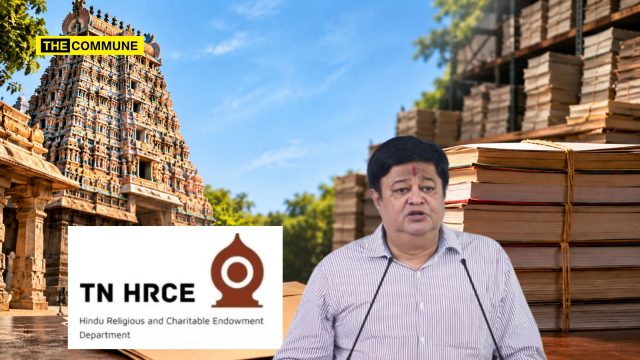
A fresh controversy has erupted over the alleged misuse of the Hindu Religious and Charitable Endowments (HR&CE) Department’s Common Good Fund, with a legal notice accusing the Tamil Nadu government of diverting temple funds towards an extensive book publishing and distribution venture.
TR Ramesh, president of the Temple Worshippers Society and Indic Collective Trust, has issued a legal notice to the Tamil Nadu government and the HR&CE Department, demanding an immediate halt to further publication and distribution of books financed through the Common Good Fund. The notice alleges that the department has used money meant for temple renovation and other religious purposes to operate what effectively amounts to a government publishing enterprise.
At the centre of the controversy is Government Order (Ms.) No. 93, dated 8 April 2022, under which the HR&CE Department’s Publication Division was authorised to undertake book publishing activities.
According to Ramesh, the government sanctioned ₹4.94 crore in the first year alone for the initiative, covering printing, staff salaries, a truck, software, a gallery, electricity and even unforeseen expenses. He further claims that the department has admitted, in response to an RTI application, that ₹8.94 crore has already been drawn from the Common Good Fund.
The Common Good Fund is maintained under Section 97 of the Tamil Nadu Hindu Religious and Charitable Endowments Act, 1959. Ramesh contends that the money is held in trust for temple deities and is intended for purposes such as renovating impoverished and dilapidated temples, preserving temple paintings and supporting legitimate religious activities.
11.27 Lakh Copies Of 1,016 Titles Allegedly Remain Unsold
The legal notice makes several claims about the scale of the publishing operation and the accumulation of unsold books.
According to the figures cited by Ramesh, the HR&CE Department has published 1,016 titles, with approximately 11.27 lakh copies, weighing an estimated 182 tonnes, remaining unsold in various storage facilities.
The notice identifies godowns in Kilpauk and Royapettah, as well as the marriage hall of Agatheeswarar Temple, as locations where the books are allegedly being stored.
It further claims that 204 book stalls have been opened inside temples and that another 108 titles are already lined up for publication.
Ramesh has questioned the rationale behind continuing to print more books when such a substantial quantity of existing stock remains undistributed or unsold. He argues that the publishing operation has become an exercise in producing books without establishing whether there is sufficient demand for them.
He has also alleged that temples are being directed to establish book stalls, purchase stock and sell departmental publications, effectively turning religious institutions into distribution outlets for the government’s publishing venture.
Allegations Of Favouritism Towards Arasu Arts
The legal notice also raises questions about the contractors and publishing companies involved in the initiative.
Ramesh alleges that the HR&CE Department has refused to disclose the identities of the printers and publishers engaged for the project, despite demands for transparency.
He has specifically flagged a firm identified as Arasu Arts, alleging that a substantial portion of the printing work appears to have been awarded to it.
According to the notice, publicly available records of the firm’s work include political campaign material and portraits associated with the party in power between 2021 and 2026.
Ramesh has questioned whether public funds contributed by temples were used to benefit a politically connected publishing enterprise. He has also alleged that there were no transparent tenders for content selection, no publicly disclosed selection criteria and no disclosure of the contracts awarded.
The notice demands that the government publish every detail of the printing and publication contracts awarded since 2022, including every work order issued to Arasu Arts.
These are allegations raised in the legal notice and have not, in the material provided, been independently established.
Legal Challenge To Government Order No. 93
A significant part of the legal notice challenges the government’s authority to use the Common Good Fund for the publishing initiative.
Ramesh argues that the HR&CE Department has no statutory authority under the 1959 Act or the applicable rules to undertake the publishing operation in the manner authorised by Government Order No. 93.
Citing his RTI findings, he claims that there is no specific provision in the Act or the HR&CE Common Good Fund Rules, 1962, permitting the department to carry out such activities.
He further argues that the government order relies on an observation made in an earlier judicial proceeding rather than an express statutory provision authorising the initiative.
The notice also questions the administrative process followed before the government order was issued.
According to Ramesh, no individual temples submitted applications seeking assistance for the publishing initiative. He alleges that the mandatory Rule 4 notices concerning temples were not issued, objections were not invited and no proper enquiry was conducted.
He further questions the concentration of powers within the department, alleging that the HR&CE Commissioner or subordinate government officials effectively functioned as the applicant, sanctioning authority, administrator, publisher and retailer in the same transaction.
Invoking the legal principle of nemo judex in causa sua, that no person should be a judge in their own cause, Ramesh has questioned the propriety of this arrangement.
357 Temples Could Have Been Renovated With The Money
The legal notice also highlights what Ramesh describes as the opportunity cost of diverting temple funds towards publishing.
Using the government’s own stated rate of ₹2.5 lakh for renovating a temple, he calculates that the amount allegedly spent could have been used to renovate approximately 357 village temples.
He contrasts this with the alleged accumulation of 182 tonnes of unsold books in warehouses and temple premises.
According to his argument, several village temples continue to face difficulties in maintaining regular poojas and undertaking basic repairs, while substantial sums from the Common Good Fund have been committed to printing, storage, distribution infrastructure and unsold publications.
He has questioned why funds intended for the welfare and preservation of temples should be used to sustain a publishing operation that has allegedly failed to generate sufficient demand for its output.
Six Major Demands In Legal Notice
Ramesh has called upon the Tamil Nadu government and the HR&CE Department to take six immediate steps to address the alleged irregularities.
The demands include:
- Stop all further publishing activities: Immediately halt publication, reprinting, printing, procurement, storage and distribution of books financed through the Common Good Fund.
- Withdraw Government Order No. 93: Rescind G.O. (Ms.) No. 93 dated 8 April 2022, on the ground that it exceeds the government’s statutory powers.
- Restore the money to the Common Good Fund: Return every amount spent on publication in alleged violation of Section 97 of the HR&CE Act and the Common Good Fund Rules, 1962.
- Disclose all contracts: Publish complete details of printing and publication contracts awarded since 2022, including every work order issued to Arasu Arts.
- Withdraw compulsory book-stall directions: Cancel instructions requiring temples to establish book stalls, purchase stock or sell departmental publications.
- Make all 1,016 titles freely accessible online: Upload every title already published and available in the public domain in electronic form, free of charge.
Threat Of DVAC Complaint, Audit And Madras High Court Proceedings
Beyond the six demands, Ramesh has called for an independent investigation into the alleged financial and administrative irregularities.
He has specifically sought an enquiry by the Directorate of Vigilance and Anti-Corruption (DVAC) or the CB-CID, along with a special audit by the Accountant General.
The legal notice warns that failure to comply with the demands within the stipulated period would invite further legal action, including a writ petition before the Madras High Court, complaints to the DVAC and Lokayukta, and a civil suit seeking recovery of the amounts allegedly misused.
The notice also calls for the restoration of funds to the Common Good Fund and the disclosure of the entire contractual arrangement behind the publishing initiative.
The controversy raises broader questions about the utilisation of temple funds, the statutory limits of the HR&CE Department and the accountability of officials administering money held for religious institutions.
Ramesh has maintained that temple funds cannot be treated as working capital for a publishing enterprise or used to benefit favoured contractors. He argues that contributions made by temples must be utilised strictly for the purposes prescribed under the law.
There is another ONGOING startling book publishing and procurement (dumping) SCAM in Tamil Nadu – By none other the pious darling of the corrupt – @tnhrcedept
Legal Notice issued to the Tamil Nadu Government and HR&CE Department.
The Hindu Religious & Charitable Endowments Common Good Fund — money forcibly contributed by temples –supposedly for renovating dilapidated and impoverished temples, preserving paintings, and genuine religious purposes under Section 97 of the HR&CE Act — has been systematically looted to run a commercial publishing house.
GO Ms No. 93 dated 08.04.2022 sanctioned ₹4.94 crore in the first year alone for printing, staff salaries, a truck, software, gallery, electricity and “unforeseen” expenses. The Department itself has admitted ₹8.94 crore has already been drawn.
1,016 titles printed. 11.27 lakh copies (182 tonnes) lying unsold in godowns in Kilpauk, Royapettah and even the marriage hall of Agatheeswarar Temple. 204 book stalls forcibly opened inside temples. Another 108 titles already lined up.
This is not “propagation of tenets”. This is production for its own sake. Books that do not sell. A revolving fund that never revolves. Money that could have renovated 357 village temples at the Government’s own rate of ₹2.5 lakh per temple — instead spent on cameras, compound walls, contract staff and unsold stock.
And to favor a DMK man’s publishing company.The Department has no statutory power to do this.
The IAS fellow in Religious Endowments Department who issued the G.O. is well aware that he never had any powers in this regard when he issued the G.O.In reply to my RTI it has been admitted there is no provision in the Act or Rules. It relies on an obiter dictum. No applications from any temple. No Rule 4 notices concerning Temples. No objections invited. No enquiry.
The Commissioner or his subordinate Government servant is the applicant. The commissioner, IAS fellow is the sanctioning authority, the administrator, the publisher and the retailer — all in the same transaction.
Classic nemo judex in causa sua.
The @tnhrcedept refuses even to name the printers and publishers. A substantial chunk appears to have gone to one Arasu Arts, a firm whose publicly listed work includes political campaign material and portraits for the party in power between 2021 and 2026. No tender for content. No published selection criteria. No disclosure of awards. Textbook library-book-procurement-scam model, now applied to temple funds.
Temple surplus is being converted into working capital of a publishing venture, then forced back onto temples to stock and sell books that the market will not rush to buy. Village temples without regular pooja are left unrepaired while 182 tonnes of paper sit in Chennai.
I have called upon the authorities to:
• Immediately stop all further publication and distribution
• Rescind GO 93
• Restore every rupee to the Common Good Fund
• Disclose every contract, every work order (especially to Arasu Arts)
• Withdraw all directions forcing temples to open book stalls
• Place all 1,016 titles free online• Order an independent enquiry by DVAC / CB-CID and a special audit by the Accountant General
Failure will be met with a writ petition in the Madras High Court and/or complaint to DVAC and Lok Ayukta, and a suit for recovery
Temple funds are held in trust for the deities. They are not a cash cow for a publishing house or a favoured printer. Devotees and temple worshippers of Tamil Nadu — this is your money. Watch this space.
Yours in service of Temples,
T R Ramesh
Temple Worshippers Society | Indic Collective Trust— trramesh (@trramesh) November 22, 2026
Subscribe to our channels on WhatsApp, Telegram, Instagram and YouTube to get the best stories of the day delivered to you personally.