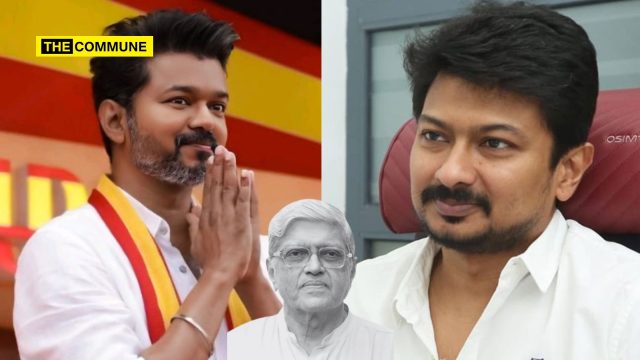
As Joseph Vijay prepares to stake claim to form the next government in Tamil Nadu, grandson of Rajaji and someone who appears to be a staunch Dravidianist, Gopalkrishna Gandhi penned an ‘open letter’ to Vijay that was published in The Hindu.
The “open letter” by Gopalkrishna Gandhi to Vijay reads less like a congratulatory note and more like an ideological onboarding document written by a senior DMK figure attempting to politically tutor a newcomer who has unexpectedly seized power.
What makes the letter striking is not merely what it says, but the tone in which it says it. Throughout the piece, Gandhi writes with the air of a headmaster addressing an intelligent but unruly schoolboy rather than an elected Chief Minister with a historic democratic mandate. The repeated insistence that Vijay must be “told some truths,” that he is “inexperienced and whimsical,” and that he must be guided into proper constitutional behavior reveals a deeply paternalistic attitude.
The condescension begins almost immediately. Gandhi admits he did not vote for Vijay and says he initially viewed him as “inexperienced and whimsical.” Even the compliment that follows – “fresh, clean” sounds less like admiration and more like the cautious approval one reserves for an untested amateur. The underlying message is unmistakable: Vijay may have won power, but in Gandhi’s eyes, he has not yet earned intellectual legitimacy.
That patronizing tone continues throughout the letter. Gandhi repeatedly frames himself as a custodian of moral wisdom passing down instructions to a politically immature figure. The structure itself resembles a lecture. Gandhi keeps repeating these words – protect secularism, avoid triumphalism, respect officers, reject sycophancy, embrace constitutional morality, uphold federalism, embody communal harmony.
If only he had instructed this to the DMK cadre and to MK Stalin himself, he could have won Kolathur and retained power? Nevertheless, instead of engaging Vijay as an independent political actor with his own ideological legitimacy, Gandhi attempts to induct him into a pre-approved liberal-secular framework.
One of the most politically revealing sections is Gandhi’s treatment of MK Stalin. Despite the letter ostensibly being about Vijay, Gandhi devotes significant space to praising Stalin and the Periyarist tradition. He describes Stalin as representing a “venerable thinking tradition” rooted in Periyar’s movement for equality and social justice. He even calls Stalin’s departure “statesmanlike” and says his absence from the Assembly would be regrettable. This seems to be the opposite of what he wrote to Vijay in the earlier paragraph.
The contrast is revealing. Vijay, despite winning a fairly massive mandate, is treated as an impulsive newcomer who must learn discipline. Stalin, despite being electorally defeated in this hypothetical scenario, is treated as a dignified statesman carrying forward an intellectual legacy. Gandhi appears far more emotionally invested in preserving the moral prestige of the outgoing Dravidian establishment than in celebrating the arrival of a new political force.
Even more curious is Gandhi’s invocation of EV Ramasamy while completely ignoring his own grandfather, C. Rajagopalachari. Rajaji was not merely Gandhi’s ancestor but one of Tamil Nadu’s greatest intellectual and political figures – a statesman deeply associated with constitutionalism, federalism, governance, linguistic balance, and ethical public life. Yet the letter contains no mention of Rajaji whatsoever.
Dear @realitycheckind I offer this letter from the esteemed Gopalkrishna Gandhi, retd Civil Servant and Ex-Governor. See the encomiums for Periyar and not a word about his own grandfathers Gandhi and Rajaji. Thankfully, Patel makes a cameo in a positive manner.
Add one more to… pic.twitter.com/v2R1ola73a
— Badri Seshadri (@bseshadri) May 6, 2026
Instead, Gandhi selectively roots Tamil Nadu’s moral legitimacy entirely within the Periyarist tradition. This omission is politically significant. It suggests an ideological alignment with the dominant Dravidian-secular narrative while sidelining alternative Tamil political inheritances, including conservative constitutionalism, classical liberalism, and Rajaji’s own critique of centralized ideological politics.
How Gandhi speaks about Udhayanidhi Stalin is even more peculiar. He effectively asks Vijay to treat Udhayanidhi as a collaborative partner within the Assembly rather than as the son of a defeated political dynasty. He adds, “And let Udhayanidhi Stalin’s presence in the House be for you a great duet, not a grim duel. As in what Nadal facing Federer has been – a balance of skills.” Even in defeat, the Stalin family is framed not as an outgoing establishment to be challenged, but as an indispensable part of Tamil Nadu’s political continuity. Gandhi appears less interested in a clean political rupture than in ensuring that the old Dravidian order remains accommodated within the new one. This creates an unusual tension in the letter: while warning Vijay against personality cults and inherited power, Gandhi simultaneously normalizes the continued centrality of the Stalin dynasty in Tamil politics.
Another revealing aspect is Gandhi’s discomfort with ideological clarity. When he asks Vijay, “What is your ideology?”, he immediately supplies the answer himself: “My ideology is following my conscience.” This sounds lofty, but it also conveniently discourages sharp ideological positioning. Vijay is subtly advised not to become too culturally assertive, too majoritarian, too anti-establishment, or too disruptive. “Conscience” here functions as a softer substitute for ideological conviction – one that fits neatly within elite liberal vocabulary.
The letter also contains unmistakable anxiety about the national political climate. Gandhi repeatedly invokes secularism, hate-free politics, fear-free India, constitutional morality, protection of minorities, and federalism – typical language of Dravidianist DMK.
The letter therefore reads not only as advice to Vijay, but as an attempt to ensure that a potentially powerful new Tamil leader remains within the ideological boundaries acceptable to the Dravidianists.
Perhaps the most extraordinary line comes at the end, when Gandhi highlights Vijay becoming “the first Christian” to head the Tamil Nadu government and describes it almost as a providential affirmation of Tamil Nadu’s secular credentials. This is politically loaded. Rather than simply treating religion as irrelevant in governance, Gandhi elevates Vijay’s Christian identity into a symbolic civilizational statement. Critics may see this as paradoxical: a letter repeatedly preaching secularism ultimately closes by celebrating the religious identity of the leader himself.
In the end, the “open letter” reveals as much about Gopalkrishna Gandhi as it does about Vijay. It exposes the anxieties of an aging intellectual-political establishment confronted with a charismatic outsider whose ideological direction remains uncertain. Gandhi praises Vijay, but cautiously. He congratulates him but lectures him. He welcomes change but simultaneously attempts to contain it within familiar ideological boundaries.
The result is a document that oscillates between blessing, warning, ideological instruction manual, and elite political gatekeeping – all wrapped in the language of constitutional morality and elder-statesman civility.
Subscribe to our channels on WhatsApp, Telegram, Instagram and YouTube to get the best stories of the day delivered to you personally.