A video segment published by India Today on 12 April 2026, just days before Tamil Nadu goes to polls on April 23, shows India Today journalist Rajdeep Sardesai interviewing young people in Chennai about the three-language policy and Hindi imposition. The clip was presented as a candid “ground interaction” capturing the organic views of Tamil Nadu’s youth.
Ahead of the April 23 Assembly elections, the Three-Language Policy has resurfaced as a key issue in Tamil Nadu’s political discourse.
In a ground interaction, @sardesairajdeep interacts with youth in Tamil Nadu to understand their views on learning Hindi, reflecting a range of… pic.twitter.com/ubWqvEqMCH
— IndiaToday (@IndiaToday) April 12, 2026
But questions are now being raised about where exactly it was filmed and who those “ordinary youth” actually are.
Filmed Inside Arivalayam – DMK’s Own Headquarters?
Multiple observers who viewed the video have pointed out that the background and premises visible in the footage match the compound of Anna Arivalayam – the official headquarters of the ruling DMK party in Chennai. Arivalayam is not a public space. It is the party office of the ruling establishment, where CM M.K. Stalin conducts party business and where high-profile political inductions have taken place.
If the interview was indeed conducted inside or within the compound of the DMK headquarters, it was not a random street survey. It was a curated interaction on partisan turf, presented to a national audience as if it were spontaneous public opinion.
The “Youth” Has Been Spotted With DMK Leaders
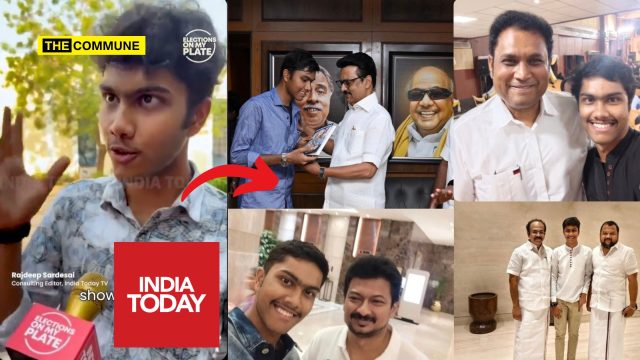
Adding to the concern, one of the young men featured in the video has reportedly been identified in photographs with DMK functionaries and leaders. None of this was disclosed in the video or its caption.
கொண்டைய மறைங்கடா 😂🚶♂️➡️ https://t.co/GDnIhFErVu pic.twitter.com/N7A88HrPkM
— Bagavath Pratheep (@Bagavathprathee) April 12, 2026
India Today’s post described it simply as Sardesai interacting with “youth in Tamil Nadu to understand their views on learning Hindi”. No mention of party affiliation, no disclosure of location, no acknowledgment of who arranged the interaction.
This is a significant editorial omission. A journalist conducting a survey of public opinion on a politically sensitive issue — nine days before a state election — has a basic obligation to disclose if the respondents are party workers or if the venue is a party office.
The Timing Is Not Incidental
The three-language policy and Hindi imposition are among the most emotionally charged electoral issues in Tamil Nadu. With voting scheduled for April 23, the DMK has strong political incentive to amplify anti-Hindi sentiment – a vote consolidation tool the party has used for decades. An India Today segment, broadcast nationally, showing Chennai youth uniformly and articulately opposing Hindi functions as free, credible-looking campaign content at the most critical moment of the election cycle.
In a state of 80 million people with diverse views on language policy, the statistical probability of interviewing seven people who hold near-identical opinions is low, unless the sample was not random at all.
That doesn’t mean the views expressed are wrong, it means that India Today is only showing one side of the opinions. The problem is not the message – it is the manufacturing of the messenger. Presenting DMK-affiliated youth inside a party office as “Chennai’s youth” to a national audience, nine days before an election, without a single line of disclosure, is not journalism. It is political communication with a press badge attached.
Subscribe to our channels on WhatsApp, Telegram, Instagram and YouTube to get the best stories of the day delivered to you personally.