There is a pattern; clear, documented, and increasingly hard to ignore. It surfaced after Dhurandhar 2: The Revenge triggered a wave of online digging, with users unearthing old tweets and archived reports on UPA-era decisions. What emerged was a consistent political record, now rapidly vanishing. As the hashtag “Old UPA Tweets” surged, links from major media outlets began returning 404 errors – one after another. Reports on terrorism, Pakistan, and past leadership positions started disappearing.
What the paper trail on Rahul Gandhi’s views on terrorism reveals is not a politician who was merely naive. It is a politician who, for over a decade, systematically deflected blame away from Pakistan-backed Islamic terrorism and redirected it at Hindus.
The Anger Defence
Start with the most charitable interpretation possible. In 2013, Rahul Gandhi, then Congress Vice President and the unchallenged heir apparent of the party that had governed India for nearly a decade offered his theory of terrorism to the nation. “Terrorism happens because anger is instilled,” he said. “Anger is the root cause of terrorist activities.”
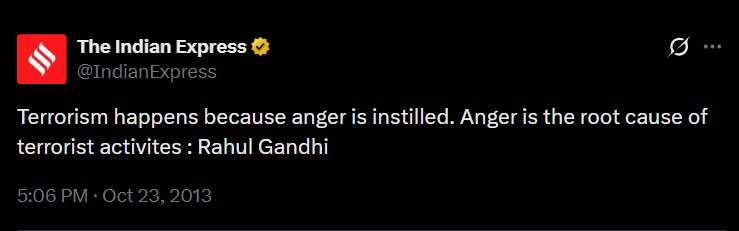
This was not a fringe statement buried in a party document. The Indian Express had reported on this from its official handle. No retraction was issued. No clarification followed.
Let the statement sit with its full weight for a moment. While terror organisations like IM, SIMI, and Pakistan’s ISI were actively funding, training, and deploying bombers across Indian cities in Hyderabad, Pune, Mumbai, Delhi – the man who aspired to lead the country offered anger as his diagnosis. Not ideology. Not Pakistani state sponsorship. Not jihadist theology. Anger. A word so vague it could justify every terrorist and condemn every government that dares to call them what they are.
The Confession at Hillary Clinton’s Lunch Table
Four years before that statement, in August 2009, Rahul Gandhi sat next to the US Ambassador at a lunch hosted by Prime Minister Manmohan Singh in honour of US Secretary of State Hillary Clinton. What he said that afternoon was classified under Reasons 1.4(B) and 1.4(D) – the diplomatic equivalent of “handle with care.” It was declassified by WikiLeaks and is now permanently on the public record.
Ambassador Timothy Roemer’s cable to Washington records it with precision: when asked about Lashkar-e-Taiba’s activities and the immediate threat to India; this is the same LeT responsible for 26/11, which had killed 166 people in Mumbai just nine months earlier – Rahul Gandhi acknowledged some Muslim support for the group within India. Then came the pivot.
“However, Gandhi warned, the bigger threat may be the growth of radicalized Hindu groups, which create religious tensions and political confrontations with the Muslim community.”
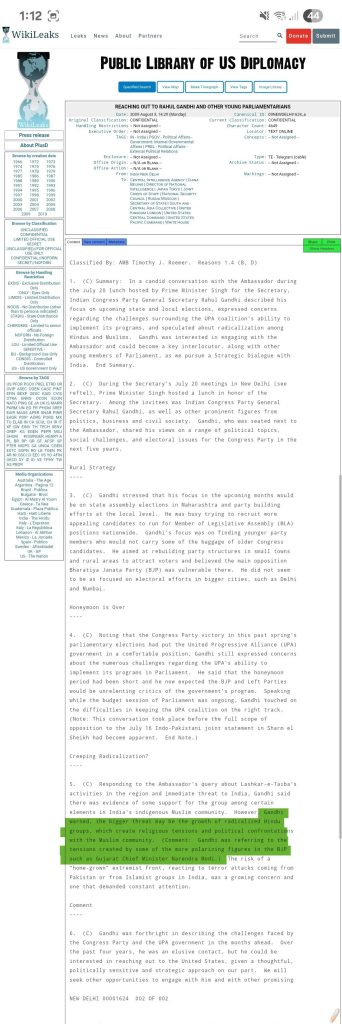
The cable’s own editorial comment removes any doubt about who Gandhi had in mind: “Gandhi was referring to the tensions created by some of the more polarizing figures in the BJP such as Gujarat Chief Minister Narendra Modi.”
Nine months after 26/11. In front of the American Secretary of State. Rahul Gandhi’s assessment of India’s biggest terror threat was not the organisation that had just slaughtered 166 Indians. It was Hindus. And specifically, the future Prime Minister of India.
The Architecture of Inversion
Taken individually, each of these statements can be explained away – poor phrasing here, political context there. Taken together, they describe a consistent architecture. Rahul Gandhi, across multiple years and multiple platforms, pursued a single ideological project: inverting the terror narrative in India so that Pakistan-backed Islamic terrorism was treated as a symptom of Hindu provocation, and Hindus: their organisations, their leaders, their elected representatives were cast as the true source of violence.
This was not accidental. It had policy consequences. It was the same Congress government that institutionalised “saffron terror” as an official counter-terrorism category, deployed the National Investigation Agency to pursue cases against Hindu sadhus and military officers on fabricated charges, and allowed IB officers to publicly theorize about “Hindutva terror networks” while the actual perpetrators of serial bombings continued operating with impunity.
It was a government that chose to see the enemy within rather than across the border.
What the Deleted Archives Know
The articles covering these statements in real time, the editorial reactions, the opposition fury, the diplomatic fallout, are now returning 404 errors on the same websites that once published them. The WikiLeaks cable cannot be erased; it sits on international servers beyond anyone’s reach. But the contemporaneous Indian media record of how these statements were received, debated, and contextualised is being quietly retired.
History, as someone once said, is written by the victors. In 2026, with India watching, the question is whether it will also be deleted by them.
Subscribe to our channels on WhatsApp, Telegram, Instagram and YouTube to get the best stories of the day delivered to you personally.