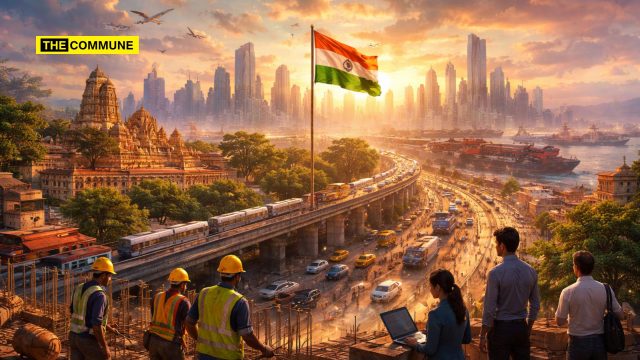
The idea that India might escape the so-called “middle-income trap” has long been treated with skepticism in global economic circles. The trap, as defined by institutions like the World Bank, describes a stage where countries rise from poverty but then stagnate before achieving high-income status. Historically, very few nations have made that leap just a few dozen in the last several decades.
Yet a recent argument in the Washington Examiner suggests that India may be one of the rare exceptions. That claim, while optimistic, is not without merit. In fact, when one steps back and examines India’s trajectory particularly under the current political and economic framework it becomes clear that this is not merely wishful thinking, but a grounded assessment of structural transformation.
At the heart of the optimism lies India’s sustained economic growth. Even conservative projections place India’s GDP growth in the range of 6-7% annually in the coming years, with periods of higher expansion already witnessed. This is not just about numbers; it is about consistency. Unlike many Latin American or Southeast Asian economies that surged and then stalled, India’s growth has shown resilience across global shocks from financial crises to pandemics.
But growth alone does not guarantee escape from the trap. What matters is the quality and drivers of that growth. This is where India’s model diverges significantly from others. Unlike export-heavy economies such as China, India’s growth has been deeply rooted in domestic consumption. With consumption accounting for roughly two-thirds of GDP, India has built a broad-based internal market that acts as a stabilizer against global volatility. This internal demand is powered by a rising middle class, urbanization, and a steady expansion of digital and financial inclusion.
Another crucial factor is governance reform. Over the past decade, India has undergone a series of structural changes tax reforms like GST, insolvency laws, digitization of welfare, and a strong push toward infrastructure development. These reforms are not cosmetic; they address long-standing inefficiencies that historically slowed India’s economic momentum. The expansion of highways, railways, ports, and digital infrastructure has dramatically reduced transaction costs and improved productivity.
Equally important is the competitive federalism that has emerged across Indian states. Unlike centralized economies, India’s 28 states are increasingly competing for investment, innovation, and industrial growth. This internal competition creates a dynamic ecosystem where policy experimentation is encouraged and best practices are replicated. Such decentralized dynamism is often absent in countries that fall into the middle-income trap.
Demographics further strengthen India’s case. While many middle-income countries face aging populations, India remains a young nation. A large working-age population provides both a labor force and a consumer base. If harnessed correctly through education and skill development, this demographic dividend could sustain growth for decades.
However, optimism must be tempered with realism. India’s journey is far from guaranteed. One of the biggest challenges is employment. Despite strong GDP growth, job creation has not always kept pace. Wage growth has also remained modest in many sectors, limiting consumption expansion. If India fails to generate sufficient high-quality jobs, its demographic advantage could turn into a liability.
Inequality is another concern. While India’s overall inequality levels are lower than some developed nations, wealth concentration at the top remains significant. A growth model that disproportionately benefits the elite risks undermining social cohesion and long-term demand.
There is also the challenge of transitioning from investment-driven growth to innovation-driven growth. The World Bank and other institutions emphasize a “3i” strategy: investment, infusion of technology, and innovation as essential for escaping the trap. India has made progress in the first two stages, particularly through infrastructure and technology adoption, but innovation remains uneven. While sectors like IT and startups are thriving, manufacturing innovation and deep-tech development need further strengthening.
Yet, what distinguishes India from many other middle-income countries is not just economics it is political stability combined with a clear long-term vision. The goal of becoming a developed nation by 2047, marking 100 years of independence, is not merely symbolic. It provides a strategic direction that aligns policy, investment, and public expectations.
Critics often argue that India’s democratic system could slow down decision-making compared to authoritarian models like China. But this critique overlooks a key advantage: democratic legitimacy. Policies that emerge from democratic consensus are more sustainable and less prone to abrupt reversals. Over time, this stability can be more valuable than speed.
Moreover, India’s global positioning has strengthened significantly. Trade agreements, such as the recent deal with the European Union, and deeper engagement with major economies like the United States, are integrating India more firmly into global supply chains. This integration is crucial for technology transfer, export growth, and capital inflows – all essential ingredients for escaping the middle-income trap.
There is also an intangible but powerful factor at play: civilizational confidence. For decades after independence, India’s economic policy was marked by hesitation and ideological constraints. Today, there is a noticeable shift toward assertiveness and ambition. This change in mindset both within the government and among the people cannot be quantified, but it plays a significant role in shaping economic outcomes.
The Washington Examiner’s argument ultimately rests on a simple but compelling premise: India is doing enough of the right things, at the right time, and at the right scale. It is building infrastructure, reforming institutions, leveraging technology, and engaging globally all while maintaining democratic stability.
Of course, history is littered with countries that seemed poised for greatness but fell short. The middle-income trap is not a myth; it is a well-documented reality. But history is not destiny.
India’s path will depend on whether it can sustain reforms, deepen human capital investment, and ensure that growth translates into widespread prosperity. If it succeeds, it will not just escape the middle-income trap it will redefine the development narrative for the 21st century.
In that sense, the question is no longer whether India can escape the trap. The more relevant question is whether it can do so while remaining true to its democratic ethos and inclusive aspirations. If the answer is yes, then India’s rise will not merely be an economic story it will be a civilizational one.
Dr. Prosenjit Nath is a techie, political analyst, and author.
Subscribe to our channels on WhatsApp, Telegram, Instagram and YouTube to get the best stories of the day delivered to you personally.