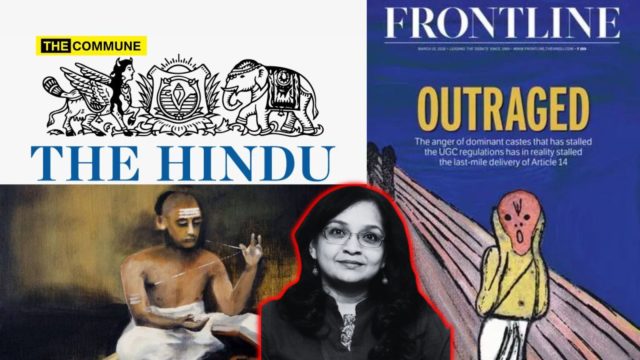
Frontline, the national magazine published by The Hindu, plastered its March 2026 cover with a grotesque anti-Brahmin caricature that recalls the darkest techniques of 20th-century racial propaganda.
The Hindu which has gone on to become a Leftist-Dravidianist rag peddling propaganda instead of objective news has crossed a line from partisanship into something far uglier — the visual demonization of an entire community.
Rather than grappling with the substance of the nationwide debate over the University Grants Commission’s newly proposed Equity Regulations, 2026, the magazine chose to splash its cover with a grotesque caricature of a Brahmin figure onto Edvard Munch’s famous artwork The Scream, complete with exaggerated cultural markers, styled in a manner disturbingly reminiscent of early 20th-century racial propaganda.
After The Commune’s report on the same, the cover became a talking point.
Following the condemnation and outrage from across social media, leftist rag Newslaundry ‘reached out’ to Vaishna Roy, the editor of Frontline to ‘hear her side of the story’ – something Newslaundry would have never done had the case been reversed.
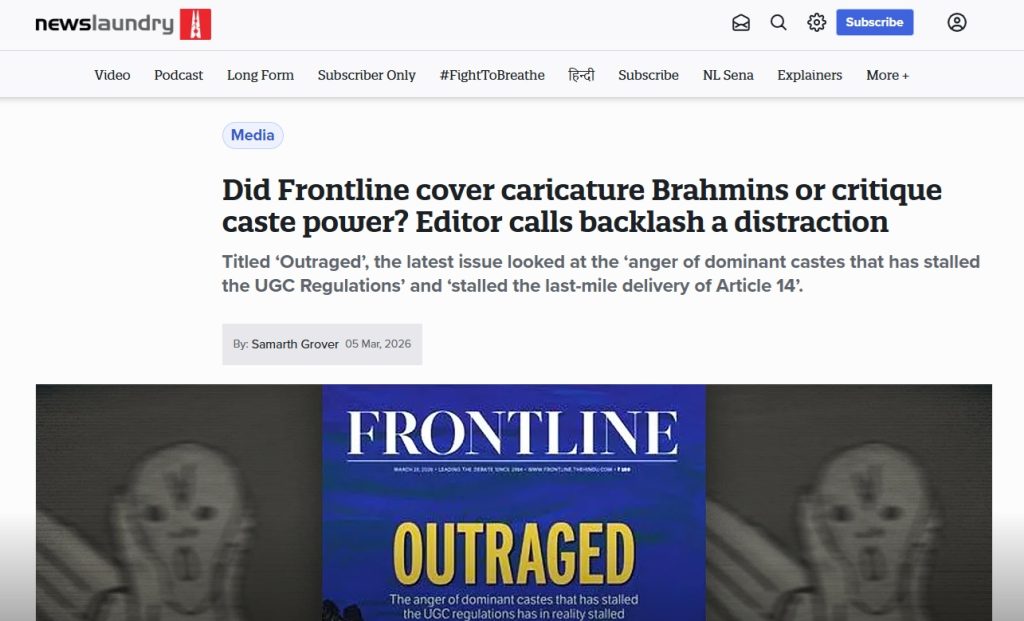
Instead of acknowledging these concerns, Frontline editor Vaishna Roy dismissed the outrage as a “deflection” from the debate surrounding the UGC regulations that have been stayed.
Speaking to a media outlet, Roy defended the cover and said the illustration had been republished with permission from the anti-caste portal The Ambedkarian Chronicle. She described it as a “clever adaptation” of Edvard Munch’s iconic painting The Scream, which is now in the public domain.
Sacred Symbols Reduced to Caricature
Roy claimed that the janeu and shikha are widely used in films, cartoons, and theatre as visual shorthand for a devout or dominant Hindu figure. She argued that the illustration was intended to highlight what she described as contradictions between demonstrative religiosity and unjust social behaviour.
Such reasoning effectively normalises the caricaturing of Hindu religious markers. For them, the issue is not artistic adaptation but the deliberate reduction of a religious community’s symbols into objects of ridicule.
If similar caricatures were drawn using markers associated with other religious communities, the response from the same media ecosystem would likely be very different.
Let us understand the problem with her ‘arguments’.
The “Power” Argument Is Self-Serving
Editor Vaishna Roy’s central defence rests on the claim that the image is acceptable because it represents the “oppressor” speaking back to “power.” But this logic is both circular and dangerous. It pre-emptively declares an entire community, Brahmins, as a monolithic power bloc, strips them of individual identity, and then licenses any visual degradation against them on those very grounds. In other words, the caricature is justified because the community deserves caricature. That is not critique. That is prejudice with a theoretical alibi.
By this logic, any ethnic or religious community deemed “dominant” by ideological fiat can be grotesquely illustrated without editorial accountability. No mainstream Indian magazine would dare run a similar exaggerated caricature of a Muslim cleric or a Dalit elder under the headline “Outraged” nor should they. The asymmetric application of this standard is the tell.
The Nazi Comparison the Editor Missed or Was It Subconscious?
Roy’s dismissal of the Nazi comparison is rhetorically clever but analytically weak. She argues the Nazi parallel fails because Jews were a minority being mocked by a majority in power. But this reframes the question to dodge it.
The comparison was never about the power dynamic; it was about the aesthetic technique. As documented analysts have noted, the illustration deploys the same well-worn visual grammar of 20th-century racial propaganda: an exaggerated, emaciated figure defined entirely by ethnic-religious markers: shaven head, tuft (shikha), sacred thread (janeu), sacred ash rendered in a posture of hysterical alarm. This is the exact aesthetic of Das Gejammer – the sneering Goebbelsian mockery of a target group as simultaneously weak and dangerously powerful. Roy addresses the politics; she deliberately sidesteps the aesthetics. That sidestep is the tell.
The “Dual Framing” Deception
The cover headline uses the plural, abstract term “dominant castes.” The artwork, however, deploys unmistakably Brahmin-specific iconography – not Kshatriya, not Vaishya, not any other “twice-born” community Roy mentions. This gap between the headline and the image is not accidental artistic shorthand. It is, as has been rightly identified, a rhetorical escape hatch – broad enough in text to evade legal or institutional challenge, specific enough in imagery to send a targeted communal message to its readership. Roy herself tacitly confirms this by listing only Brahmin-coded symbols while claiming they represent “dwija castes broadly.” If the intent was truly plural, the imagery would have been plural.
Kalpana Kannabiran: The Irony the Magazine Buried
The single most striking fact in this entire episode is one Frontline and Newslaundry buried in plain sight: the article that inspired the illustration was written by Kalpana Kannabiran, herself a Brahmin (Iyengar) from Madurai, daughter of distinguished civil liberties lawyer K.G. Kannabiran.
The original author Kalpana Kannabiran on whom Roy has modelled her article is itself a Iyengar with origin from Madurai (Father K. G. Kannabiran)
— Baskar (@bas_viveka) March 6, 2026
The article, titled “Hostile Environments and Brahmanical Enclosures: The Fear of Equality,” thus has a Brahmin academic providing the intellectual framework for an illustration that grotesquely caricatures Brahmin identity.
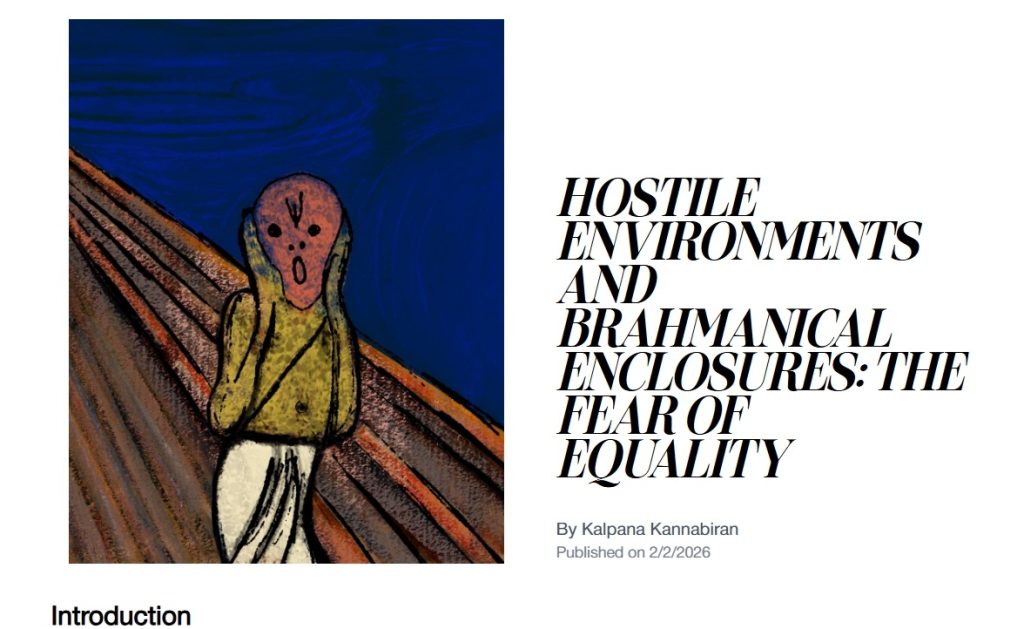
This does not, by itself, make the caricature acceptable, it makes it more revealing. It illustrates how ideological positioning in Indian academia has become so identity-detached that a community’s own members provide the scaffolding for communal visual attacks against it, and that is presented as moral sophistication. The magazine chose not to foreground this context. Ask yourself why.
Sinnakaar’s Admission
Shripad Sinnakaar (the artist of Kannabiran’s article)’s candid statement that “Brahmins themselves constitute the apex of power structure that should be critiqued” is not an editorial policy – it is a declaration of communal targeting. He states that his primary reader is “a caste oppressed person” and that the publication serves that constituency. That is an explicitly sectarian editorial mandate. Publishing a grotesque caricature of a community and then claiming it is purely structural critique, not aimed at people but at “power”, while simultaneously declaring that community the legitimate and permanent target of critique, is a contradiction that no editorial integrity defence can bridge.
What This Is Really About
The UGC Equity Regulations triggered a legitimate public debate involving faculty, students, and institutions across caste backgrounds. Reducing that debate to a screaming Brahmin caricature does not advance the cause of Dalit rights or constitutional equality. It converts a policy argument into a communal provocation.
The “real offence,” as Roy puts it, may well be in the UGC regulations being stayed but packaging that argument inside a dehumanising ethnic caricature does not amplify the offence; it replaces it. It ensures that the conversation becomes about the image, not the policy. If that outcome is a “pity,” as Roy says, it is a pity the magazine’s own editorial choices manufactured.
The test is simple and consistent: would The Hindu Group publish a similarly styled, marker-laden caricature of a Dalit figure, a Muslim, or a Christian under the headline “Outraged”? The answer requires no research. And that answer tells you everything Vaishna Roy’s eloquent defence cannot.
Subscribe to our channels on WhatsApp, Telegram, Instagram and YouTube to get the best stories of the day delivered to you personally.