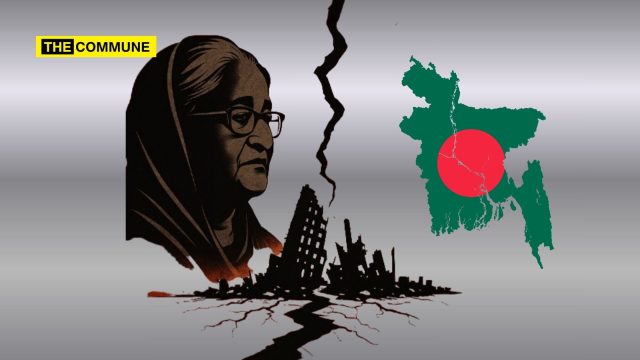
The death sentence handed down to former Bangladesh Prime Minister Sheikh Hasina by the reconstituted International Crimes Tribunal is more than a legal verdict; it is a political earthquake. And like all political earthquakes in the subcontinent, its rumblings carry the unmistakable resonance of history.
The comparison many analysts have drawn between Hasina’s trial in 2025 and Zulfikar Ali Bhutto’s trial in Pakistan in 1978 is not an exaggeration; it is a warning. A warning that when courts become theaters and justice becomes a prop for political vendettas, the nation drifts into dangerous waters.
The tribunal that delivered Hasina’s sentence was created to prosecute the atrocities committed during the 1971 Liberation War. Its purpose was to close old wounds, bring justice to victims, and honor the foundational values of Bangladesh. But the Yunus-led interim government’s decision to expand the tribunal’s jurisdiction in 2024, giving it the authority to try contemporary political actors, weaponized the institution.
Instead of healing historical traumas, it has now become an instrument to manufacture new ones. Hasina was tried in absentia, denied the opportunity to testify directly, barred from cross-examining witnesses, and subjected to a hastily conducted judicial process that resembled a political purge rather than a legitimate trial.
Supporters of the verdict might argue that Hasina must be held accountable for alleged abuses committed during her tenure. But accountability must arise from a process that upholds the basic tenets of justice. What transpired instead was a judicial spectacle: rushed proceedings, opaque evidence, and a tribunal whose neutrality had evaporated long before the verdict was announced.
In politics, optics matter, and the optics here are unmistakable: a regime intent on erasing its predecessors, using the legal system as a sword rather than a scale.
This is where the shadow of Bhutto looms large. Bhutto’s trial in 1978 under Pakistan’s General Zia-ul-Haq is now universally recognized as a travesty. Conducted under pressure, presided over by a judiciary molded by the military regime, and fueled by political animosity, Bhutto’s hanging remains one of the darkest chapters in South Asian judicial history.
Decades later, even Pakistan’s Supreme Court conceded that Bhutto had not been granted a fair trial. The parallels to Hasina are too strong to dismiss: a toppled leader, a new regime desperate to consolidate power, a judiciary re-engineered to comply, and a verdict that seems designed to eliminate political opposition rather than deliver justice.
Bangladesh, unlike Pakistan, was born out of a struggle for secular democracy. The Awami League under Sheikh Mujibur Rahman built its identity on linguistic nationalism and liberation from Pakistani militarism. But in recent years, the drift in Dhaka has been troubling.
The interim government’s accommodation of Islamist groups previously barred from politics, its shrinking tolerance for dissent, and its aggressive dismantling of the Awami League’s organizational structures all indicate an ideological shift, a shift that eerily resembles Pakistan under Zia. This is not merely about punishing Hasina; it is about rewriting the ideological DNA of the republic.
By sentencing Hasina to death, the interim regime has sent a message to its domestic rivals: political displacement will not stop at exile; it may end at the gallows. For a nation that prides itself on emerging from the ashes of genocide and dictatorship, this is an alarming regression.
Bangladesh’s political system has always been turbulent, but this verdict threatens to push it into a new phase: one where political competition is no longer mediated through elections or parliamentary processes but through courts and punitive tribunals acting under executive influence.
For India, the developments in Bangladesh carry profound strategic implications. New Delhi has long regarded Dhaka as a key ally in maintaining stability in the Northeast, combating cross-border terror networks, and managing migration flows. Sheikh Hasina’s government played an instrumental role in neutralizing extremist groups and strengthening bilateral cooperation.
Her ouster, followed by a death sentence delivered under dubious legal circumstances, destabilizes the regional balance. Bangladesh drifting toward Islamist politics even moderately threatens to reopen security challenges that India spent years combating. The Northeast, already sensitive, cannot afford a Bangladesh where anti-India political currents regain strength.
Moreover, the verdict raises questions about the future of Bangladesh’s democratic institutions. If courts can be repurposed to eliminate political opponents, then elections cease to be meaningful. The interim regime may claim to be restoring democracy, but a democracy built on judicial intimidation is hollow.
Even critics of Hasina’s governance and she had many recognized that justice cannot be selective. Her trial sets a precedent that any future government could exploit, trapping Bangladesh in a cycle of judicial vengeance with no exit.
The human rights dimension cannot be ignored either. Trials in absentia belong to authoritarian playbooks, not democratic ones. Executing a former prime minister under such circumstances violates international norms and invites scrutiny from global bodies. It signals to the world that Bangladesh is turning inward, away from democratic accountability and toward ideological consolidation. Nations that rely on international legitimacy do not pass death sentences in politically charged trials without expecting consequences.
This is why the comparison to Bhutto is so powerful. Bhutto’s execution did not strengthen Pakistan. It delegitimized its judiciary, deepened political polarization, emboldened authoritarian forces, and created a martyr whose shadow haunted Pakistani politics for generations. Bangladesh now stands at a similar crossroads.
Hasina’s sentence risks creating a political vacuum filled not by democratic forces but by opportunistic alliances of Islamist groups, disillusioned power centers, and authoritarian actors seeking permanence.
The tragedy of South Asian politics is that its leaders seldom learn from history. Institutions are reshaped to serve immediate goals, only to later become instruments of oppression for those who once controlled them. The tribunal that now convicts Hasina with sweeping authority may one day be turned against the very people who empowered it. That is the nature of political tools; they rarely remain in one set of hands for long.
Bangladesh’s soul was forged in the fires of 1971. Its promise was democracy, secularism, and justice. By sentencing Sheikh Hasina to death in a trial that carries the unmistakable scent of political revenge, the country risks abandoning that promise. The world, and especially India, must watch with vigilance.
Not because Hasina must be defended uncritically, but because democracy must be defended vigorously. When justice becomes indistinguishable from politics, nations lose their moral compass. And when nations lose their moral compass, history often the darkest parts of it has a way of repeating itself.
Dr. Prosenjit Nath is a techie, political analyst, and author.
Subscribe to our channels on WhatsApp, Telegram, Instagram and YouTube to get the best stories of the day delivered to you personally.