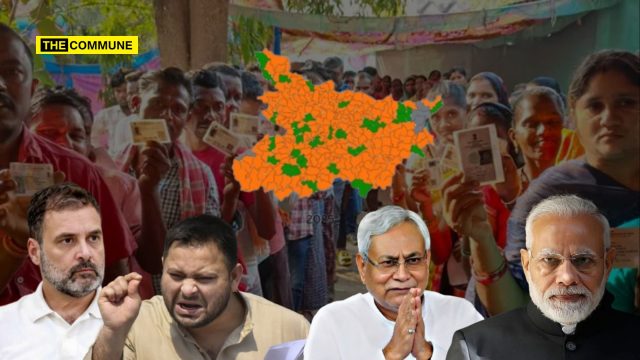
The 2025 Bihar assembly election will be remembered not only for the unprecedented sweep by the National Democratic Alliance (NDA) but also for the spectacular collapse of the RJD-Congress grand alliance, which recorded its worst performance since 2010, winning only 35 seats against the NDA’s formidable 202.
The Mahagathbandhan did not lose because of a single weakness; it disintegrated because of a cocktail of internal quarrels, leadership missteps, incoherent messaging, and disastrous strategy. From the beginning, the alliance functioned less like a coalition and more like a family locked in constant disputes. The Mahagathbandhan came across as a quarreling group, unable to hide its mistrust and power struggle.
Tejashwi Yadav wanted to assert himself as the undisputed leader, while Congress refused to accept a secondary role, and this friction burst into the open. Rahul Gandhi’s disappearance after the Voter Adhikar Yatra left Tejashwi stranded, while smaller partners such as Mukesh Sahani and CPML loudly demanded their share.
The episode where Tejashwi travelled to Delhi for the land-for-jobs hearing but reportedly left in anger without meeting Rahul Gandhi symbolized the disconnect. The alliance never recovered from the bitterness caused during seat-sharing talks, and each party ultimately ran its own campaign. Workers refused to transfer votes to partners, while the NDA showcased unity and disciplined messaging, strengthening its credibility in the eyes of voters.
The projection of Tejashwi Yadav as chief ministerial candidate further deepened the divide. Congress leaders later admitted that announcing Tejashwi as CM face was a strategic mistake many felt he carried too much political baggage and lacked the credibility that the political discourse, shaped by Prashant Kishor’s development and merit narratives, now demanded.
His lack of higher education and his association with the so-called jungle raj era made many voters skeptical. Ashok Gehlot’s late intervention as Congress troubleshooter failed to patch up the widening rift, and his scripted speech in Maurya only highlighted the disconnect between Delhi and the ground reality. Posters dominated entirely by Tejashwi signalled that the RJD had sidelined Congress.
The decision to declare Mukesh Sahani as deputy CM candidate alienated core Muslim and Mahadalit voters, who saw the NDA as a more reliable benefactor through schemes such as the Lakhpati Didi initiative and cash transfer programs.
Rahul Gandhi’s campaign performance shattered the myth that he could galvanize a state election through charisma alone. By the time he returned from his Latin America visit, the Congress had already “missed the bus.” His entry into the campaign appeared mechanical, lacking energy and purpose. His theatrics, including the now-infamous jump into a pond in Khagaria, raised eyebrows even within the Congress.
Voters felt these stunts were unbecoming of a Leader of the Opposition who often accuses Prime Minister Modi of indulging in theatrics. Rahul Gandhi’s speeches on migration felt dated and disconnected from Bihar’s political mood, which had shifted toward development, welfare delivery, infrastructure, and youth aspirations domains dominated by Nitish Kumar’s governance record and Prashant Kishor’s narrative. Priyanka Gandhi Vadra, usually an impactful campaigner, had a minimal presence, appearing almost like a supporting act. This weakened the Congress’s overall mobilization.
Rahul Gandhi’s insistence on making SIR (vote chori allegations) the central campaign issue proved disastrously ineffective. Bihar voters were not interested in allegations of election manipulation; they were far more concerned with jobs, welfare, inflation, and stability. The Voter Adhikar Yatra drained the alliance’s manpower at a critical time. Even RJD leaders admitted that the yatra consumed resources and energy without delivering any electoral benefit.
While Rahul fixated on SIR, the NDA focused on delivering a positive narrative: improved welfare schemes, governance continuity under Nitish, and women-centric policies. This sharpened the NDA’s appeal among female voters, who constituted a stable and decisive support base. The Congress thus campaigned on an issue that resonated nowhere and ignored the pulse of the electorate.
Seat-sharing chaos finally brought the Mahagathbandhan to the brink. Negotiations stretched endlessly between Patna and Delhi, worsening tensions as days passed. Without senior leaders like Lalu Prasad Yadav or Sonia Gandhi playing a mediating role, there was no strong authority to hold the alliance together. Congress leaders, emboldened by Rahul Gandhi’s directive to negotiate firmly, dug in their heels over certain “winnable” seats.
Krishna Allavaru’s uncompromising stance only escalated the conflict. The alliance reached a breaking point when parties began contesting against each other in over a dozen constituencies, effectively cannibalizing their own vote base. Nothing damages an alliance more than internal competition, and this self-inflicted wound proved decisive.
In the end, the Mahagathbandhan did not lose because the NDA was exceptionally strong; it lost because it was exceptionally dysfunctional. The alliance collapsed under the weight of its contradictions – leaders mistrusted each other, cadres refused cooperation, campaign messaging lacked coherence, and the coalition failed to offer a credible alternative to a disciplined and well-coordinated NDA.
The Tejashwi-Rahul partnership was built on fragile foundations, and when tested under electoral pressure, it crumbled completely. In Bihar 2025, the NDA did not defeat the RJD-Congress alliance. The alliance defeated itself.
Dr. Prosenjit Nath is a techie, political analyst, and author.
Subscribe to our channels on WhatsApp, Telegram, Instagram and YouTube to get the best stories of the day delivered to you personally.