Rahul Gandhi and KT Rama Rao, both sophisticated scions of famous political families, recently made the audacious attempts to manipulate the Gen-Z of Bharat into creating Nepal-like unrest with indirect calls for political action.
Rahul Gandhi’s social media post proclaimed, “the nation’s youth… Gen Z, will defend the Constitution, protect democracy and stop vote theft. I always stand with them. Jai Hind!”, even invoking Nepal’s student-led protests. This rhetoric is dangerous and hypocritical. Maharashtra Chief Minister Devendra Fadnavis aptly described him as an “urban Maoist.” Fadnavis said that “Rahul Gandhi has effectively asked Gen-Z to rise and overthrow a democratically elected government. That’s not ‘vote chori’, it’s his brain that’s been stolen. He speaks the language of urban Maoists who don’t believe in the Constitution or democratic institutions”.
Leaders like Virendra Sachdeva hailed the student’s vote for ABVP as proof that Gen-Z has “shown its resolve” and spurned Rahul’s vision, calling the ABVP’s win a “slap in the face” for Rahul Gandhi. Similarly, KT Rama Rao from Telangana’s political dynasty, who inherited power from his father K Chandrasekhar Rao warned ominously at the NDTV Yuva Conclave that “a Nepal-like Gen Z protest could happen in India if governments fail the aspirations of the people”.
The Nepal Narrative
The narrative peddled by these politicians crumbled when Nepal’s own Gen-Z protesters spoke their truth with clarity and confidence. In exclusive interviews, young Nepali demonstrators openly stated, “Not Oli, we want a prime minister like Modi.” One passionate protester explained, “Nepal needs a PM like Modi who can prioritize the country’s welfare. Under PM Modi’s leadership, India has made remarkable changes in the past decade, and we want to see similar progress in Nepal.” They went on to stress that their demand is not about party politics but about strong, decisive leadership that can deliver jobs, infrastructure, and dignity to the youth.
View this post on Instagram
Many of them expressed frustration over years of political stagnation and corruption, saying they are inspired by the energy and development they see across the border. For these young voices, the call for a “Modi-like” leader reflects a deeper yearning for accountability, growth, and a future where merit takes precedence over family name.
ABVP’s Nationalist Sweep Across Campuses
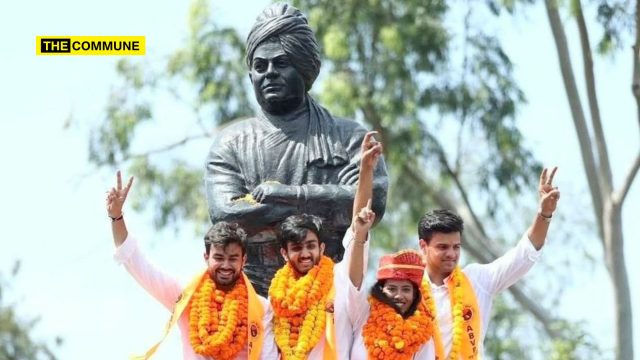
Over the past few months, India’s Gen-Z delivered their verdict through democratic means, rejecting the anti-national narratives across university campuses. India’s Gen-Z Students are choosing leaders who talk about national pride, development, and everyday campus concerns. The Akhil Bharatiya Vidyarthi Parishad (ABVP) achieved historic victories across multiple prestigious institutions:
Delhi University Students’ Union (DUSU) 2025: ABVP secured three of four key posts, with Aryan Maan winning the presidency with 28,821 votes, defeating NSUI’s candidate, who managed only 12,645 votes. This is proof that Gen-Z has shown its resolve and demonstrated its faith in nationalist ideology.
#ABVP sweeps #DUSU
Congratulations to all the Winning Candidates of ABVP in Delhi University Students Union Election and its cadres as well as all the well wishers!#DUSUElection2025 @ABVPVoice pic.twitter.com/3h67HNFM29— Kiren Rijiju (@KirenRijiju) September 19, 2025
Punjab University: In a groundbreaking achievement, ABVP’s Gaurav Veer Sohal won the presidential post for the first time in 48 years, securing 3,148 votes with a margin of 488 votes. This historic victory shattered decades of opposition dominance and established ABVP as a formidable force in Punjab’s academic landscape.
BIG BREAKING NEWS 🚨 ABVP candidate Gaurav Veer Sohal elected as President of Panjab University.
For the first time in history, ABVP won in Panjab University 🔥🔥
AAP backed candidate at 3rd position while Congress backed candidate secured 4th position 😂 Historic victory for… pic.twitter.com/aPeZgng7gP
— Times Algebra (@TimesAlgebraIND) September 3, 2025
University of Hyderabad: ABVP completed a remarkable sweep, winning all six posts, including president, vice-president, general secretary, joint secretary, cultural secretary, and sports secretary. The victory came after seven years and was achieved with substantial margins of 400-1,000 votes, demonstrating overwhelming student support.
Gen Z has spoken again – loud & clear in HCU Students’ Union elections after #DUSUElections2025!
Young Bharat trusts #ABVP’s vision of nationalism, student welfare & vibrant campuses.
ABVP’s Victory March is going on!#ABVPwinsHCU pic.twitter.com/5h7Chejw1e
— Ashish Sharma (@ashishkksharma) September 20, 2025
Assam University: ABVP secured a comprehensive victory with Subham Roy winning the presidency, Pranjal Dey the vice-presidency, Kuldeep Pal as AGS, and Bishal Chanda as Cultural Secretary, reflecting students’ trust in ABVP’s nationalist vision.
ABVP Congratulates the Student Community & Karyakartas of Assam University for winning Assam University Students Union election.ABVP Candidate Shri Subham Roy won as President, Pranjal Dey as Vice President, Kuldeep Pal as AGS and Cultural Secretary Bishal Chanda.
. #ABVPAssam pic.twitter.com/zzmDOMSmgb
— ABVP Assam (@ABVPAssam) February 9, 2024
Patna University: In Bihar, Maithili Mrinalini of Akhil Bhartiya Vidyarthi Parishad (ABVP), in a historic win, became the first female President of the prestigious Patna University Students Union (PUSU). She secured victory over her closest competitor, Manoranjan Kumar Raja of the National Students’ Union of India (NSUI), with a margin of 603 votes in the PUSU elections.
High voter turnouts and decisive margins in these campuses make it clear that these victories are not mere accidents but, young voters are showing that they value strong leadership, honest governance and a focus on real issues like infrastructure, opportunities and campus development. This wave of student support signals a generational move away from legacy politics and towards a more active, issue-driven form of participation.
JNU: In April 2025, ABVP made a significant comeback at Jawaharlal Nehru University (JNU) by winning the Joint Secretary post through Vaibhav Meena, marking the organization’s first central panel victory in nine years. While the Left alliance retained dominance by winning the President, Vice-President, and Secretary positions, ABVP’s breakthrough was historic given JNU’s reputation as a Left bastion.
More significantly, ABVP won 23 out of 42 councillor seats across JNU’s 16 schools and special centers – the highest number ever secured by any single organization. This included winning two seats in the School of Social Sciences for the first time in 25 years.
Mangalore University: Completing September’s hat-trick, ABVP secured all six seats in the Mangalore University College student union elections, which the organization described as a “historic mandate”. This victory followed the pattern established at Delhi University and Hyderabad University, reinforcing ABVP’s national reach.
BREAKING NEWS 🚨 📢
ABVP wins all 6 posts in Mangaluru Students Union elections.
RSS’s Student Body extends its winning run.
Patna
Punjab
Hyderabad
Delhi
Mangaluru
Uttarakhand pic.twitter.com/tLMFmvD85e— News Arena India (@NewsArenaIndia) September 27, 2025
Uttarakhand State-wide Dominance
Adding to September’s victories, ABVP won student union elections across more than 100 colleges in Uttarakhand, despite the ongoing UKSSSC paper leak controversy. BJP leaders highlighted this as evidence that student confidence in the government remained strong despite opposition claims of youth discontent
High voter turnouts and decisive margins in these campuses make it clear that these victories are not mere accidents, but young voters are showing that they value strong leadership, honest governance, and a focus on real issues like infrastructure, opportunities, and campus development. This wave of student support signals a generational move away from legacy politics and towards a more active, issue-driven form of participation.
Waning Influence of NSUI and Leftist Unions
The so-called traditional opposition student organizations are struggling to connect with today’s student community. The Congress’s NSUI and the various Left-leaning federations, such as SFI and AISA, saw their relevance collapse. NSUI won only one post (VP) at DU but didn’t win a single position at Assam University. Its vote share is dwindling – in DUSU, NSUI won 29,339 votes for VP, but ABVP candidates trounced them elsewhere, and NSUI candidates barely matched the top-tier counts in other races.
Similarly, the AISA–SFI combined polled only a few thousand votes and captured no seats. The so-called student wings of old national parties performed poorly this year. This decline reflects wider trends: Gen-Z voters seem disenchanted with dynastic politics and class-based appeals. Even Congress leaders admit the challenge: NSUI president Varun Choudhary complained that his union was fighting “the combined force” of establishment powers during the DU polls, but results speak louder than excuses. The Gen-Z students clearly prioritized issues and identity over party loyalty.
As MP Nishikant Dubey noted, today’s generation “is against nepotism and dynastic rule”, a sentiment reflected in the margins of every student vote.
A Student’s Perspective
As a student activist observing these developments, I find this shift reassuring. Instead of being swayed by alarmist calls for revolution, Gen-Z in India is embracing electoral and issue-based engagement. Across campuses from the Northeast to the West and North to South, I’ve seen peers prioritize campus problems and national pride. We chant ‘’Vande Mataram’’ and ‘’Jai Hind!’’, not slogans for overthrow. The election results are a reflection of that spirit. They show that despite the anguish and social media uproar, most young Indians want stability and progress under institutions they trust. They prefer leaders who speak of “Vikaas’’ (development) and ‘’Rashtra’’ (Nation) over those who stoke fear or exploit dynastic grievances.
This pattern also undercuts the “anti-national” label that Rahul Gandhi often levels at his opponents. In reality, it is his narrative that has been rejected: the data is plain that Gen-Z voted overwhelmingly for organizations like ABVP, pledging patriotism and integrity. The student electorate has smashed the idea that the students are inclined toward an external model like Nepal’s; instead, they have reaffirmed faith in India’s democratic path. By choosing ABVP candidates, Gen-Z has signalled that it stands with the nation and its future, not with imported agitation.
In the end, Rahul Gandhi and KTR’s attempt to paint Indian students as eager for revolution has failed. As Maharashtra’s CM put it, “the youth of today… firmly believes in the Constitution”. The evidence is on record: at every campus where polls were held, students voted for the pledge “Nation first”, not the divisive rhetoric of dynastic politicians.
Karthik HP is an entrepreneur and ABVP activist.
Subscribe to our channels on Telegram, WhatsApp, and Instagram and get the best stories of the day delivered to you personally.