
Chief Justice of India BR Gavai claiming he comes from an underprivileged background and that it was possible that someone like him could become the CJI was due to Dr BR Ambedkar has gone viral on social media after his insensitive remarks during a hearing came to be known.
**Father of BR Gavai (CJI)**
Name and Background :
Ramkrishna Suryabhan Gavai, known as Dadasaheb or R.S. Gavai, was the father of Bhushan Ramkrishna Gavai, the 52nd Chief Justice of India.
**Achievements
– Ambedkarite Leadership : Senior leader in the Ambedkarite movement,… pic.twitter.com/gnDX1emh9u— Pip_Quips (@Pip_Quips) September 17, 2025
While CJI Gavai has publicly portrayed himself as a product of humble origins who rose through constitutional provisions, the reality presents a starkly different picture of dynastic privilege, wealth generation, and selective application of legal protections.
The Political Dynasty Behind The ‘Humble’ Chief Justice
Contrary to his viral statements about studying “in a municipal school situated in a slum area,” CJI Gavai comes from one of Maharashtra’s most influential political families. His father, Ramkrishna Suryabhan Gavai (1929-2015), popularly known as “Dadasaheb,” was far from an ordinary citizen struggling against discrimination.
RS Gavai’s Political Empire:
- Founder of the Republican Party of India (Gavai) faction
- Member of Parliament from Amravati constituency (1998)
- Governor of three states: Bihar, Sikkim, and Kerala
- 30-year member of Maharashtra Legislative Council, serving as Chairman, Deputy Chairman, and Opposition Leader
- Close associate of Dr. B.R. Ambedkar and key figure in Maharashtra’s political landscape
The family’s political connections run deep, with CJI Gavai himself acknowledging that his father “was associated with Congress for more than 40 years” and his brother Rajendra Gavai “is still in politics and is associated with Congress”.
He said, “My father was associated… Though he was not a Congress member, but he was associated with Congress and very closely…, He was associated with Congress for more than 40 years. He had been a Member of Parliament, Member of Legislature, with support of the Congress and… And my brother is still in politics and is associated with Congress.”
As regards his brother, in 2009, Rajendra Gavai’s faction had a pre-poll alliance with the Congress after a disagreement with Ramdas Athawale who aligned with the BJP.
This political dynasty provided the foundation for the family’s rise to prominence, contradicting Gavai’s narrative of constitutional bootstrapping.
The Mysterious Case Of Rajendra Gavai: A 740% Asset Surge
Perhaps the most explosive revelations concern CJI Gavai’s younger brother, Dr. Rajendra Ramkrishna Gavai, a politician, businessman, event organizer, and farmer whose asset declarations raise serious questions about corruption and money laundering.
Suspicious Asset Growth Pattern
According to MyNeta data analysis, Dr. Rajendra Gavai’s wealth exhibited extraordinary growth patterns that defy conventional income sources:
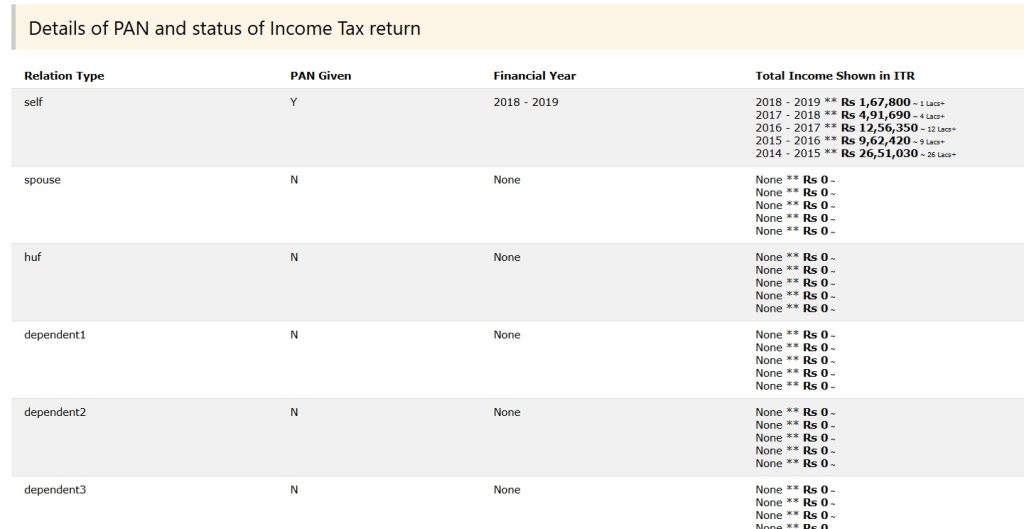
2009-2014 Period: Asset growth of more than 740%
2014-2019 Period: Additional 20% growth despite declared income of only ₹26 lakhs

Declared Income vs. Asset Growth (2014-2019)
- Total declared income: ₹26 lakhs over five years
- Increase in immovable property value: ₹40 lakhs
- Unsecured loans given: ₹62 lakhs
- Total asset increase: ₹76 lakhs
- Unexplained gap: ₹74 lakhs (300% of declared income)
The Worli Property Transaction
The most questionable transaction involves a flat in Mumbai’s Worli area, one of the city’s most expensive neighborhoods. According to electoral affidavits:
- Property: Flat No. 902, Purna Worli Sagar Co-op Housing Society, Worli
- Area: 1,140 sqft total area, 950 sqft built-up area
- Purchase Date: January 1, 2014
- Declared Purchase Cost: ₹2,07,07,000 (over ₹2 crore)
- Current Market Value (2019): ₹3,50,00,000 (₹3.5 crore)
- Classification: Listed as “inherited” despite purchase date
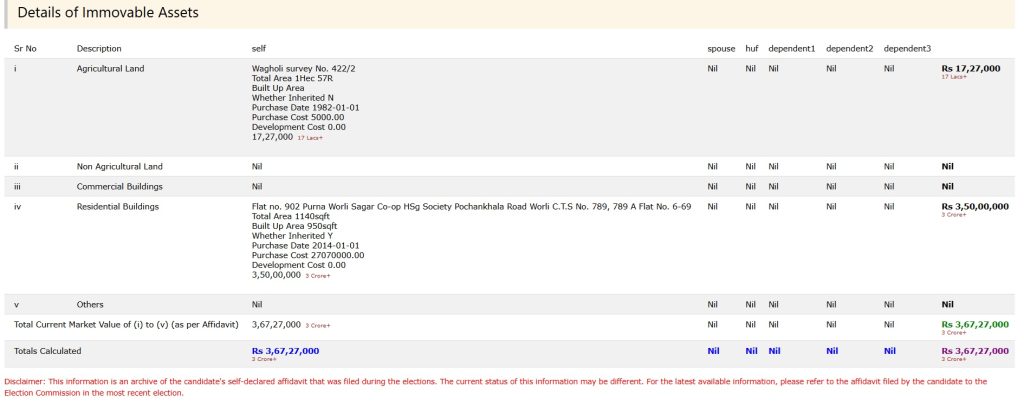
The contradiction is glaring: how can a property purchased on 1 January 2014, for over ₹2 crores be classified as “inherited”?
Agricultural Holdings And Political Connections
Dr. Rajendra Gavai owns 1.57 hectares of agricultural land in Wagholi, an area that has seen massive real estate development in recent years. The Wagholi region has been controversial, with reports of land disputes and property development irregularities.
Property Details:
- Location: Wagholi Survey No. 422/2
- Area: 1 hectare 57 acres
- Purchase Date: 1982
- Original Cost: ₹5,000
- Current Value (2019): ₹17,27,000
The 3,440% appreciation in land value since 1982, while not unusual for prime development areas, raises questions about the timing of purchases and potential inside information about development plans.
So that was about CJI Gavai’s brother Rajendra Gavai. Now let’s move on to the next family member.
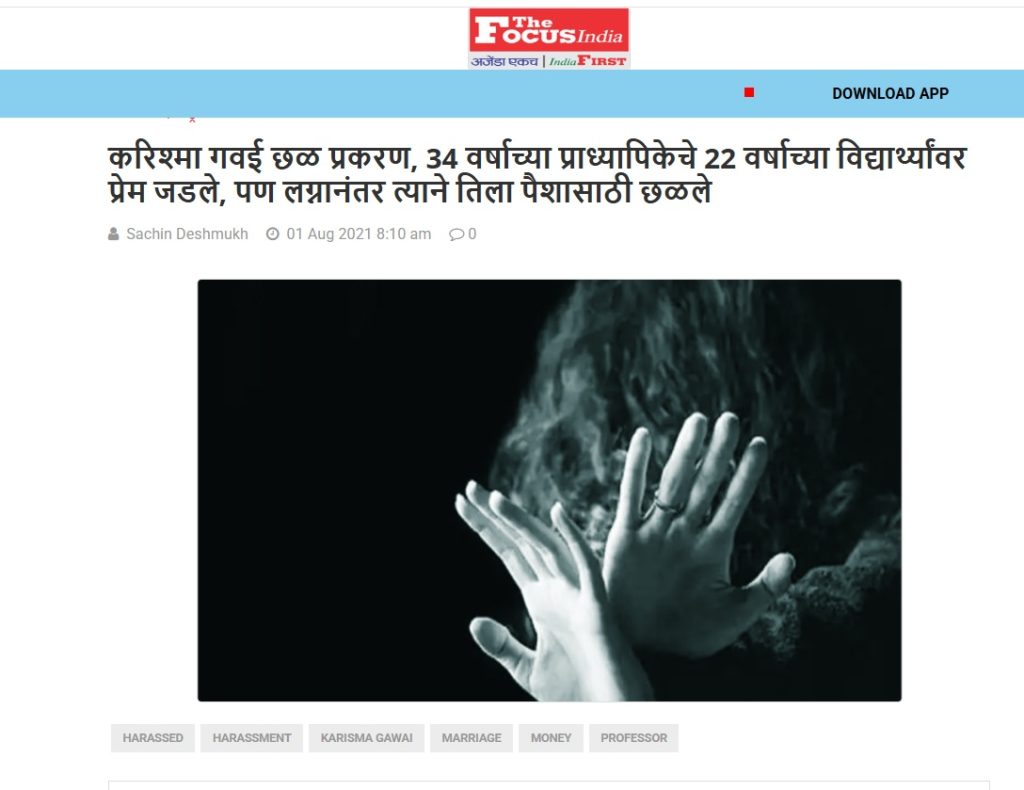
Karishma Gavai: The SC/ST Act Controversy
The most damaging revelations concern CJI Gavai’s daughter, Karishma Gavai, whose actions represent a textbook case of legal privilege abuse and potential misuse of protective legislation.
Academic and Professional Profile
Karishma Gavai’s academic record appears impressive on surface:
- Education: LL. B (2013) from Dr. Ambedkar College, Deekshabhoomi, Nagpur – First rank
- Post-graduation: LL.M in Criminology (2015) from Govindrao Wanjari College – First rank
- Professional Position: Assistant Professor at Maharashtra National Law University, Nagpur (since November 2016)
- NET Qualified: 2015
However, her trajectory raises questions.
Father was a sitting judge of Bombay High Court during her law school years (2013-2015)
Grandfather was Governor of multiple states and MP.
Appointment to prestigious NLU Nagpur position at age 25, shortly after her father’s elevation to Supreme Court.
The Marriage And Legal Battles
The most controversial episode involves Karishma’s brief marriage and subsequent legal actions.
Karishma Gavai allegedly married Palash Darokar, while teaching at a law college. The union was short-lived, ending in a brief and turbulent marriage.
Alleged Misuse Of SC/ST Act And Dowry Laws
In July 2021, while her father was a sitting Supreme Court judge, Karishma Gavai allegedly filed multiple serious cases against her husband and his family including cases under
- IPC Sections 498A (dowry harassment), 323 (assault), 294 (obscenity), 504 (insult), 506 (threats), 34 (common intention)
- SC/ST Prevention of Atrocities Act provisions
- Domestic Violence Act charges
In July 2021, his daughter Karishma Gavai lodged a case under IPC Sections 498a, 323, 294, 504, 506, 34 and SC/ST Act against her Husband and In Laws just few days after her marriage. Police immediately arrested the Husband and his Parents after lodging the case by violating the…
— NCMIndia Council For Men Affairs (@NCMIndiaa) May 19, 2025
The accused were mentioned as Palash Darokar (husband), Purushottam Darokar (father-in-law), Lalita Darokar (mother-in-law), Sanjay Tongse (maternal uncle of husband) and Prashant Tongse (maternal uncle of husband).
The Broader Pattern Of SC/ST Act Misuse
This case exemplifies the exact type of SC/ST Act alleged misuse that legal experts have criticized. Notably, CJI Gavai himself has acknowledged the problem of frivolous cases under these provisions. The irony is palpable: while CJI Gavai criticizes SC/ST Act misuse, his own daughter appears to have weaponized these very provisions in a personal dispute, potentially using her father’s judicial position as leverage.
CJI Gavai’s Nephew Picked By Collegium
Questions about nepotism surfaced publicly after media reported that the Supreme Court collegium recommended a nephew of CJI Gavai, Raj Damodar Wakode (also reported as Raj Wakode), among a batch of names for elevation to the Bombay High Court in August 2025; a selection some commentators said merited public explanation to avoid perceptions of favouritism.
While nepotism concerns arise, CJI Gavai reportedly recused himself from deliberations involving his relatives. Former Justice Abhay S. Oka stressed transparency, urging disclosure of the decision-making process and suggesting amendments to the memorandum of procedure to prevent such controversies.
Financial Irregularities and Undisclosed Wealth
CJI Gavai’s Asset Portfolio
According to Supreme Court disclosures, CJI Gavai’s declared assets include the below.
Real Estate
- Residential house in Amravati (inherited from father)
- Apartment in Bandra, Mumbai
- Apartment in Defence Colony, New Delhi
- Agricultural lands in Amravati and Nagpur
Financial Assets
- Bank balance: ₹19.63 lakhs
- PPF: ₹6.59 lakhs
- GPF: ₹35.86 lakhs
- Gold ornaments: ₹5.25 lakhs
- Spouse’s jewelry: ₹29.70 lakhs
While these declarations appear routine, they must be viewed in the context of the family’s overall wealth generation pattern and political connections.
Last Word
Justice B.R. Gavai’s controversial remarks on Hinduism have thrust him into the spotlight for all the wrong reasons, putting his integrity and impartiality under the scanner. What began as outrage over his words has now widened into scrutiny of his personal and political background, with critics pointing to his family’s entrenched Ambedkarite legacy and long-standing political connections. By stepping into sensitive religious debates, he has invited a level of distrust that undermines the dignity of the Chief Justice’s office. From such a position of power, every word carries weight — and loose remarks only erode the credibility of those occupying that chair.
Subscribe to our channels on Telegram, WhatsApp, and Instagram and get the best stories of the day delivered to you personally.