The DMK government’s freshly released Tamil Nadu State Education Policy 2025 is being touted as a “future-ready” blueprint by the Dravidian Stocks. But a closer reading reveals it to be an ideologically loaded, poorly conceived, and dangerous recipe for disaster that will worsen learning outcomes for lakhs of children.
Beneath the lofty talk of “equity” and “holistic learning” lies a toxic combination of failed experiments and recycled ideas from the National Education Policy (NEP) 2020 — ideas which the DMK has selectively borrowed while rejecting its workable solutions. The policy’s most glaring blunders are its retention of the No Detention Policy (NDP) up to Class 8, the scrapping of the Class 11 public examinations, and its obsession with political symbolism over academic rigour.
The Ghost Of Samacheer Kalvi Still Haunts TN
This is not the first time the DMK has pushed a sweeping education overhaul without considering ground realities. The Samacheer Kalvi (Uniform School Education) system introduced under the late M. Karunanidhi was sold as a measure to bring “quality” education to all. In reality, it diluted syllabus content to the lowest common denominator, eroding competitiveness and widening the gap between Tamil Nadu’s students and their peers from other states in national-level exams.
A decade later, survey data shows that the state is still struggling with poor foundational skills, especially in Mathematics and even in reading basic Tamil. Instead of learning from the Samacheer Kalvi debacle, the new SEP doubles down on similar “feel-good” policies that sound progressive on paper but sabotage rigour.
No Detention Policy: Proven Failure, Yet Retained
The No Detention Policy, retained for Classes 1–8, has been widely discredited. While the SEP dresses it up as “child-friendly” and “supportive,” the reality is that automatic promotion without mastery has devastated learning levels across India.
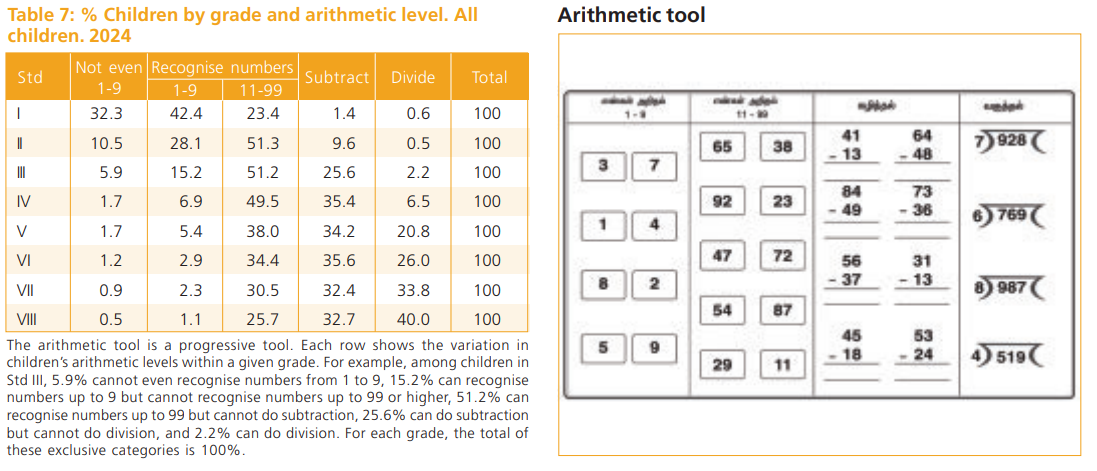
ASER 2024 found that only 43% of Class 5 children in Tamil Nadu could read a Class 2-level text; just 35% could do simple division.
NAS 2024 showed Grade 8 students in Tamil Nadu scoring below the national average in Mathematics and Science.
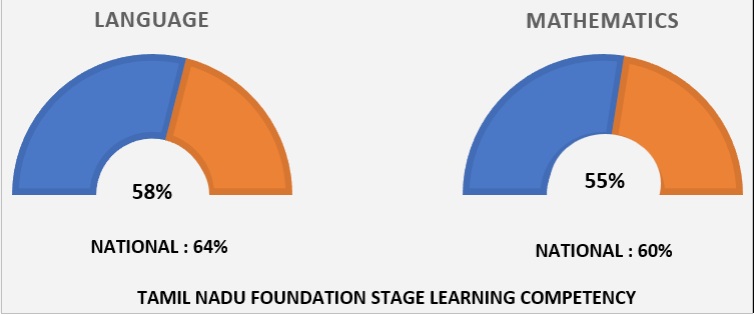
PARAKH’s latest competency data for TN reveals that in Class 8, only 40% achieved minimum proficiency in Mathematics, with rural and disadvantaged groups faring far worse.
Promoting students without holding them accountable for learning milestones has not “reduced stress” — it has locked them into a cycle of ignorance, making later remediation nearly impossible.
Scrapping Class 11 Boards: One More Nail In The Coffin
The decision to abolish the Class 11 public exam is another catastrophic move. The SEP calls Class 11 a “preparatory year” for Class 12, but in practice, it will encourage both students and teachers to skip serious learning in this crucial phase as the syllabus of Class 11 is crucial for competitive exams like NEET, JEE, etc.
With only Class 10 and 12 as “high-stakes” checkpoints, much of the Class 11 syllabus will be sidelined in favour of last-minute rote cramming for the Class 12 boards. This undermines subject depth, critical thinking, and analytical ability — skills already in short supply, as evidenced by Tamil Nadu’s Grade 9 NAS scores (Math: 32%, Science: 36%, Social Science: 35%).
High On Ideology, Low On Innovation
The policy repeatedly invokes “social justice” and “equity” — ideals worth upholding — but in practice, this rhetoric is used to justify watering down academic benchmarks. In fact, the so-called “innovations” in the policy are almost entirely lifted from NEP 2020: competency-based assessment, digital integration, vocational exposure.
What the DMK has added is a political framing that prioritises linguistic imposition (mandatory Tamil even for non-Tamil students) and ideological content over proven, evidence-based strategies to improve quality. Instead of addressing teacher accountability, classroom effectiveness, and syllabus standards, the SEP is preoccupied with cosmetic changes.
The Looming Disaster
The data is unambiguous: Tamil Nadu’s students are already slipping in national proficiency indicators. By retaining failed policies like NDP, removing critical exams, and focusing on political posturing instead of pedagogy, the DMK government is laying the groundwork for a generation of underprepared graduates.
If Samacheer Kalvi was the first major blow to Tamil Nadu’s academic competitiveness, this State Education Policy is poised to be the final, crushing hit. The state risks producing students with high pass percentages on paper, but woefully inadequate skills for higher education, employment, or national-level competition.
In short, the SEP is not a roadmap for educational excellence — it’s a recipe for disaster. And unless the government course-corrects, the real losers will be Tamil Nadu’s children, condemned to an education system that values optics over outcomes.
Vallavaraayan is a political writer.
Subscribe to our channels on Telegram, WhatsApp, and Instagram and get the best stories of the day delivered to you personally.