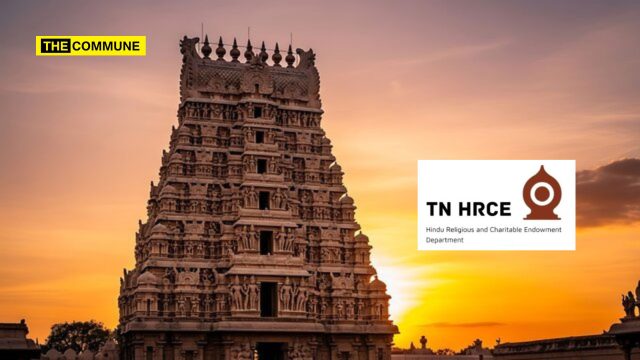
The Hindu Religious and Charitable Endowments (HR&CE) Department’s classification of temples under its “Agama temple survey” has come under criticism from spiritual figures and researchers, who have alleged that several ancient temples have been incorrectly classified as temples that do not follow Agama traditions, as reported in Dinamalar.
According to the classification published by the HR&CE Department, 34,971 temples were examined, of which 7,461 were classified as following Agama traditions, while 27,510 were classified as not following Agama traditions. The latter figure accounts for around 79% of the temples examined. The department has invited members of the public to submit corrections or objections to the published details.
Spiritual figures and temple researchers have, however, questioned the methodology adopted for the classification. They have argued that whether a temple was constructed according to Agama traditions should be determined based on its structure and historical characteristics, rather than solely on its present-day worship practices.
Allegations Of Incorrect Classification
Vijay Narayanan, director of the Aalayam Kaappom organisation, alleged that Agama-related decisions should be taken by temple trustees. He claimed that in temples where trustees had not been appointed, Executive Officers were holding additional responsibility as Thakkars and had signed the Agama reports themselves.
As an example, Narayanan referred to the Madhyapuriswarar Temple at Parakkalakkottai in Thanjavur district.
He alleged that the temple had been classified as a temple that does not follow Agama traditions and as being less than 100 years old, despite being a historical site dating back to the 16th century. He further claimed that the temple’s priest had certified that the temple had conducted its consecration ceremony in accordance with Agama traditions.
Narayanan also alleged that several ancient Chola- and Pandya-period temples in the Thanjavur and Thiruvarur regions had similarly been classified as being less than 100 years old or as non-Agamic temples.
According to him, the court directions were intended to identify temples that were constructed according to Agama traditions and did not require an assessment of whether Agama-based worship was currently being conducted at a particular temple.
He further alleged that Executive Officers signing the Agama reports was contrary to the court’s directions.
Narayanan also claimed that some temples that are more than 1,000 years old had been classified as non-Agamic and alleged that signatures had been obtained from several priests under pressure.
He called for the HR&CE Department to withdraw what he described as an erroneous classification report and conduct a fresh survey involving historians, Agama experts and priests.
What Are Agamas?
Explaining the concept of Agamas, Srilasri Swaminatha Sivachariyar, head of the Sri Maha Sadasiva Peetham in Mayiladuthurai and an Agama expert, said that temples across Tamil Nadu had traditionally been constructed and operated according to Agama principles.
He explained that the Agamas are regarded within Hindu traditions as authoritative texts governing temple construction, consecration and worship practices.
According to him, Shaiva temples follow the 28 Shaiva Agamas, while Vaishnava temples follow traditions including the Pancharatra and Vaikhanasa Agamas.
He further said that temples dedicated to deities such as Mariamman and Durga also follow Agama-based worship practices in accordance with their respective traditions.
Sivachariyar explained that practices ranging from the construction of a temple to the prana pratishtha or consecration of the principal deity are governed by detailed traditional procedures associated with the Agamas.
He maintained that the ancient temples of Tamil Nadu broadly fall within the tradition of Agama temples, while different Agama traditions may be followed depending on the nature and circumstances of a particular temple.
Worship Frequency Does Not Determine Agama Status, Expert Says
Sivachariyar further argued that the presence or absence of certain physical features or the frequency of worship should not by itself determine whether a temple belongs to an Agama tradition.
He said that even if a temple does not have features such as a temple tank or flagstaff, or if worship is conducted only once a day, the temple could still remain within the Agama tradition.
Similarly, he said that the absence of annual festivals would not necessarily mean that a temple had ceased to be an Agama temple.
He added that Agama traditions provide for different categories of priests and worshippers to conduct rituals according to the traditions governing particular temples.
The HR&CE Department’s published list covers 34,971 temples reviewed by the committee constituted for the exercise. The department has provided an opportunity for corrections and objections to be submitted regarding the classifications.
Subscribe to our channels on WhatsApp, Telegram, Instagram and YouTube to get the best stories of the day delivered to you personally.