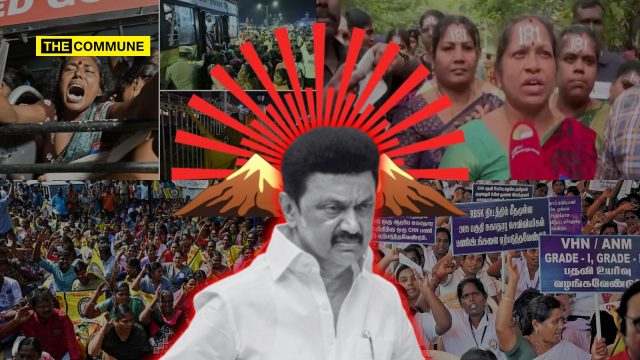
When the Dravida Munnetra Kazhagam (DMK) returned to power in May 2021 under Chief Minister MK Stalin, it did so on the back of sweeping promises to government employees, contract workers, and frontline service providers. From restoring the Old Pension Scheme (OPS) to regularising contract labour and improving healthcare worker pay, the DMK manifesto was framed as a social-justice corrective to what it described as the “anti-worker” policies of the AIADMK.
Five years later, Tamil Nadu is witnessing one of the largest and most persistent cycles of labour unrest in its history. More than 30 lakh government employees and their dependents have been affected by protests, strikes, hunger fasts, police crackdowns and long-running agitations, many of them directly linked to unfulfilled DMK manifesto commitments.
What has emerged is not a series of isolated disputes, but a systemic breakdown of trust between the state and its workforce.
Government Employees & Pensioners: The Old Pension Scheme Betrayal
No promise was more central to the DMK’s 2021 campaign than the restoration of the Old Pension Scheme (OPS). Here is what they said in their 2021 manifesto.
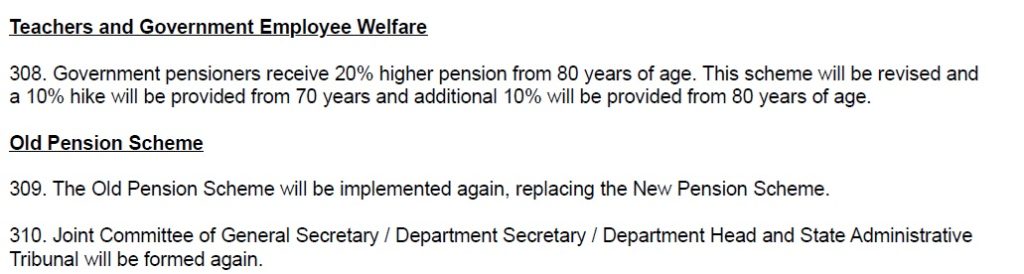
Under OPS, retired employees receive 50% of their last drawn salary for life without contributing from their own wages. In 2003, the AIADMK replaced this with the New Pension Scheme (NPS), forcing employees to contribute 10% of their salary to a market-linked pension fund.
The DMK pledged to reverse this. For 11 lakh government employees, OPS was not a technical issue, it was the foundation of their retirement security.
Yet for nearly four years after taking office, the Stalin government did nothing. Union after union, including the powerful JACTO-GEO, wrote memorandums, held meetings, staged district-level protests and organised hunger strikes. Each time, the government responded with vague assurances and fiscal excuses.
By late 2025, patience snapped. With no movement from the state, unions announced an indefinite statewide strike from 6 January 2026, a move that would have shut down revenue offices, transport departments, schools and local bodies.
Facing paralysis, Stalin announced a last-minute compromise: the Tamil Nadu Assured Pension Scheme (TAPS). It promised 50% of last salary as pension but only after employees contributed 10% every month, just like under NPS. OPS had required no contribution.
Unions accepted TAPS only to avert chaos, but they did so under protest. The central promise that had brought millions of votes to the DMK was, in substance, never delivered. Read here what TAPS is all about.
Teachers: Equal Work, Unequal Pay
Tamil Nadu’s education system is quietly bleeding because of a policy discrimination that has lasted over 16 years.
Secondary Grade Teachers (SGTs) appointed after June 2009 are paid ₹3,170 less per month than teachers appointed earlier, even though they do the same work, teach the same students, and hold the same qualifications. Over a career, this amounts to more than ₹6.4 lakh stolen from each teacher.
The DMK promised to correct this injustice. Here is what they said in their manifesto.
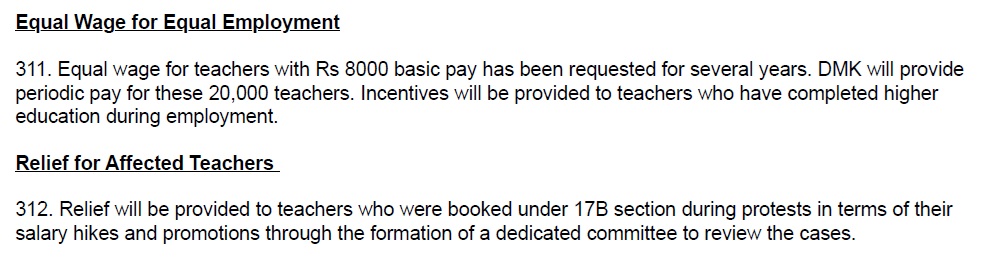
It did not. By December 2025, thousands of teachers were back on the streets. Demonstrations spread across districts, accusing the government of institutionalising discrimination inside public education. Many teachers are now approaching retirement without ever receiving pay parity.
Despite years in power, the DMK has refused to issue a simple administrative correction.
Nurses & Doctors: Frontline Workers Treated as Disposable
The DMK rode to power on the moral capital of the COVID-19 crisis, where nurses and doctors had risked their lives. But its treatment of healthcare workers since then has been devastating.
Contract Nurses
Tamil Nadu runs its hospitals on the backs of nearly 8,000 contract nurses. They earn less than permanent nurses, lack job security, and are denied full maternity benefits. Meanwhile, only 723 nurses are on permanent government rolls.
In December 2025, hundreds of nurses launched a hunger strike in Chennai, demanding regularisation and maternity leave. After police arrests and public pressure, the government regularised only 723 nurses, leaving over 7,000 still trapped in contract labour.
Community Health Officers: Overworked and Underpaid
More than 4,000 Community Health Officers (CHOs) run rural primary health centres. They are the backbone of maternal care, vaccinations and disease prevention, yet they are paid just ₹18,900 per month, less than half of what their counterparts earn in Kerala and Haryana. In December 2025, CHOs marched on Chennai demanding salary parity, maternity leave, and permanent status. They called off their protest after the government acknowledged their demands but offered no timeline.
Sanitation Workers: Dalit Labour and Corporate Contracts
Nowhere is the DMK’s betrayal starker than in Chennai’s sanitation sector. Mostly Dalit women, sanitation workers were promised permanent government jobs by Stalin in opposition. This is what was there in the manifesto.
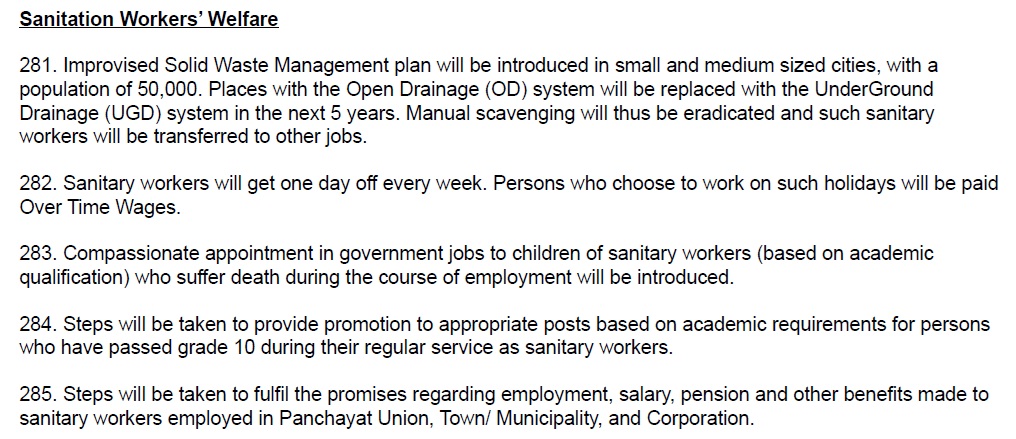
Instead, after coming to power, the DMK expanded corporate outsourcing of garbage collection.
From August 2025, 2,000 sanitation workers sat in protest for over 74 days outside the Greater Chennai Corporation. They lost ₹46 crore in wages, pulled children out of school, skipped medical treatment, and were beaten and detained by police. Their demand was simple: regularisation and an end to privatisation.
The protests continued till January 2026 and only on 12 January 2026, after DMK Minister Sekar Babu met them and promised to resolve their grievances, did they call of their protest. However, it is not clear if they will have all their concerns addressed.
Anganwadi Workers: 4 Lakh Women Still Waiting
Anganwadi workers run Tamil Nadu’s nutrition and childcare programmes – feeding infants, monitoring pregnant women, and preventing malnutrition. Yet they earn just ₹5,000 to ₹8,000 per month.
The DMK made several promises as below.
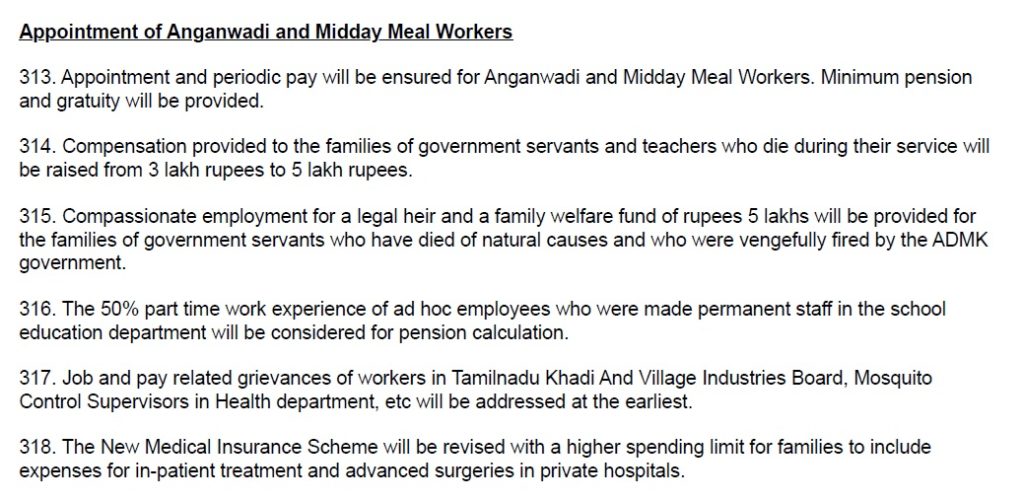
Five years later, nothing has changed. District-level protests began in May 2025, they continued protesting even in December 2025, but the government has not moved.
Midday Meal Workers Go On Indefinite Strike
Midday meal workers across Tamil Nadu are on an indefinite strike from 20 January 2026, demanding the implementation of assurances made by the DMK government during the last Assembly elections. The decision was taken at a preparatory conference held at Thomas Club Hall near Coimbatore Railway Station, presided over by Noon Meal Workers’ Union district president Banulatha and inaugurated by Aranganathan, State Vice President of the All Departments Pensioners’ Association. District secretary Latha said key demands remained unfulfilled, including time-scale pay, promotions for cooking assistants after five years, a minimum family pension of ₹9,000, and filling of vacancies. Over 200 workers attended the meeting and warned the strike would go ahead if demands were ignored.
Dravidian Model – A Government That Only Responds to Pressure, But Just Partially
Across every sector, the pattern is the same grand promises before elections, delay and denial in government, concessions only when protests become explosive, and police action against the weakest workers.
From pensioners to nurses, from teachers to sanitation workers, Tamil Nadu’s workforce is no longer asking for favours, it is demanding what was promised. The DMK did not inherit this unrest. It created it.
Subscribe to our channels on Telegram, WhatsApp, and Instagram and get the best stories of the day delivered to you personally.