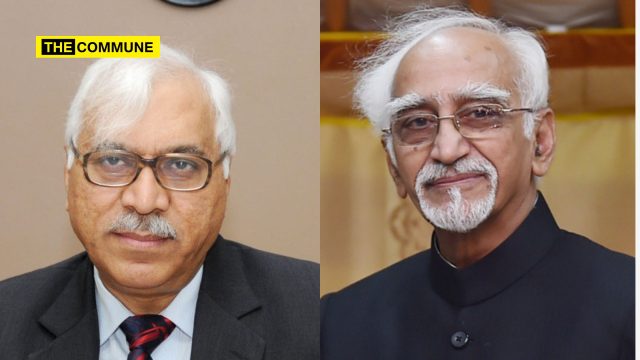
Religious fundamentalism in India isn’t confined to the uneducated or underprivileged. Even individuals in the highest offices judges, diplomats, and constitutional authorities have, at times, allowed personal religious beliefs to overshadow their official responsibilities.
Ironically, while sections of India’s intelligentsia and political left often urge Hindus to embrace secularism and progressive constitutional values, they don’t always hold themselves to the same standard.
Below are three widely discussed examples of prominent Muslim civil servants who have been accused of prioritizing religion over constitutional or national obligations.
#1 Former Vice President Hamid Ansari
Hamid Ansari’s distinguished diplomatic career included ambassadorships to Iran, Afghanistan, and Saudi Arabia, and culminated in two terms as India’s Vice President. Yet, his career post-retirement has been shadowed by a series of serious allegations and contentious statements that have prompted criticism from political and intelligence circles.
a) Allegations From Former Intelligence Officers
In 2019, former RAW (Research and Analysis Wing) officials accused Hamid Ansari of endangering intelligence operations while serving as India’s ambassador to Iran (1990–1992). They claim Ansari failed to protect Indian intelligence assets and may have even exposed undercover operatives to Iranian agencies.
🚨I think it is time to make a film Titled
'The Ansari Files'🚨Hamid Ansari helped Pakistani spies !
🚨 He endangered lives of RAW unit members in Iran !
🚨 He supported anti-India & anti-Hindu organisations like PFI !
🚨 Hamid Ansari participated in Indian American… pic.twitter.com/9syiFbvzeM
— Mona Patel 🇮🇳🐅🌳 (@MonaPatelT) July 14, 2025
One officer alleged that Ansari downplayed the abduction of an Indian diplomat, Sandeep Kapoor, by Iranian intelligence agency SAVAK, failing to report SAVAK’s involvement in his official communication to the Ministry of External Affairs. Another incident involved RAW operative D. B. Mathur, who was reportedly kidnapped after Ansari allegedly leaked intelligence details to the Iranian Foreign Ministry.
I was in Tehran, Iran n Hameed Ansari was ambassador in Tehran. Ansari had played a crucial role in exposing RAW set-up in Tehran endangering lives of RAW unit members. But this very man was made vice President for two consecutive terms.
— NK Sood (@rawnksood) June 28, 2019
Ratan. Sehgal was Addl. Secretary in IB n he was later found to be working for CIA and held passing on documents to a CIA lady agent in Delhi. He should have been arrested, jailed n dismissed. But was asked to resign n allowed to go. Now he is settled in US.
— NK Sood (@rawnksood) July 5, 2019
The RAW officers later submitted a letter to Prime Minister Narendra Modi demanding an investigation into Ansari’s role during his Tehran tenure. They claimed Ansari also collaborated with intelligence officials like Ratan Sehgal to dismantle RAW units in Gulf countries prior to the 1993 Mumbai bomb blasts.
In his book Mission R&AW, former intelligence officer R.K. Yadav reveals how Hamid Ansari, during his tenure as India’s ambassador to Iran, was uncooperative and even obstructive to Indian intelligence efforts. When a R&AW operative was abducted by Iranian agencies, Ansari reportedly showed no urgency, and it took pressure from Atal Bihari Vajpayee to push Prime Minister Narasimha Rao into securing the agent’s release. Yadav also notes that Ansari advised another official, Muhammad Umar, to stay silent after Iranian intelligence tried to recruit him. Umar refused, was abducted and tortured, yet Ansari allegedly told him not to escalate the matter. This period, critical in the formation of global jihadist networks, saw significant intelligence setbacks in Tehran, setbacks Yadav believes gave the Iran-ISI axis leverage and indirectly fueled jihad in Kashmir.
b) Allegations Of Hosting Pakistani Spy
In 2022, Pakistani journalist Nusrat Mirza claimed he visited India on several occasions between 2005 and 2011 to collect intelligence for Pakistan’s ISI, allegedly attending a seminar on terrorism at the invitation of Hamid Ansari. Ansari categorically denied the claims, asserting that invitations to foreign delegates during his tenure were issued based on recommendations from the government, particularly through the Ministry of External Affairs.
While Ansari insisted he neither invited nor interacted with Mirza, the controversy cast a shadow over his tenure, prompting strong reactions from BJP leaders and sections of the media.
c) Wants Sharia Courts
Following his retirement, Ansari made several statements that sparked nationwide backlash. He spoke in favor of establishing Sharia courts across districts in India and claimed to feel “insecure” as a citizen a remark that was widely criticized as divisive.
d) Simping For Jinnah
He also drew attention for attending events hosted by the now-banned Popular Front of India (PFI), a group accused by Indian agencies of fostering radical Islamist ideology and involvement in “love jihad” cases in Kerala. Additionally, Ansari expressed support for students demanding the restoration of Muhammad Ali Jinnah’s portrait at Aligarh Muslim University.
e) Criticizing India To Appease Iran
In 2005, after India voted against Iran’s nuclear program at the International Atomic Energy Agency, Hamid Ansari openly criticized the decision. He remarked that the Indian government had acted based on its own “judgment” a phrase he used to imply bias and argued that the position taken lacked a factual basis.
#2 Former Chief Election Commissioner S.Y. Quraishi
Former Chief Election Commissioner S.Y. Quraishi has also faced allegations of allowing religious identity to influence his public conduct. In April 2025, BJP MP Nishikant Dubey accused Quraishi of facilitating the inclusion of Bangladeshi infiltrators in the voter rolls of Jharkhand’s Santhal Pargana region during his tenure.
In a now deleted post, Quraishi via his X handle, labelled the Waqf Act a “sinister and evil plan to grab Muslim lands.” He wrote, “Wakf Act is undoubtedly a blatantly sinister/evil plan of the govt to grab Muslim lands. I’m sure SC will call it out. Misinformation by the mischievous propaganda machine has done its job well.”
Dubey responded to this sharply, accusing the former CEC of acting with religious bias during his tenure. “You were not an election commissioner, you were a Muslim commissioner,” he posted on X, further alleging that large numbers of Bangladeshi infiltrators were added to voter rolls in Jharkhand’s Santhal Pargana under Quraishi’s watch.
Dubey also invoked historical context to question the legitimacy of expansive Waqf claims, stating that lands before the advent of Islam in India in 712 CE belonged to Hindus, tribals, Jains, and Buddhists. Citing his own village’s destruction by Bakhtiyar Khilji in 1189, and the legacy of the ancient Vikramshila University, he urged citizens to “unite this country” and revisit real Indian history.
आप चुनाव आयुक्त नहीं,मुस्लिम आयुक्त थे,झारखंड के संथालपरगना में बांग्लादेशी घुसपैठिया को वोटर सबसे ज़्यादा आपके कार्यकाल में ही बनाया गया ।पैगंबर मुहम्मद साहब का इस्लाम भारत में 712 में आया,उसके पहले तो यह ज़मीन हिंदुओं की या उस आस्था से जुड़ी आदिवासी,जैन या बौद्ध धर्मावलंबी की… https://t.co/yf8uBjmoYN
— Dr Nishikant Dubey (@nishikant_dubey) April 20, 2025
Subscribe to our channels on Telegram, WhatsApp, and Instagram and get the best stories of the day delivered to you personally.