


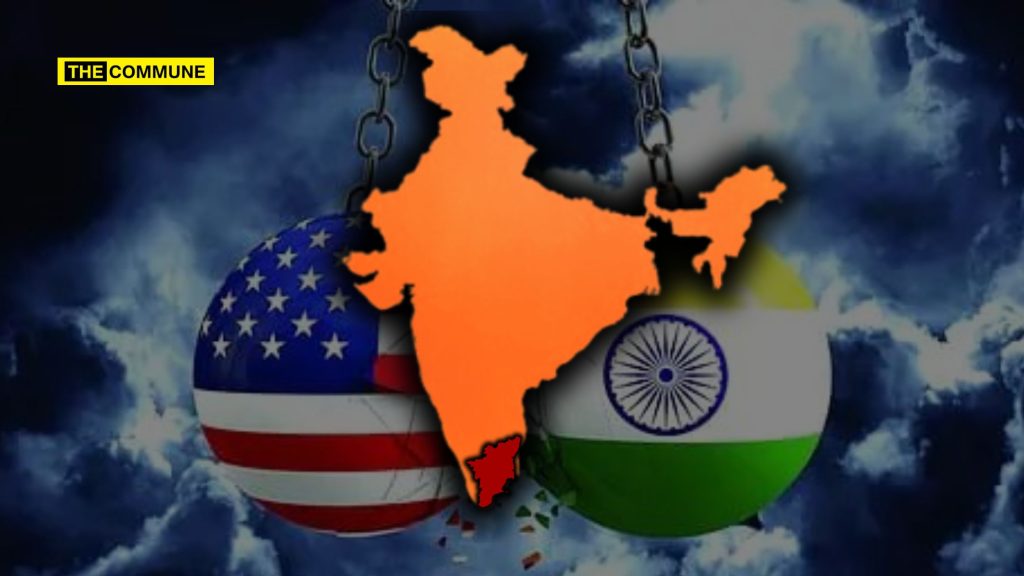
The beginning of the 50% tariff regime by the US a few days ago has caught the world by surprise. Why would the US take this extreme step against a far less powerful country, and too a country which has had increasingly improved relations with it in the past few decades? A country would impose tariffs on an adversary; not on a weaker power that is in no position to attack it militarily or economically.
There are two schools of thought that have tried to understand this seemingly non-intuitive US behavior. The first holds that the US considers India as a country of no significance. It views Russia and China as its rivals. By punishing India, a country of no consequence in its view, it is sending a message to its lesser rival Russia: stop selling your oil or we will punish those who buy it. To its greater rival China, it is making a conciliatory move: we are punishing your major irritant, India, and so you had better behave yourself so we can move to a bipolar G2 world with us two as world hegemons. So much for the popular theory that the US was using India as a counter to China.
The entirely opposite view is that the US is really frightened about an India that is rising rapidly. A country of 1.4 billion people, half of whom are under 30 has sheer people power with favourable demography. India is at a takeoff stage in its military, atomic energy and space programs. It has shown this prowess by downing a US satellite in 2019. A country that can do this is well capable of using this capability in a regular war—in principle, India can attack the continental USA. Joining the dots, it seems more than possible that India inflicted some big damage on installations within Pakistan during Operation Sindoor— damage of a type that made the US, and maybe China as well, realize that they might have underestimated a sleeping giant.
Trump has never been unaware of the potential of India to assume a rank of primary importance in the international high table—if its growth is allowed unchecked for, say 15 years. If India is allowed to grow to $7 or 8 trillion by 2030, it will reach a status when the US and China will have to factor it in, in any geopolitical calculation. Already India is punching above its weight. It continues to buy Russian oil, strengthen its supply chains, begin to exert an influence on the shipping lanes in the Indian Ocean and make its defence equipment. It is no longer the place where computer coolies do low grade back end jobs for Silicon Valley.
India is a valued member of both BRICS and QUAD. The latter was created ostensibly to act as a check on China’s Pacific ambitions. The former sees India, China and Russia trying to de-dollarise the world economy. Imagine the deftness of Indian foreign policy to be able to do this. India now sees itself as a necessary intermediary between nations that have been at odds: Japan and China; Japan and Russia; Russia and Ukraine; Israel and Iran. One doesn’t need to be the policeman of the world. In the new order it is more strategic to be the ambassador of the world. This is Chanakya Neeti. A lesser power can punch above its weight by artfully placing itself as an intermediary between rivals seeking areas of congruence rather than dissonance between them.
No country except India can even try to do this because only India has the priceless ownership of Sanātana Dharma. Only sanatanis seek to resolve rather than exacerbate tensions. This is the real meaning of Vishwaguru. India has realised that it can use its soft power — but only if it has hard power. In my view this is what makes Trump and the US Deep State really anxious about India. Very slowly they are beginning to understand that this primary pagan non-Abrahamic religion is very different from the monotheistic world, which is the only world they have ever known. What is scary to them, because clever Americans are really clever, is that it is this missing X-factor, Hinduism, that gives us the feelings of confidence to punch above our strength today. Will Sanātana Dharma really become eternal? This is the question.
In this context, where economic punishment is hardly likely to deter us, the only tactic that the US can resort to is to encourage our half enemy that is within India—specifically I mean the Congress party and the regional hereditary parties of which the DMK is the most notable. Let us expect increased financial aid to these entities from the US Deep State in the coming months. The US would like nothing better than a weak, entitled and stupid person from the Congress as a token PM of India surrounded by strong regional hereditary satrapies.
Tamil Nadu can well become a big battleground in this conflict between two world systems. It is strong economically, strategically located geopolitically (Straits of Malacca), Kalpakkam is located there, it is close to Sriharikota, it is the home of many defence installations, and above all—and this is the clinching factor—it is an authentic home of Sanātana Dharma with its grand temples, religious orders within the Hindu fold, the cradle of Carnatic music and Bharata Natyam. The people of Tamil Nadu are deeply religious despite 400 years of crackpot Dravidian indoctrination beginning with De Nobili and ending with Udayanidhi. Sterlite Copper was only a pilot plant. The entire state will become a complete factory with large-scale manufacturing.
The biggest reason for the latest American fire and brimstone on India is that it doesn’t want us to succeed and become strategically autonomous. A combination of strategic autonomy with economic self-sufficiency, can catapult Bharat’s civilizational and value based ethos to make it the norm for most of the world barring the Amerisphere. This will be the real Visisht Bharat. Our model will show many countries that are weaker than us that they do not need to abandon their cultural and spiritual values, and struggle to align with the now dying “rules based order” paradigm to appear “modern” in the eyes of the West.
Chanakya tells us that when faced with enemies of different strengths, an aspiring power attacks the most powerful one first. India is doing exactly this by going after the US, ignoring the tariffs, continuing to buy Russian oil, parleying with countries as disparate as Japan, Poland, Israel, UAE and Egypt.
It will be ironic if Tamil Nadu becomes the Dharmakshetra for the first real battle between the global clash of civilizations.
Gautam Desiraju is in the Indian Institute of Science and UPES Dehradun.
Subscribe to our Telegram, WhatsApp, and Instagram channels and get the best stories of the day delivered to you personally.