


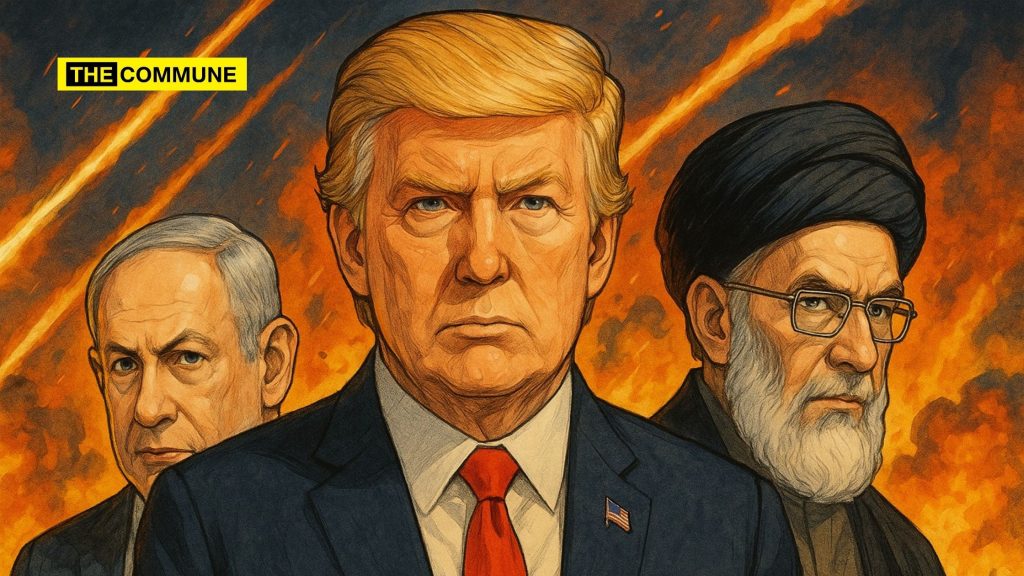
Iran Israel conflict isn’t really about Iran’s nuclear program or assassinating its top leadership. The deeper, long-term objective seems to be regime change. But achieving that is far more complicated than just military strikes or media pressure. There are only a few possible paths to such a change—and none of them look likely at this point.
Case 1: A Ground Invasion
Think back to Iraq. The U.S. gained air superiority over Saddam’s forces in no time, yet regime change required boots on the ground. The same principle applies here. But Iran isn’t Iraq.
- The country’s size, landscape, and defensive depth are completely different.
- The Iranian military is more disciplined and battle-hardened than Saddam’s ever was.
Even if a combined U.S.-Israel ground operation were launched, it wouldn’t be an easy win. Even if they win, it would be long, costly, and messy. And then there’s the possibility of Russia and China stepping in to supply Iran – much like the U.S. is aiding Ukraine. In this scenario, the conflict could be a proxy war dragging on indefinitely, turning into a slowburning, expensive war of attrition.
Case 2: Civil War Scenario
Some might point to Afghanistan (2021) or Syria (2024) as examples of regime change through civil war. But those countries already had fragmented political landscapes and powerful local militant factions.
- Syria endured a brutal civil war for more than a decade. Assad didn’t fall to foreign troops directly but to another faction that rose from within but backed by foreign powers – Al-Sharaa’s group.
- In Afghanistan, Taliban forces didn’t come out of nowhere. They had existed since the days of the Mujahideen’s victory over the Soviets, fought through civil wars, were removed temporarily by the U.S. using local militias like the Northern Alliance, but ultimately re-emerged.
- Iran, by contrast, doesn’t have any such homegrown armed opposition strong enough to attempt a power grab. There’s no militia waiting with foreign support and enough influence, support, or firepower to challenge Tehran.
Case 3: Uprising and Military Coup
Western media loves to highlight public dissatisfaction in Iran. There’s some truth to it. Yes, people are frustrated with the regime’s hardline stance – but the idea that Iran is on the verge
of a mass revolt is often overblown.
West is trying to reinstall Shah Regime in Iran but even among the dissenters, very few are actually calling for foreign intervention or a return to monarchy headed by Shah. And when it comes to the military, the picture gets more complex. Iran has two key forces:
- The Artesh, the traditional army from before the 1979 revolution.
- The IRGC, created by Khomeini to keep the Artesh in check.
Today, the IRGC wields far more power, but the two forces still operate in tandem. Unless there’s a dramatic shift within Artesh—something we’ve seen no signs of—an internal coup looks very unlikely. And let’s not forget: the Iranian public has seen what American regime change looks like in their neighbourhood. Iraq and Afghanistan are their stark reminders.
Most Iranians, even those disillusioned with their leaders, won’t back a movement that opens the door to foreign intervention.
So where does that leave us? Not at a breakthrough. Not at peace. Not even at victory for either side.
We’re looking at a prolonged stalemate. The idea of toppling Iran’s regime may keep popping up in think tanks and newsrooms, but on the ground, the odds are slim. All the
realistic paths to regime change are blocked. The longer this drags on, the higher the global economic costs—and still, the political outcome may be nothing more than a deadlock.
Saiganesh is a political commentator and the founder of Desiyasiragugal YouTube channel.
Subscribe to our channels on Telegram, WhatsApp, and Instagram and get the best stories of the day delivered to you personally.