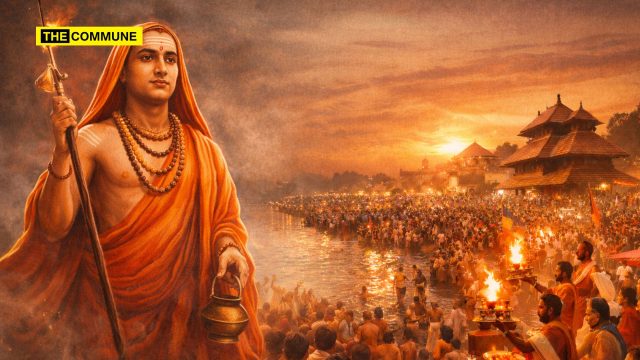
The Mamankam (Maha Makham) Festival is underway in Kerala and will conclude on 3 February 2026. It has been reported that with each passing day, the crowds have been increasing and is a perfect stepping stone to Hindu awakening in Kerala where Hindus are not the majority.
The numbers seem to have caused certain leftist portals a lot of heartburn and they came up with a shoddy narrative to show the Mamankam in a bad light.
On 31 January 2026, leftist rag The News Minute published yet another pathetic episode of “Let Me Explain”. It took nearly two weeks for The News Minute (TNM) to finally assemble an “explanatory” outrage video on 31 January, packaged as investigative journalism. That delay itself is telling: outrage was manufactured, in the most cringest sense.
What Pooja Prasanna’s Let Me Explain episode actually does is not “contextualise” history but force a predetermined ideological narrative onto a living cultural event, using absolutist claims, selective scholarship, and speculative motives.
As always, in this article, we dismantle down their lies one by one.
“Kumbh Has Nothing to Do With Mamankam”: A False Absolutism
TNM repeatedly insists that Kumbh and Mamankam/Mahamakham are fundamentally unrelated, “nothing to do with each other,” “not an oblation festival at all.” This is historically sloppy.
Yes, Mamankam was deeply political, centred on kingship, succession, and ritualised violence. But to claim it had nothing to do with ritual is simply false. Mamankam did involve:
- Ritual bathing in the Bharathapuzha
- Worship at Thirunavaya temples
- Cyclical gatherings every 12 years
- Large-scale fairs combining religion, politics, trade, and spectacle
Likewise, Kumbh has never been a purely spiritual bathing ritual. It has always combined kingship, political legitimacy, trade networks, monastic power, and mass congregation.
A fair statement would be: Mamankam and Kumbh are not identical, but they share structural similarities, and modern organisers are consciously drawing from the Kumbh template.
TNM instead chooses absolutist language to delegitimise the very idea of regional Hindu adaptation.
“It Had Nothing to Do With Hindu or Muslim”: Historical Erasure Disguised as Pluralism
One of the most misleading claims in the video is that Mamankam had “nothing to do with Hindu or Muslim.” TNM is just stripping the context. Medieval Kerala was not a religion-neutral vacuum. Mamankam was anchored in:
- Hindu temples and Brahmin settlements
- Saivite and Vaishnavite ritual orders
- Sacred geography centred on Thirunavaya
At the same time, Muslim merchants and warriors played important roles, including ceremonial and military functions. That shows shared participation, not religious irrelevance.
TNM slides from a valid point (“Muslims were part of the structure”) to an absurd conclusion (“therefore it had nothing to do with Hindu or Muslim”). That leap exists only to delegitimise any contemporary Hindu framing.
The “Northern Imposition” Myth: When Adaptation Is Branded as Colonisation
The video claims that river aarti with multi-tiered lamps is “almost unheard of in Kerala” and therefore an “artificial northern imposition.”
This is historically illiterate. Kerala has long traditions of:
- Deepam and vilakku rituals
- Temple lamp festivals
- Deeparadhana
- Processional lighting tied to sacred geography
What is new is the scale and visual idiom, consciously inspired by Varanasi and Haridwar. That is adaptation, not imposition.
Calling it “artificial” denies local agency and assumes that Kerala’s Hindus are incapable of choosing pan-Indian symbols on their own terms. Ironically, this is cultural paternalism masquerading as resistance.
The South Has Mamankam Too
It is also misleading to suggest that large, twelve-year Hindu river gatherings are somehow alien to the South. Mamankam in Kerala and Mahamaham in Tamil Nadu can examples of this. Though they are not identical festivals, they can be compared to some extent. Both are major assemblies held once every twelve years on or around riverbanks, and this shared duodecennial cycle has led several scholars to group Kumbh, Mahamaham and Mamankam as part of a broader family of twelve-year Hindu commemorations. Where they differ is in their core logic.
Mamankam at Tirunavaya on the Bharathapuzha was a medieval politico-ritual assembly, where kingship, martial display, temple worship and trade converged, and authority for the next twelve years was symbolically contested on the nilapaduthara platform. Mahamaham at Kumbakonam, by contrast, is primarily a ritual bathing and merit-seeking festival, centred on the Mahamaham tank, where devotees believe multiple sacred rivers converge, with little or no political function. It occurs once every twelve years in the Tamil month of Masi (February–March) when the Magam (Magha) star is ascendant – the last in February 2016 and the next scheduled for February 2028.
The existence of Mahamaham alone punctures the claim that Kumbh-style or duodecennial river festivals are a purely North Indian phenomenon being “imposed” on the South.
“The Only Reason Is Hindu–Muslim Polarisation”: Speculation Presented as Fact
Perhaps the most revealing line in the video is the claim that the “only reason” for sacralising the Bharathapuzha is to create a Hindu–Muslim divide in Malappuram. This is just narrative setting – they want to put this seed of doubt in the viewer’s head. And they do it without evidence, just words. TNM projects motive and then treats it as settled truth.
The organisers themselves speak of cultural revival, reconnecting with civilisational roots, and pan-Hindu solidarity. This is what irks the left. One may disagree with that ideology, but disagreement is not proof of communal conspiracy. TNM collapses potential social effects into declared intent, a classic activist trick.
Environmental Alarmism With Selective Memory
TNM invokes pollution at North Indian Kumbhs to raise environmental alarms, while carefully avoiding comparisons with:
- Sand mining in Bharathapuzha
- Long-standing encroachments
- Construction along riverbanks
- Secular fairs and commercial exploitation
All done under the Communist & Congress regimes. But TNM will not open their mouths to question all that.
If “any intervention harms rivers,” then ritual gatherings are not uniquely culpable. TNM’s framing exists to reinforce a narrative: Hindu ritual = ecological threat, while secular or commercial damage fades into the background.
The False Binary: “Secular Heritage” vs “Hindu Spectacle”
The video romanticises 1990s “secular” Mamankam commemorations as neutral heritage while portraying the present festival as ideological distortion. They are just being dishonest.
Both are interpretive projects. Earlier festivals downplayed ritual, temples, and sacred meaning. The current one foregrounds them.
One is not inherently more “truthful” than the other. TNM simply treats its preferred framing as default reality and labels the rest as dangerous revisionism.
The Real Story: Panic Over Hindu Re-Assertion
Mahamakham did not erupt overnight. It unfolded peacefully from 18 January 2026, in public view. TNM’s outrage arrived late because it had to be assembled, not observed.
What truly unsettles TNM is not historical distortion, environmental harm, or communal tension, it is the sight of Hindus reclaiming their Dharma and spaces unapologetically, drawing from pan-Indian symbols without asking for elite approval.
Kerala’s history has always been layered – ritual, political, plural, and sacred at once. TNM’s problem is not with distortion, but with the wrong layer gaining confidence.
And that is why this “explain” video is a hurriedly put together last-minute ideological firefight.
Subscribe to our channels on WhatsApp, Telegram, Instagram and YouTube to get the best stories of the day delivered to you personally.