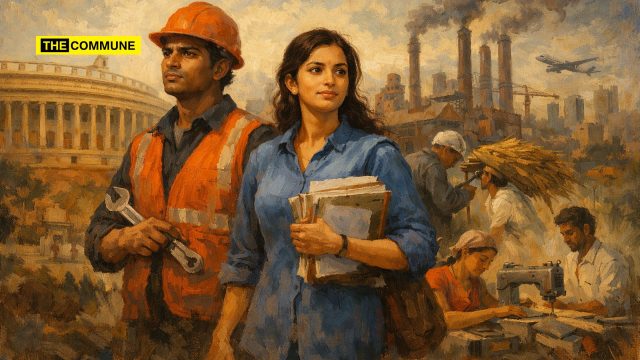
India has been extremely fortuitous to come under resolute, innovative and visionary leadership since 2014, gradually marking a distinct break from the damage perpetuated during Congress regime in every domain.
The Congress regimes presided over outright administrative failure, leaving vital ministries such as the Ministry of Labour & Employment (MLE), Ministry of Micro, Small and Medium Enterprises (MSME) and Ministry of Corporate Affairs (MCA) in a state of collapse due to dreadful mismanagement. Congress incompetence in governance peaked in the heedless institution of almost 29 garbled labour laws which reduced employment opportunities across the nation, ruined many MSMEs and pushed millions of employees into informal jobs.
The present government led by PM Narendra Modi has superseded and consolidated these 29 labour laws into four new, unified Labour Codes, and these codes came into effect on 21 November 2025. These reforms were made by scrapping the old system to create a simplified framework for wages, industrial relations, social security, and occupational safety for India’s working community.
Although labour and trade unions have raised concerns about potentially diluting worker rights, the central government claims that these reforms will enhance welfare and modernize labour regulations, employment practices, and broader worker protection; integrate workers across organised, unorganised, gig, and platform sectors under a common labour framework; and reflect India’s current economic conditions and growth trajectory.
Impact of Labour Law Reforms On Working Community
These historic labour law reforms announced by the central government consolidate different wage rules (Code on Wages, 2019), social security systems (Code on Social Security, 2020), industrial relations procedures (Industrial Relations Code, 2020), and workplace safety provisions (Occupational Safety, Health and Working Conditions Code, 2020).
This amalgamation extensively reduces legal complexity for both workers and employers. All unorganised or informal gig, contract, fixed-term, migrant, and platform workers will be able to avail themselves of or claim the following rights moving forward: wages, welfare schemes, benefits, social security, and work protection from their employers, similar to permanent employees in the organised sector. These provisions became mandatory for employers from 21 November 2025, and employers must comply thereafter.
Workers Legal Rights & Proof of Employment
Workers will now receive official appointment letters as documented proof of their employment terms, which will eventually reduce disputes over the position applied for, wages, and job conditions. This will prevent employers from arbitrarily terminating or exploiting workers or withholding pay or benefits simply because a worker was informally recruited. This inclusion strengthens the negotiating power and legal standing of the working community.
Wage Protection
For the first time in India, all workers across the country, regardless of sector or state of employment, are legally guaranteed a minimum wage, eliminating major wage disparities and inconsistencies across sectors.
Another inclusion is that wages must be paid within a stipulated time frame (the prior month’s salary to be paid by the 2nd, 5th, or 7th of the following month) along with a defined payslip. This ensures workers can see how their salary is structured, including the breakup of basic pay, allowances, overtime, loss of pay (LOP), etc. This provision enhances transparency and fairness and reduces financial stress among workers.
Social Security & Health/Risk Coverage
The incorporation of consistent safety, health, and welfare provisions in the recent reforms enhances workers’ dignity and well-being. This act encompasses crores of workers previously engaged in informal employment, granting them safety and legal recognition and enabling access to mandatory workmen’s compensation, retirement schemes, PF, ESI, pensions, gratuity, maternity benefits, and systematic leave entitlements that were earlier restricted to formal employees.
The OSH Code mandates that employers comply with health and safety norms nationwide. It requires employers to provide welfare amenities such as clean drinking water, adequate sanitation facilities, trained first-aid resources, restrooms, canteens, hazard communication displays, proper ventilation, lighting, and hygienic working conditions.
Work–Life Balance & Higher Pay
Employers cannot compel the workers to work lavishly long hours without their consent, as the workers should be having predictable time schedules that their families and personal lives can rely on. Daily and weekly work time ceilings are standardized. Typical working hours are limited to 8 hours per day and 48 hours per week. Overtime (work beyond these limits) can only be done with the worker’s consent, and the employers are mandated to compensate the overtime at statutory rates (twice the normal wage rate).
This specific measure discourages employers from pushing workers to work long hours, as the government wants to ensure that the workers are having adequate rest and weekly holidays. This reform gives workers leverage and reduces burnout, stress, and health issues tied to their work. This move is particularly beneficial for women, and it strengthens the balance between work and family time.
Uplifting Female Workforce Participation
This is one of the epoch-making reforms in India, as women are now legally empowered and entitled to work in all sectors, right from small shops on the streets to heavy industries with rotational shifts, including night shifts that were previously confined, restricted, and off the map for women, provided safety protocols are observed. These working provisions improve gender equality in employment and encourage more women to engage in diverse sectors.
Women will get to get access to lucrative roles, which will strengthen their financial independence. Employers are mandated to provide ample safety measures for women, such as transportation with security, well-lit workplaces, workstation security, and welfare facilities that are exclusive for women. These measures will lead to rise in female participation in the workforce and augment economic empowerment.
Impact on Indian Economy
These recent labour law reforms are significant for economic growth since the present central government overhauled and retouched a super stern and obdurate labour framework into a more streamlined and simplified system that nurtures productivity, fosters international and domestic investment, and promotes inclusive development. Engaging millions of informal workers in the formal system and providing them a healthy, secure workplace leads to increased productivity, reduced absenteeism and improved accuracy and integrity of India’s workforce as well as economic efficiency.
Increasing female workforce participation leads to broader economic development and helps meet the demographic objectives of Bharat. On the other hand, these reforms also improve ease of doing business, thereby attracting domestic and foreign investment. These reforms strengthen MSMEs and startups as these are engines of job creation in the country besides supporting faster industrial and manufacturing diversification and expansion. A more simplified, transparent, and uniform regulatory framework and common labour codes and practices across the nation will aid employers in having smooth business operations, thereby strengthening their competitiveness, and that will ultimately fuel economic growth.
Congress-Era Labour Law failure
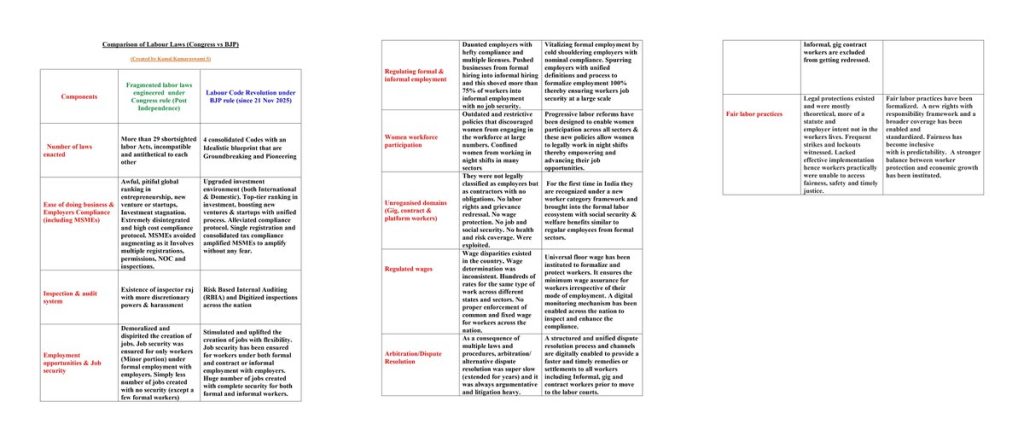
Congress as a party with the collective absence of prescience and innovation created the most topsy-turvy, anti-economic and anti-labour laws that not only jolted the working community into informality but throttled employers in bureaucracy. Most policies designed under Congress were warpaint at best and deteriorating at worst and those made India’s labour market inflexible, pushing international investors to move to flexible labour markets like China, Indonesia and Vietnam. On the other hand, The BJP government introduced an innovative, simplified but comprehensive labour codes aligning with global best practices and that shows India’s preparedness for a competitive and inclusive labour market to the rest of the world.
Comparison of Labour Laws (Congress vs BJP)
Conclusion
These new labour reforms across the board mark one of India’s most sweeping transformations in the work culture since these new reforms are systematizing employment, regulating wages, methodizing work hours, reinforcing the safety norms, and dilating opportunities for women in all the sectors. These reforms impulse India’s transition toward a more comprehensive, impartial, and global-ready labour framework. These reforms will remarkably uplift the status, patronage, contemplation, and security of crores of workers across Bharat. These new reforms not only empowered the workers but have also simplified and optimized employer responsibilities as groundwork for resilient growth model competent in succoring long-term national progress with a fertile and robust economy.
Kamal Kumaraswami is an advocate and writer.
Subscribe to our channels on WhatsApp, Telegram, Instagram and YouTube to get the best stories of the day delivered to you personally.