


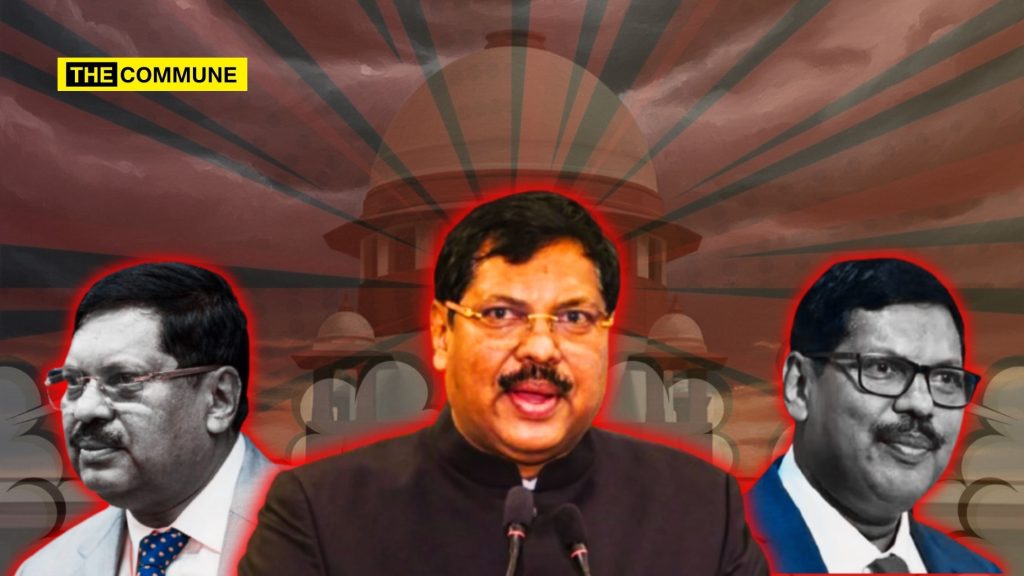
The judiciary of India is often called the last refuge of citizens seeking justice. It is precisely for this reason that the conduct and words of the Chief Justice of India (CJI) matter more than those of any other constitutional authority.
Unfortunately, Chief Justice Bhushan Ramkrishna Gavai has repeatedly demonstrated not only a lack of judicial restraint but also a consistent pattern of comments and orders that betray incapacity to discharge his office with the impartiality, seriousness, and dignity it demands.
His recent statement mocking Hindu devotees seeking restoration of a mutilated Lord Vishnu idol at Khajuraho saw calls for his impeachment. His statement represents not an isolated incident but the culmination of years of biased conduct that warrants his removal on grounds of incapacity as defined under Article 124(4) of the Constitution.
The Legal Framework For Impeachment
The Constitution provides for removal of Supreme Court judges, including the Chief Justice, on two specific grounds: “proved misbehaviour” or “incapacity”. While misbehaviour typically involves corruption or willful misconduct, incapacity encompasses a judge’s inability to perform judicial duties due to physical, mental, or intellectual limitations. More critically, incapacity includes the inability to maintain the impartiality and dignity essential to judicial office.
The impeachment process requires 100 Lok Sabha MPs or 50 Rajya Sabha MPs to initiate proceedings, followed by a three-member inquiry committee comprising a Supreme Court judge, High Court Chief Justice, and distinguished jurist. Parliament must then pass the motion with a special majority in both houses.
He Claims To Be From Humble Background But That’s Not The Case
CJI Gavai’s public narrative has centered on his humble origins, claiming in viral videos that “it was only because of Dr. Ambedkar and the Constitution of India framed by him that a person like me who began his schooling in a municipal school situated in a slum area could reach this position”.
**Father of BR Gavai (CJI)**
Name and Background :
Ramkrishna Suryabhan Gavai, known as Dadasaheb or R.S. Gavai, was the father of Bhushan Ramkrishna Gavai, the 52nd Chief Justice of India.
**Achievements
– Ambedkarite Leadership : Senior leader in the Ambedkarite movement,… pic.twitter.com/gnDX1emh9u— Pip_Quips (@Pip_Quips) September 17, 2025
His father, Ramkrishna Suryabhan Gavai (1929-2015), was far from a common man. Known as “Dadasaheb,” he was the founder of the Republican Party of India (Gavai), served as a Member of Parliament from Amravati, held positions in both Lok Sabha and Rajya Sabha, and was Governor of Bihar, Sikkim, and Kerala. He spent 30 years in the Maharashtra Legislative Council, serving as Chairman, Deputy Chairman, and Opposition Leader.
Justice Gavai himself acknowledged this political connection, stating his father “was associated with Congress for more than 40 years” and his brother remains active in politics.
He said, “My father was associated… Though he was not a Congress member, but he was associated with Congress and very closely…, He was associated with Congress for more than 40 years. He had been a Member of Parliament, Member of Legislature, with support of the Congress and… And my brother is still in politics and is associated with Congress.”
In 2009, Rajendra Gavai’s faction had a pre-poll alliance with the Congress after a disagreement with Ramdas Athawale who aligned with the BJP.
This misrepresentation of his background to claim victimhood while occupying the highest judicial office demonstrates a fundamental lack of integrity and self-awareness that compromises his capacity to serve.
Pattern Of Anti-Hindu Bias: Evidence Of Judicial Incapacity
The Khajuraho Vishnu Idol Case: Judicial Mockery
On 16 September 2025, when petitioner Rakesh Dalal sought restoration of a seven-foot beheaded Lord Vishnu idol at Khajuraho’s Javari temple, CJI Gavai responded with stunning insensitivity: “Go and ask the deity itself to do something now. You say you are such a staunch devotee of Lord Vishnu so go and pray now”. This gratuitous mockery of Hindu religious sentiment, while the matter could have been dismissed on jurisdictional grounds, reveals a deep-seated bias that renders him incapable of impartial judgment.
Selective Application of Religious Sensitivity
The asymmetry in Gavai’s approach becomes evident when contrasted with his handling of minority religious issues. While he readily mocks Hindu devotees, he has shown extraordinary deference to other religious communities. His participation in hearing the appeal against the Waqf Amendment Act and also staying some provisions of the Act – effectively giving voice to the Muslims while simultaneously ridiculing Hindu temple restoration pleas exposes this bias.
The Firecracker Ban Hypocrisy
CJI Gavai has consistently pushed for nationwide firecracker bans, particularly targeting Diwali celebrations, citing pollution concerns. However, he has remained conspicuously silent on environmental damage from Christmas tree cutting or mass animal slaughter during Bakrid. This selective environmental consciousness reveals religious prejudice masquerading as judicial activism.
The Ramcharitmanas Controversy
When Samajwadi Party leader Swami Prasad Maurya made inflammatory remarks against the Ramcharitmanas, potentially inciting book burning, CJI Gavai’s response was dismissive: “Why are you so touchy about these things?”. This casual dismissal of Hindu religious texts’ sanctity while treating criticism of other religious texts as hate speech demonstrates incapacity to apply constitutional principles equally.
Systematic Judicial Overreach And Poor Judgment
Preferential Treatment For Political Allies
Remember CJI Gavai’s father Gavai’s judicial record shows preferential treatment for Congress-aligned figures:
Teesta Setalvad: Granted urgent midnight bail hearings and regular bail despite serious charges of fabricating evidence in Gujarat riots cases.
Rahul Gandhi: Stayed conviction in Modi surname defamation case, citing “wide ramifications” while showing no such concern for other defamation convicts.
Manish Sisodia: Granted bail in Delhi excise scam citing delay, despite the gravity of charges.
Anti-Constitutional Positions On Reservation
While Gavai claims to champion Dalit rights, his push for creamy layer exclusion in SC/ST reservations contradicts constitutional provisions that treat these categories differently from OBCs. His argument that multiple generations shouldn’t benefit from reservations ignores the constitutional understanding that caste-based discrimination requires generational redressal.
Gavai approved 27% OBC reservation implementation in Chandigarh despite the fact that OBCs constitute only 22% of entire population as of 2011.
Anti-Aam Aadmi?
CJI Gavai also dismissed a Public Interest Litigation (PIL) challenging the nationwide rollout of 20% ethanol-blended petrol (E20). The petition argued that older vehicles and some BS-VI models are not designed for high ethanol blends, leading to engine damage, corrosion, reduced efficiency, and higher repair costs. It also alleged that insurance claims linked to ethanol damage were being rejected. The plea sought ethanol-free petrol availability, mandatory labelling at pumps, and disclosure of vehicle compatibility. Citing US and EU practices, it argued for consumer choice. The Court, however, upheld the government’s policy.
Failure To Maintain Judicial Dignity
The office of Chief Justice requires maintaining dignity and avoiding inflammatory statements. Gavai’s pattern of provocative remarks, from mocking deities to making inappropriate analogies demonstrates an inability to uphold the gravitas required for the position.
Poor Case Management And Arbitrary Decisions
His intervention in the stray dog case, where he personally stepped in and constituted a larger bench which modified the earlier Supreme Court orders, shows poor institutional understanding and arbitrary decision-making that undermines judicial consistency.
Constitutional Incapacity: The Core Argument
Incapacity, as interpreted by constitutional experts, includes the inability to discharge judicial duties with the required impartiality, dignity, and constitutional understanding. CJI Gavai’s conduct demonstrates several forms of incapacity:
Intellectual Incapacity: Inability to apply constitutional principles consistently across religious communities, showing fundamental misunderstanding of secular governance.
Moral Incapacity: Lack of integrity evidenced by misrepresenting his privileged background while claiming victimhood and showing bias based on religious and political considerations.
Institutional Incapacity: Failure to maintain the dignity of the office through inappropriate remarks and arbitrary interventions that undermine judicial consistency.
Constitutional Incapacity: Inability to uphold Article 14 (equality), Article 25 (religious freedom), and Article 44 (secularism) equally for all citizens, particularly the Hindu majority.
The Impeachment Imperative
CJI Gavai’s tenure has demonstrated that he serves not as an impartial constitutional guardian but as a partisan actor whose personal biases have compromised his judicial capacity. His anti-Hindu statements, preferential treatment for political allies, misrepresentation of his background, and consistent display of religious prejudice render him constitutionally incapacitated from serving as Chief Justice.
The Constitution’s framers included impeachment provisions precisely for situations where a judge’s continued tenure undermines public faith in judicial impartiality. When the highest judicial officer openly mocks the religious sentiments of the majority community while showing deference to minorities, the very foundation of constitutional secularism crumbles.
CJI Gavai’s conduct has created a constitutional crisis where Hindus cannot expect equal treatment from the apex court. His incapacity to serve all citizens equally, maintain judicial dignity, and uphold constitutional principles makes his removal not just justified but constitutionally necessary.
The time has come for Parliament to exercise its constitutional duty and initiate impeachment proceedings against CJI B.R. Gavai on grounds of incapacity, thereby restoring public faith in an impartial judiciary that serves the Constitution rather than personal prejudices.
No judge, regardless of position, should remain in office when their continued tenure threatens the very constitutional principles they are sworn to uphold. CJI Gavai’s removal would send a clear message that judicial bias has no place in India’s constitutional framework, and that the dignity of all citizens’ religious beliefs deserves equal protection under law.
Subscribe to our channels on Telegram, WhatsApp, and Instagram and get the best stories of the day delivered to you personally.
Subscribe to our channels on Telegram, WhatsApp, and Instagram and get the best stories of the day delivered to you personally.