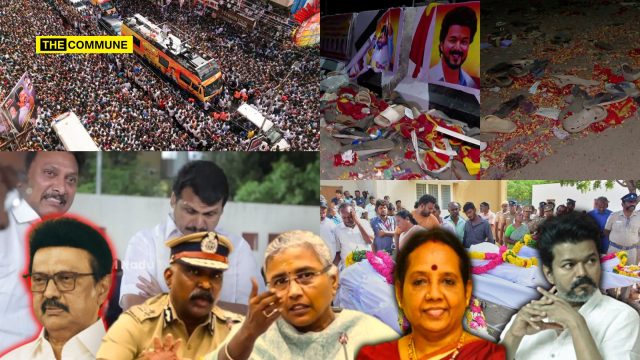
The tragic Karur stampede that claimed 41 lives, including children, has exposed contradictions in the DMK government’s crisis management. Within hours, the Tamil Nadu government deployed top bureaucrats and police officers to hold detailed press conferences, presenting video evidence, timestamps, and crowd analyses that systematically blamed the Tamilaga Vettri Kazhagam (TVK) for the disaster. Yet simultaneously, Chief Minister MK Stalin established a judicial commission headed by retired Justice Aruna Jagadeesan to investigate the same incident.
This approach raises questions about the misuse of taxpayer money. If the DMK government was confident enough to field Additional Chief Secretary P. Amudha, ADGP Davidson Devasirvatham, and other senior officials to present “evidence,” what purpose does an expensive judicial commission serve?
Pre-emptive Damage Control
The September 30 press conference was a pre-emptive strike to control the narrative. Officials presented crowd estimates, security deployment ratios (1:20 instead of the standard 1:50), and minute-by-minute accounts of the incident, including video evidence showing alleged TVK violations.
Additional Chief Secretary Amudha detailed venue selection and crowd management logistics, while ADGP Davidson Devasirvatham offered technical explanations of police deployment and response. Essentially, the government conducted its own investigation before the judicial commission began its work.
The timing was also telling: just hours after TVK chief Vijay released a video statement challenging the government, alleging conspiracy. This suggests the press conference was less about accountability and more about narrative control.
The Commission: Redundant And Wasteful Expenditure
Justice Jagadeesan’s commission appears to be a costly formality, collecting information already analyzed by government officers. The absurdity is clear – the officials who publicly defended the government’s actions will provide the “evidence” to the commission, compromising its independence.
Tamil Nadu has a history of such wasteful commissions. In 2018, the Madras High Court criticized the state for spending ₹4.5 crore on the Justice Regupathy Commission, which remained non-functional for three years. The court emphasized that taxpayer money should be spent judiciously. The same principle applies here: if the government already conducted investigations, why burden the public with another expensive, largely redundant exercise?
The TVK Blame Game
The DMK’s strategy is clear: use bureaucrats to immediately blame TVK while appointing a judicial commission to provide legal cover. FIRs against TVK leaders Mathiazhagan, Bussy Anand, and C.T. Nirmal Kumar echo the government’s press conference points. Interestingly, Vijay himself was not named, suggesting selective targeting to avoid confrontation with a popular actor while targeting his party machinery.
The government highlights TVK’s alleged violations: delayed arrival, inadequate crowd control, ignoring police warnings, and cadres climbing structures. Yet, these also raise questions about government preparedness and security adequacy, questions unlikely to be seriously examined by a commission already fed a government-sanctioned narrative.
Political Insurance At Taxpayer Expense
The judicial commission acts as political insurance. When criticism grows, officials can deflect by pointing to an “independent” inquiry. The commission’s eventual report, likely months away, will provide institutional legitimacy to the government’s version of events, at a cost of crores to taxpayers. The exercise is largely performative, providing political cover while consuming public funds.
By briefing the media before an inquiry begins, the DMK government undermines the credibility of institutional processes. Administrative officers act as investigators, prosecutors, and defenders simultaneously, turning what should be an independent judicial inquiry into a theatrical exercise. Opposition leader Edappadi K. Palaniswami questioned why officials briefed the media when a commission was already appointed.
A Call For Real Accountability
Tamil Nadu’s citizens deserve genuine accountability for the Karur tragedy, not political theater. If the government is confident in its handling, it should present evidence through proper legal channels rather than bureaucrat-led press conferences. If independent investigation is truly needed, the government must avoid prejudicing it through pre-emptive damage control. Conducting both simultaneously wastes public resources and insults the memory of the victims.
The Karur tragedy reveals that institutional processes are being used as political tools rather than mechanisms of accountability. Until this changes, Tamil Nadu taxpayers will continue funding expensive exercises in political theatrics while real accountability remains elusive.
Subscribe to our channels on Telegram, WhatsApp, and Instagram and get the best stories of the day delivered to you personally.