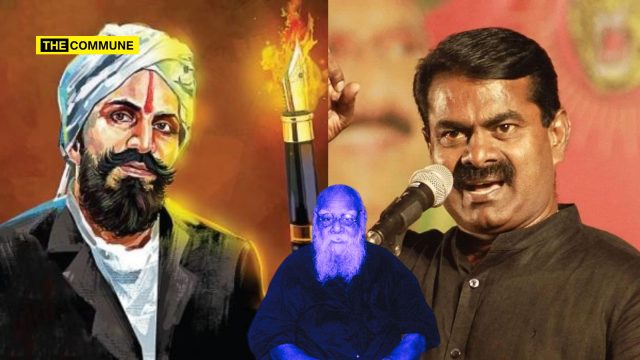
In a fiery, wide-ranging speech delivered on Mahakavi Subramania Bharathi’s birth anniversary, Naam Tamilar Katchi (NTK) chief Seeman launched a profound ideological offensive. Positioning himself as the sole true inheritor of Bharathi’s vision, he systematically sought to dismantle the intellectual foundations of the Dravidian movement, attack its icon EV Ramasamy Naicker (Periyar) and redefine Tamil nationalism within a framework of Indian unity.
‘Bharathi Praised Tamil While EVR Denigrated The Language’
Seeman framed his entire speech as a corrective to historical betrayal, painting a picture of a society that neglected its greatest poet while elevating a figure he portrays as contemptuous of Tamil itself.
He began with a raw emotional charge: “This is indeed a cruel country. That Bharatham starved Bharathi… and the children of the beautiful Tamil race should not forget this.” He directly addressed the ridicule he faces for claiming Bharathi as an ancestor: “When I said Bharathi was my ancestor, they criticized it… ‘Bharathi has become Seeman’s ancestor, hasn’t he?’ everyone questioned.”
His counter-argument was pointed: “When someone who called Tamil ‘misfortune’ (saniyan) is considered my father, why shouldn’t Bharathi, who sang about the sweetness of Tamil, be considered an ancestor?”
This contrast became the core of his attack. He juxtaposed Bharathi’s verse – “‘Among the languages we know, the Tamil language is the sweetest, nowhere to be seen’… ‘Long live the powerful language that measured all that the sky measured’” – with EVR’s statement that “Tamil is a barbarian language (kāttumirāndi mozhi).” Seeman turned this into a searing question for the audience: “If Tamil is a barbarian language, who spoke Tamil?… Who is the barbarian? Is he (EVR) the barbarian? Am I the barbarian? Are you all barbarians?”
Seeman also contrasted Bharathi’s patriotism with what he characterised as anti-Tamil statements by others, asking rhetorically: “If Tamil is a barbarian language, who spoke Tamil? Who is the barbarian?” and rebutting that the poet’s vision of Tamil was universal: “Bharathi sings, ‘Worship the auspicious Tamil country as our mother… It is the land of our wise ancestors.’”
He extended this critique to social reform, arguing Bharathi preceded and surpassed the Dravidian movement. “They say that feminism (penniyam) was spoken about only after the respected Ayya EVR started… But look at Bharathi – he finished singing long before they came to speak.” He quoted extensively: Bharathi’s call to “set fire to the foolishness that degrades women (maadharathamai),” his demand for equality in chastity (“If chastity… is what they want to talk about, let us place it common to both parties”), and his declaration that “Woman is not inferior to man in intellect.”
Seeman then presented a powerful visual argument for Bharathi’s lived feminism, referencing a famous photograph. “Go and look at the picture of our grandfather. Our grandfather will be sitting like this. Our grandmother will be standing behind like this. But in Tamil Nadu, there is only one photograph… Go and look at Bharathi’s house. Chellamma is sitting. Bharathi is standing. Only one picture. Hey, he made Chellamma sit in the chair, and he stood. Feminism stood up.”
He elaborated on this act as a revolutionary, public statement: “In public, they shouldn’t put their hand on a woman’s shoulder. ‘Come, Chellamma,’ he calls, and walks with his hand on Chellamma’s shoulder, majestically.” For Seeman, this was not just poetry but practiced philosophy. “If you want to break an existing principle… and build a new one. The courage to establish that principle… requires more bravery and nerve than a warrior… Our ancestor Bharathi is the great man who shattered the existing tradition and established a new principle.” He concluded this point with a defining praise: “Bharathi is the great man whose writing and life had no gap.”
Redefining “Paarpaan,” Exposing “Brahmin Antagonism” as Political Tool
Perhaps the most provocative segment was Seeman’s address of caste and his redefinition of the term “Brahmin.” He focused on Bharathi’s radical egalitarian line: “There are no castes, Paapa. To speak of high or low birth is a sin.”
He then identified what he called a “great betrayal”: “They taught us that the one who sang ‘There are no castes, Paapa’ was a Brahmin (paarppan).” Seeman offered a stunning reinterpretation: “Bharathi is a Brahmin (paarpaan) because he did not differentiate between high and low birth and treated everyone equally. Now, will anyone call Bharathi a Brahmin?”
He argued that the Dravidian movement’s politics relied on a manufactured enemy. “The same Brahmin antagonism (Brahmana Ethirppu) you used to establish Dravidian presence. I am using that Brahmin crowbar to break down this dilapidated building, ancestor.” He claimed this political need required suppressing Tamil giants like Bharathi: “There should be no identity or greatness for Tamils in history. What is the problem if you praise Bharathi?… Tamil is the problem. His Tamil is the problem.”
Seeman also listed non-Brahmin Tamil scholars and Vaidyanatha Iyer social reformers who championed Tamil and temple entry, questioning EVR’s unique claim as a social revolutionary.
“Not Hindi Ozhiga, But Tamil Vaazhga” – A New Tamil-Indian Nationalism
Moving to linguistic politics, Seeman articulated a principle meant to transcend the traditional anti-Hindi agitations of Dravidian politics. “Our principle is not ‘Let Hindi perish’ (Hindi Ozhiga). It is ‘Let Tamil live long, flourish, and win’ (Tamil Vaazhga).”
He elaborated a vision of mutually respectful linguistic federalism: “I don’t have the right to destroy another person’s mother tongue. I praise, love, and respect his mother tongue. Likewise, I praise, respect, and love my mother tongue. I should be a Tamilian on this land. He should be a Telugu on that land… If everyone is well, India will be well.”
He grounded this inclusive patriotism firmly in Bharathi’s own verses, quoting him at length: “‘Sing praises daily of Hindustan, filled with wealth, Paapa’… ‘We will say Vande Mataram, we will worship our State Mother’… ‘This is the country where my father and mother lived and played happily… Shall I not worship it, saying Vande Mataram, Vande Mataram?’”
Seeman concluded by elevating Bharathi to a divine, timeless figure: “He is the poet who created time. The time-seer (kālagnāni). The seer. The avatar. He is the one man in the world… Tell me something he didn’t sing about.” By declaring himself the “ideological heir” to this comprehensive legacy encompassing Tamil pride, social justice, rationalism, and Indian nationalism, Seeman’s speech was not merely a tribute, but a bold manifesto aimed at supplanting Dravidianism as the dominant political ideology of Tamil Nadu.
Subscribe to our channels on WhatsApp, Telegram, Instagram and YouTube to get the best stories of the day delivered to you personally.