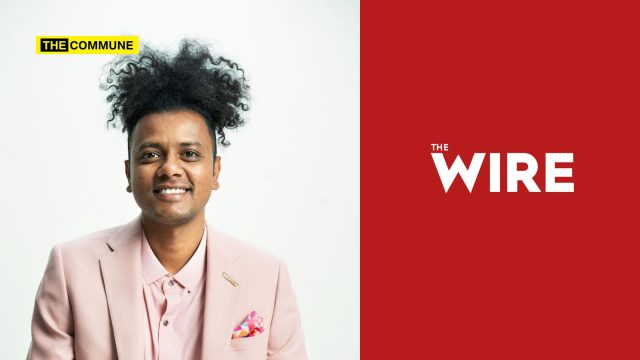
The Wire, in its characteristic posture of victimhood, issued a statement this week calling the controversy around Suraj Yengde’s purported article the work of “hatred and perversity among casteist Hindus.” The article in question, titled “The Case for ‘Dalit Porn’ – Why Bahujan Content Creators Must Conquer this Last Frontier” had reportedly been published on The Wire’s website before being quietly deleted, with no correction notice and no editorial explanation, after screenshots of it went viral on X.
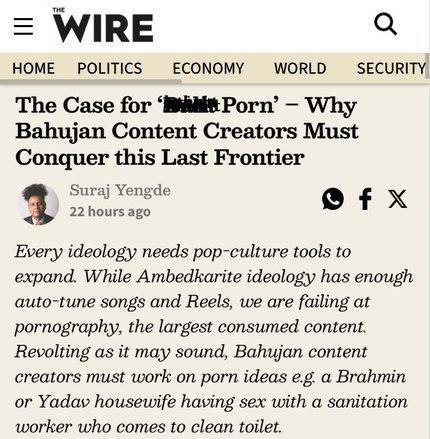
In it, Yengde allegedly made a case for Bahujan content creators to enter pornography as an ideological project framing caste-targeted sexual content as a tool of Ambedkarite liberation.
The Wire’s response to the ensuing outrage was not to acknowledge the deletion. It was to declare the entire article a fabrication by those with “sick minds,” defend Yengde as a “respected Dalit scholar,” and close ranks entirely. Statement issued. Outrage dismissed. Case closed or so The Wire hoped.
Hatred and perversity among casteist Hindus, especially those infected with Hindutva, knows no bounds. Some of them have gone to the extent of fabricating a fake ‘story’ based on their sick minds and tried to pin it on a respected Dalit scholar, and on The Wire. https://t.co/XKYd6g0R9X
— Siddharth (@svaradarajan) March 27, 2026
There is just one problem. The fabrication defence does not extend to Suraj Yengde’s own X feed.
“Brahmin Women Salivate Over Dalit Man. Ask Me.”
In a tweet responding to journalist Dilip Mandal’s post on domestic violence against Brahmin women, a thread that referenced a JSTOR-linked research paper, Yengde did not express solidarity, nuance, or scholarly detachment. He wrote, in plain English: “Brahmin women salivate over dalit man. Ask me.”
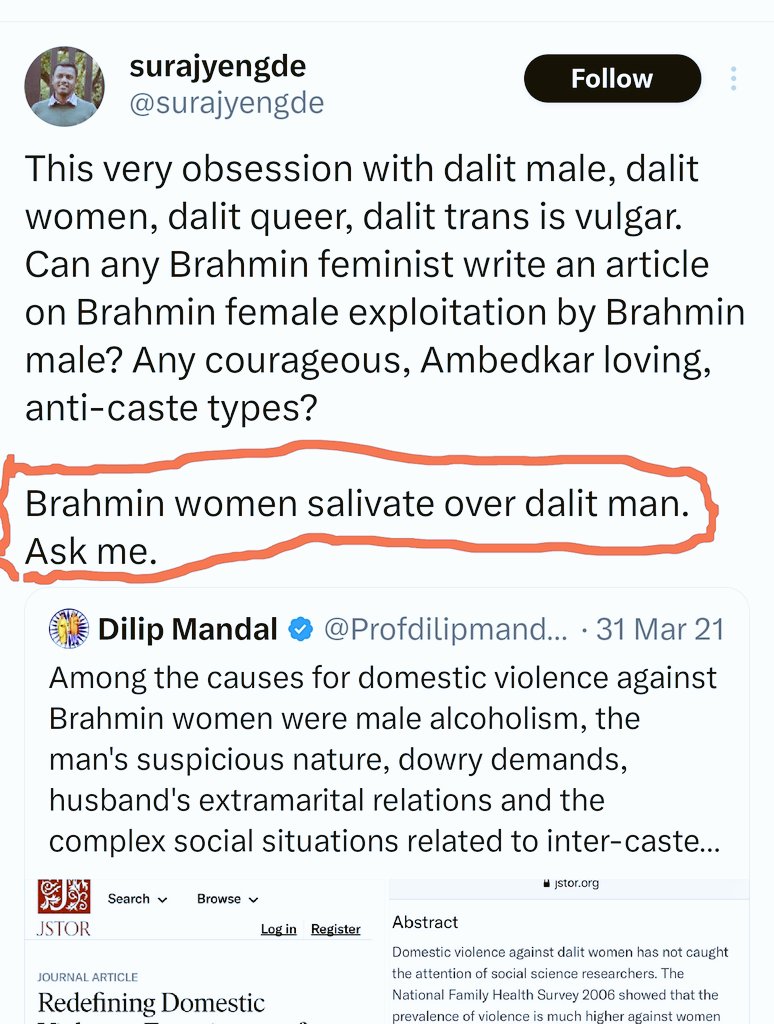
That is not a fabrication. That is not the product of a “sick mind” of any ideology. That was from the handle of Suraj Yengde, the man The Wire calls a respected scholar, reducing Brahmin women to objects of sexualised caste fantasy, in public, on a platform indexed to the world.
Read it again: “Brahmin women salivate over dalit man. Ask me.” The invite at the end “Ask me” is not incidental. It is a boast. It is a man presenting himself as evidence of his own claim about upper-caste women’s desires. And it was published not in a dark corner of the internet but on the public timeline of a Harvard-affiliated academic who regularly writes for India’s self-styled paper of record.
Editorial Response and Prior Statements Don’t Match
The Wire, in its response to the controversy, stated that the purported article did not appear on its platform and described the claims as fabricated. The statement focused on denying the existence of the article and defending its contributor, Suraj Yengde.
However, the response did not address discussions that emerged online regarding Yengde’s previously published social media posts. These posts, which remain publicly accessible, have been cited by netizens in the context of the controversy.
The Wire’s statement framed the controversy as a fabricated campaign but did not address questions regarding the interpretation or implications of the cited social media posts. This has led to continued discussion about editorial judgment, contributor accountability, and the scope of response expected from media platforms in such situations.
Subscribe to our channels on WhatsApp, Telegram, Instagram and YouTube to get the best stories of the day delivered to you personally.