


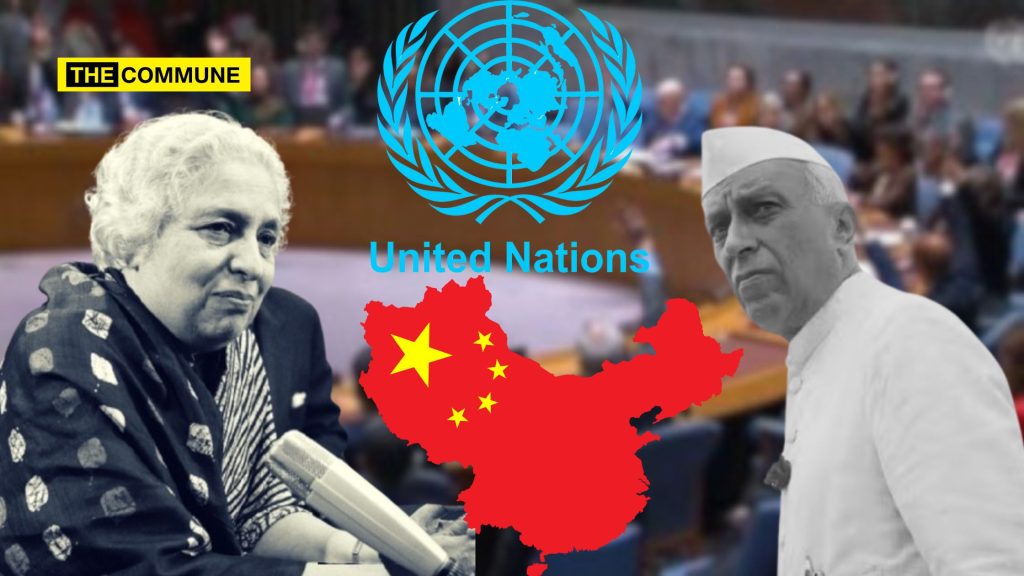
One of the more controversial aspects of Indian foreign policy under Prime Minister Jawaharlal Nehru was the consistent push to support the People’s Republic of China’s inclusion in the United Nations even after China waged war on India in 1962. Despite clear aggression from Beijing, top Indian leaders continued to advocate for China’s representation at the UN, often at odds with India’s national sentiment and strategic interests.
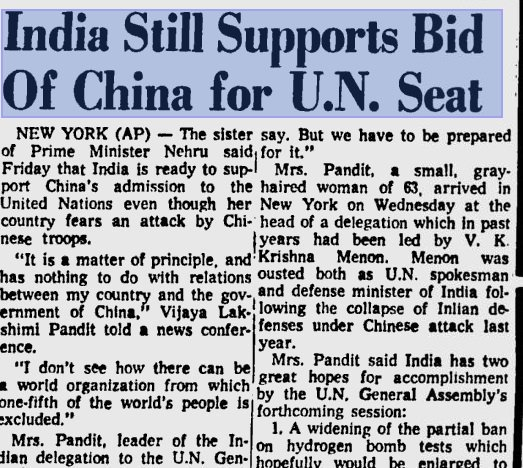
A 1963 article, reportedly from the Associated Press, revealed that India maintained its support for China’s UN seat. It quoted Nehru’s sister, Vijaya Lakshmi Pandit, who headed the Indian delegation to the UN General Assembly at the time. She stated, “India is prepared to support China’s entry into the UN, despite our concerns over Chinese military threats. This is a matter of principle, not bilateral relations.” Emphasizing the importance of inclusivity, she added, “One-fifth of humanity cannot be excluded from a global organization.”
Pandit had taken over leadership from V.K. Krishna Menon, who had lost both his UN and Defense Minister roles after the Indian military’s collapse during the Sino-Indian War. Still, India’s broader diplomatic stance toward China remained unchanged in principle.
The full excerpts read, “The sister of Prime Minister Nehru said Friday that India is ready to support China’s admission to the United Nations even though her country fears an attack by Chi-nese troops. “It is a matter of principle and has nothing to do with relations between my country and the government of China,” Vijaya Lakshmi Pandit told a news conference. “I don’t see how there can be world organization from which mone-fifth of the world’s people is excluded.” Mrs. Pandit, a small, gray-haired woman of 63, arrived in New York on Wednesday at the head of a delegation which in past years had been led by V. Κ. was Krishna Menon. Menon ousted both as U.N. spokesman and defense minister of India fol-lowing the collapse of Inlian de fenses under Chinese attack last year. Mrs. Pandit said India has two great hopes for accomplishment by the U.N. General Assembly’s forthcoming session: 1. A widening of the partial ban on hydrogen bomb tests.”

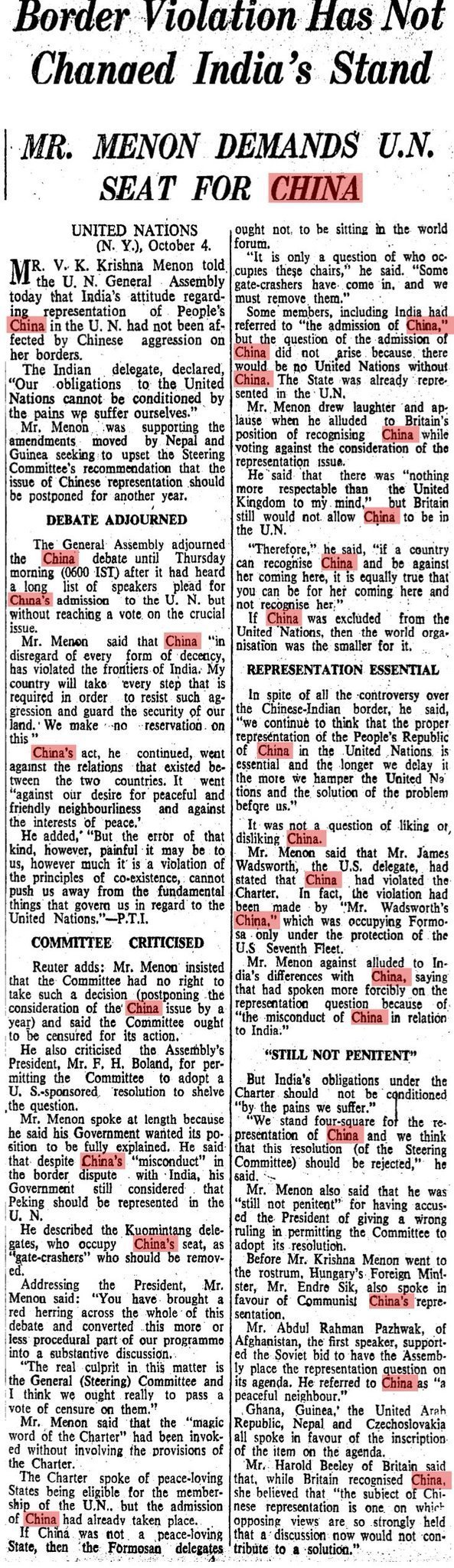
Another report from the same period shows that Krishna Menon, despite having been sidelined, remained firm on the issue. Speaking at the UN General Assembly, he stated that Chinese aggression on India’s borders had “not altered India’s commitment to support China’s rightful place at the United Nations.” Menon asserted that India’s obligations to the UN should not be influenced by the “pain” caused by China’s military actions.
He criticized the Steering Committee’s recommendation to postpone China’s membership discussion and argued for immediate consideration. Menon condemned China’s violation of India’s borders as a breach of peace and friendly coexistence yet insisted that this should not detract from China’s entitlement to representation.
Calling the Nationalist Chinese delegation (from Taiwan) “gatecrashers,” Menon argued that the real issue wasn’t about who liked or disliked China but about the legitimacy of its representation. He stated, “If the world excludes China, which already exists as a state, the United Nations loses relevance.” Menon also highlighted the contradiction in some Western countries—particularly the UK—which officially recognized China diplomatically but opposed its representation in the UN.
Despite China’s “misconduct” on the border issue, Menon said India believed that denying Beijing a seat was a bigger threat to the credibility and function of the United Nations. He even criticized the UN President and the committee for trying to delay the decision, calling it a distraction from procedural norms.
Menon’s impassioned defense drew both laughter and applause at the Assembly. He also challenged the U.S. position, claiming that the real Charter violations were being committed by the Taiwan-based Chinese representatives, supported by American military power in the region.
In closing, Menon reinforced that, “India stands firm on its principles. Our Charter obligations are not conditional on our suffering. We continue to support China’s rightful place at the United Nations.”
Despite the political and military hostilities, Nehru’s administration remained committed to the ideal of global inclusivity and rule-based international order—even if it meant accommodating a hostile neighbor like China.

This is how Prime Minister Nehru shamelessly gave China a permanent seat on the UN Security Council with veto power.
This seat was once offered to India, but PM Nehru turned it down, referring to it as "American Bait," even though India and China were at war in October 1962. pic.twitter.com/J1JId2yBhY
— Rishi Bagree (@rishibagree) January 23, 2025
Subscribe to our channels on Telegram, WhatsApp, and Instagram and get the best stories of the day delivered to you personally.