


The DMK has once again taken a U-turn, now insisting that ideology should take precedence over linguistic or regional identity, a position that directly contradicts its earlier stance where it frequently invoked Tamil pride as a decisive factor in politics.
This position was highlighted in a bid to support the NDA’s Vice-Presidential nominee, C.P. Radhakrishnan, despite his Tamil background. DMK spokesperson T.K.S. Elangovan reiterated that the party does not extend support merely because a candidate happens to be Tamil, stressing that political beliefs and policy positions matter far more than ethnicity.
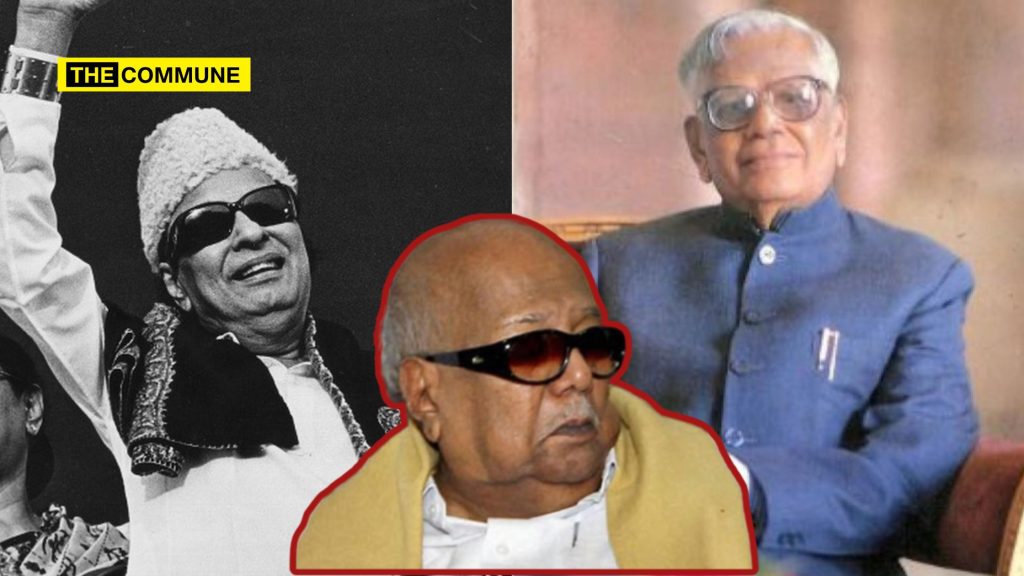
This is not the first instance of DMK dismissing the “Tamilian” factor when it doesn’t suit their political agenda. History offers a parallel in 1987, during the Presidential election, when R. Venkataraman, a distinguished Tamil leader, was nominated. Back then, AIADMK founder and Chief Minister M.G. Ramachandran (MGR) pointedly remarked that “not supporting a Tamilian is their stand” in reference to DMK’s reluctance. DMK patriarch M. Karunanidhi responded by downplaying Tamil identity, stating that “it is important to see what he has done for Tamil people rather than whether he is Tamil.”
MGR, however, had his own reasons for backing Venkataraman, viewing him as not only a Tamil but also a statesman with significant contributions to both the state and the nation.
Who is R. Venkataraman?
Ramaswamy Venkataraman, born in Rajamadam village of Thanjavur district, began his career as a lawyer at the Madras High Court and later at the Supreme Court of India. He was an active participant in the independence struggle, including the Quit India Movement, and later served as a member of the Constituent Assembly and the provisional government. His political career spanned both state and national levels. In Tamil Nadu, he worked under Chief Ministers K. Kamaraj and M. Bhaktavatsalam, handling portfolios like Industries, Labour, and Transport. At the national level, he was elected to the Lok Sabha four times and held key positions such as Union Finance Minister, Defence Minister, Vice President, and eventually the President of India between 1987 and 1992.
Venkataraman is often remembered as the architect of Tamil Nadu’s industrial growth. As Industries Minister in the 1950s and 60s, he spearheaded the establishment of the state’s first industrial estates at Guindy and was instrumental in attracting major public sector undertakings such as the Integral Coach Factory, Neyveli Lignite Corporation, and the Heavy Vehicles Factory. He also encouraged private sector investment, paving the way for companies like Ashok Leyland, Hindustan Motors, TVS Group, and Enfield to set up operations in Tamil Nadu. These initiatives earned him recognition as the father of the state’s industrialization.
At the Centre, his contributions were equally significant. As Finance Minister in the early 1980s, he introduced reforms that promoted economic growth and savings while negotiating a major loan package with the International Monetary Fund. He also oversaw the creation of the National Bank for Agriculture and Rural Development (NABARD). Later, as Defence Minister, he prioritized modernization of India’s armed forces, encouraging diversification of equipment sources and laying the foundation for the Integrated Guided Missile Development Programme, which would eventually produce indigenous systems like Prithvi and Agni. His election as Vice President in 1984 and his role in ensuring stability after the assassination of Indira Gandhi demonstrated his ability to act as a steadying influence during uncertain times. As President of India from 1987 to 1992, he worked with four different prime ministers Rajiv Gandhi, V.P. Singh, Chandra Shekhar, and P.V. Narasimha Rao during the dawn of coalition politics, navigating a turbulent phase in Indian democracy.
Venkataraman’s career stands as a reminder that leadership cannot be reduced to questions of identity alone. While he was undeniably a proud Tamilian, his life’s work reflected a vision that placed nation-building and institutional development above narrow politics. For Karunanidhi, this reinforced the argument that ideology and public service mattered more than linguistic pride. For MGR, supporting Venkataraman was a recognition of his stature as a statesman. Both positions, though opposed politically, underlined the fact that Venkataraman’s contribution transcended the limits of Tamil identity and became part of India’s national legacy.
R. Venkataraman was not only a freedom fighter who actively participated in the Quit India Movement, but also a visionary statesman who transformed Tamil Nadu’s industrial landscape.
As the Industries Minister of Tamil Nadu in 1957, he was instrumental in setting up industrial… https://t.co/PnntTMUBKC
— 𑀓𑀺𑀭𑀼𑀱𑁆𑀡𑀷𑁆 🇮🇳 (@tskrishnan) August 20, 2025
Subscribe to our channels on Telegram, WhatsApp, and Instagram and get the best stories of the day delivered to you personally