The unearthing of Congress-era news continues to this day in the aftermath of the Dhurandhar 2: The Revenge movie release.
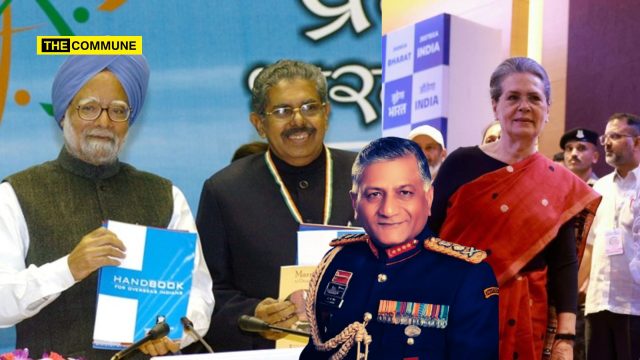
In today’s instalment, we take a look at a time 14 years back in history when the then-UPA government called the army chief ‘a frustrated man’.
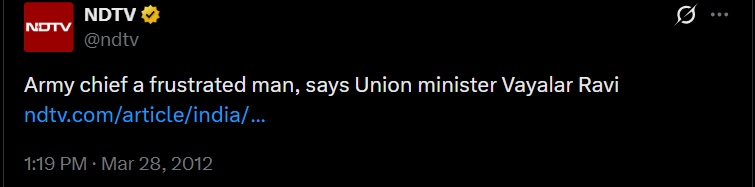
This was reported by several mainstream media.
On 12 March 2012, Army Chief General V.K. Singh wrote a classified letter to Prime Minister Manmohan Singh, warning that India’s military was dangerously unprepared to defend itself against two hostile neighbours – China and Pakistan. India Today and The New Indian Express reported the contents of the letter after it leaked.
What the Army Chief Actually Said
In the letter to the PMO, Gen Singh wrote: “The state of the major fighting arms – Mechanised Forces, Artillery, Air Defence, Infantry and Special Forces, as well as the Engineers and Signals, is indeed alarming.” He urged the Prime Minister to “pass suitable directions to enhance the preparedness of the Army.” The specific deficiencies flagged were:
- The entire tank fleet was devoid of critical ammunition to defeat enemy tanks
- Air Defence was 97% obsolete and could not provide deemed confidence against aerial threat
- Infantry had severe deficiencies in crew-served weapons and lacked night-fighting capabilities
- Elite Special Forces were “woefully short of essential weapons”
- The Army was facing these failures against the “reality of large land borders” and “two inimical neighbours”
Gen Singh also noted that the “hollowness” in the system was caused by slow procurement procedures, a lack of urgency at all levels, and poor work quality.
The Congress Government’s Response: Attack the Messenger
Rather than treating the letter as a national security emergency, the UPA government and its allies turned their fire on Gen Singh:
Defence Minister A.K. Antony told Parliament: “I am aware of the letter and government will take appropriate action at appropriate time. It is a top-secret paper – it should not have been leaked.” His primary concern was the leak, not the crisis.
Union Minister Vayalar Ravi publicly dismissed the Army Chief outside Parliament, saying: “The Army is a disciplined force. (He) could not get an extension even by the court. May be a frustrated man suffers.” He labelled it the “action of a frustrated individual.”
JD(U) leader Shivanand Tiwari, then a UPA ally, attacked the Army Chief directly: “The Army Chief’s conduct is now doubtful. It seems that he is lying. Now that he has got involved in the controversy, he is trying to pass the buck.”
Government sources told the press that the letter amounted to a “breach of protocol” because Gen Singh had written to the PM instead of limiting it to the Defence Minister.
SP and RJD, both UPA allies, publicly demanded the Army Chief be sacked.
Parliamentary Uproar – Against the Chief, Not the Crisis
When the letter became public, Parliament saw an uproar. The opposition’s demand was not that the government address the ammunition shortage or weapons crisis, but that the Army Chief be dismissed for “gross indiscipline.” The government convened a high-level meeting involving PM Manmohan Singh, Defence Minister Antony, and Home Minister P. Chidambaram ,not to fix the military deficiencies, but to assess action against Gen Singh.
What Followed After Retirement
After Gen Singh retired in May 2012 and joined the BJP, Congress threatened him with legal action in September 2013.
In 2019, Gen Singh publicly alleged that two UPA ministers were involved in fabricating a fake “military coup” story in 2012 as a conspiracy to discredit him, and he wrote to PM Narendra Modi seeking a high-level probe into the matter.
The Bottom Line
A sitting Army Chief formally warned the Prime Minister that Indian soldiers were facing two nuclear-armed adversaries without adequate ammunition, weapons, or air cover. The Congress government’s documented response was to call him “a frustrated man,” investigate the letter’s leak, debate dismissing him, and eventually threaten him with legal action after he retired. The ammunition and infrastructure crisis he warned about was, as reported at the time, already an open secret inside the defence establishment.
Subscribe to our channels on WhatsApp, Telegram, Instagram and YouTube to get the best stories of the day delivered to you personally.