


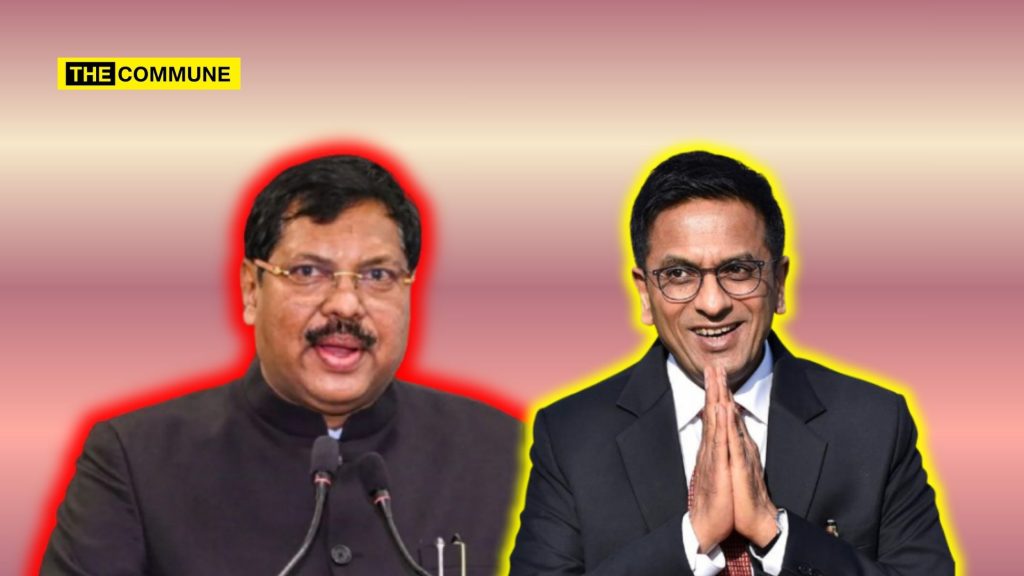
In a development that had unsettled the legal fraternity, the Supreme Court’s administrative wing under Chief Justice B.R. Gavai had written to the Union government demanding the “immediate eviction” of former CJI D.Y. Chandrachud from his official residence in New Delhi. The move, unusually sharp and abrupt, was criticised by many as unnecessary and vindictive.
Traditionally, outgoing Chief Justices are given a grace period of a few months to vacate their government bungalows. In Justice Chandrachud’s case, it turned into a controversy.
The Pressure From CJI Gavai
Sources confirmed that it was the CJI’s office that triggered the eviction process by formally writing to the Centre. The letter argued that Chandrachud had overstayed beyond his allotted time and urged the Housing and Urban Affairs Ministry to initiate proceedings “without further delay.” The uncharacteristic haste has raised eyebrows, especially since past precedents allowed greater flexibility to retiring judges.
For observers, the timing of the letter and its subsequent leak to the media seemed anything but accidental. Coming against the backdrop of growing friction between the legacies of Chandrachud and Gavai, the decision is being read as more than just a matter of “accommodation logistics.”
Why Chandrachud Asked For An Extension
Breaking his silence, former CJI Chandrachud explained why he had not yet vacated. In an interview, he said the government-allotted alternative house was still under renovation, with contractors delaying completion. More importantly, he cited his daughter’s health needs, stressing that the new residence required special modifications including wheelchair access and space for medical equipment.
He said, “Kalpana and I are parents to two special needs children, our adopted daughters. The hard fact which I realized after I retired was of accessibility. You do not have homes, even in a place like Delhi, what about other cities where you could hve access to children who are on a wheelchair? One of my daughters is connected to a tracheostomy tube and a BiPAP machine. Both the children are on wheelchairs. And we found that there are no ramps. If there is a ramp, the lift, there is no lift thereafter to go to the first floor or the second floor. Even within homes, within flats in Delhi, bathroom doors are not wide enough for a wheelchair to enter for a special needs child to use a toilet. This was something that I pointed out to the then Chief Justice that I need two more months to find suitable accommodation. For the two months that you overstay, the government has a standard schedule of rates, market rent for which you have to pay the government. But surely, I do expect that after 25 years of having served the nation, two months, particularly when neither of my successors were going to occupy the home of the chief justice of India, this is not too much to ask.”

Chandrachud revealed that he had personally written to both his successor, CJI Gavai, and his predecessor, Justice U.U. Lalit, seeking an extension. He said he had made clear that he would vacate by the end of June 2025 once the new house was ready. By his account, much of his luggage had already been shifted, and he was “in the middle of packing.”
Extensions Have Precedent
Former CJIs and judges have in the past been granted extensions for medical or family reasons. Chandrachud pointed out that similar requests had been considered sympathetically earlier. Yet, in his case, the Supreme Court administration pushed for eviction, portraying him as clinging to privileges.
Court insiders questioned why the CJI’s office could not show the same flexibility, particularly given the health concerns involved. The speed and tone of the eviction letter and its convenient leak only intensified suspicions that the move was intended to embarrass Chandrachud.
The eviction row was seen less as a bureaucratic tussle over housing and more as an assertion of authority by CJI Gavai over his predecessor.
A Battle Beyond A Bungalow
With Chandrachud confirming he was ready to move, the practical dispute did soon end. But the manner in which the matter was handled, through pressure, leaks, and public spectacle cast CJI Gavai in a deeply negative light. Additionally, we got to see his nature when he dismissed the petition as “publicity interest litigation.” Addressing the petitioner, who identified as a staunch devotee of Lord Vishnu, the CJI remarked: “Go and ask the deity itself to do something now. You say you are a staunch devotee of Lord Vishnu. So go and pray now.”
For many, the bungalow may have been the excuse. The real story is the unmistakable clash of egos, ideologies, and legacies at the very top of India’s judiciary.
(With inputs from Law Chakra)
Subscribe to our channels on Telegram, WhatsApp, and Instagram and get the best stories of the day delivered to you personally.