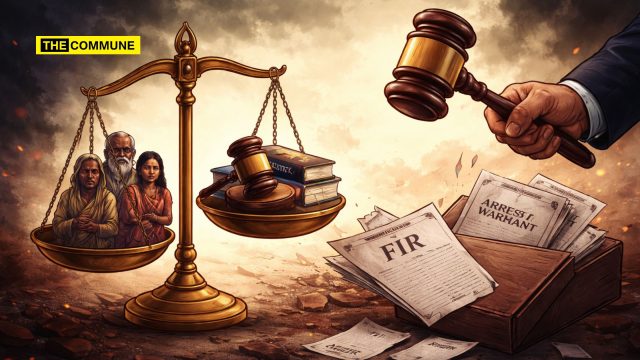
The Supreme Court of India has once again intervened to clarify the application of the Scheduled Castes and Scheduled Tribes (Prevention of Atrocities) Act, 1989, a crucial piece of legislation that safeguards the rights of marginalized communities. This latest ruling signals a persistent judicial effort to strike a balance between the Act’s protective intent and concerning instances of its “farcical” or “vexatious” misuse.
Another Clarion Call from the Apex Court
In its significant judgment in the case of Keshaw Kumar Mahto v. State of Bihar & Anr. (2026), the Supreme Court quashed criminal proceedings where the First Information Report (FIR) and chargesheet lacked specific allegations of caste-based insult. The Court reiterated that for an offense under the SC/ST Act to be established, the insult or intimidation must be motivated by the victim’s caste identity. It cannot be a general act of abuse. This ruling reinforces the principle that the Act is designed to combat systemic discrimination, rather than serving as a tool for personal vendettas or unrelated disputes.
The 2018 Ruling and the Government’s Legislative Response
This is not the first time the SC has addressed the potential for misuse. In its earlier landmark case of Subhash Kashinath Mahajan v. State of Maharashtra (2018), the Court highlighted concerns that the Act has been, at various instances, used to “blackmail” innocent citizens and public servants. To prevent arbitrary arrests and ensure due process, the SC had introduced safeguards, including a mandatory preliminary inquiry before the registration of an FIR and the requirement of prior approval for the arrest of public servants.
However, this ruling sparked widespread protests from those who argued it diluted the Act’s essence. In response to public pressure, the Government of India introduced the Scheduled Castes and the Scheduled Tribes (Prevention of Atrocities) Amendment Act, 2018. This amendment, specifically Section 18A, effectively nullified the 2018 judgment by removing the requirements for preliminary inquiries and prior approval for arrests. It also reaffirmed the “no anticipatory bail” clause, restoring the Act’s procedural stringency and emphasizing immediate action upon a complaint.
Documented Instances of “Farcical” Use
Despite the noble intentions behind the Act, its procedural power has occasionally led to documented instances of misuse. The judiciary has intervened in several key areas:
Private vs. Public Spaces: In Hitesh Verma v. State of Uttarakhand (2020), the Supreme Court clarified that an offense is not established if the incident occurs within a private space. The Act requires the offense to be committed in “public view,” meaning personal altercations in private settings do not automatically fall under its purview.
Delayed and Frivolous Allegations: In Aznan Khan v. State of U.P. (2025), the Allahabad High Court granted bail in a case involving delayed allegations, observing that the rights granted to victims “should not be misused and abused.” The court warned that frivolous complaints risk eroding the credibility of genuine atrocity cases.
Property and Workplace Disputes: Numerous rulings have highlighted cases where civil land ownership disputes or professional rivalries were maliciously reframed as criminal cases under the Act to pressure opponents into settlements or to bypass standard bail procedures. A casual Google search would give us multiple such instances.
A Counter-Perspective: The Reality of Atrocities
It is equally vital to consider the perspective of activists and scholars. NCRB Crime in India Data (2025) indicates over 50,000 registered cases of atrocities against SC/ST communities, marking a rise from previous years. Dalit rights groups argue that under-reporting remains a significant issue and that low conviction rates, often around 30%, are frequently caused by systemic biases and inadequate investigations rather than frivolous filings.
Notwithstanding claims and counterclaims, what remains true and real is the need for an impartial application of such “stringent” laws, without letting personal vendetta and bias come into the picture. The law is meant to be used in a very specific instance, and invoking its provisions because it makes for an easy tool to harass and humiliate your adversaries and extort unreasonably from them is neither fair nor serves the intent of the legislation.
Conclusion
The Supreme Court’s latest ruling in Keshaw Mahto (2026) serves as a crucial check against the arbitrary invocation of the law. By demanding a higher threshold of evidence regarding caste-based intent, the Court seeks to protect innocent individuals from malicious prosecution while preserving the integrity of the Act for genuine victims.
The true spirit of the SC/ST Act can only be upheld through collective responsibility. While the government must ensure the law remains a strong shield for the vulnerable, the common people must understand and recognize that making false allegations is a severe act of slander that harms both the accused and the moral authority of a vital social justice framework.
G Saimukundhan is a Chartered Accountant.
Subscribe to our channels on Telegram, WhatsApp, and Instagram and get the best stories of the day delivered to you personally.