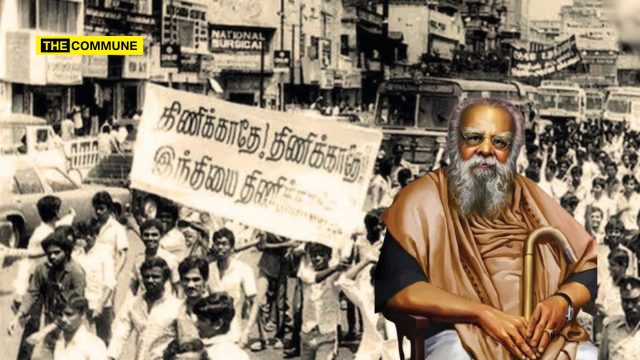
A renewed political debate has emerged over the role of EV Ramasamy (hailed as Periyar by his followers) during the 1965 anti-Hindi agitation, with historical writings and magazine records being cited to challenge the dominant narrative associated with the Dravidian movement.
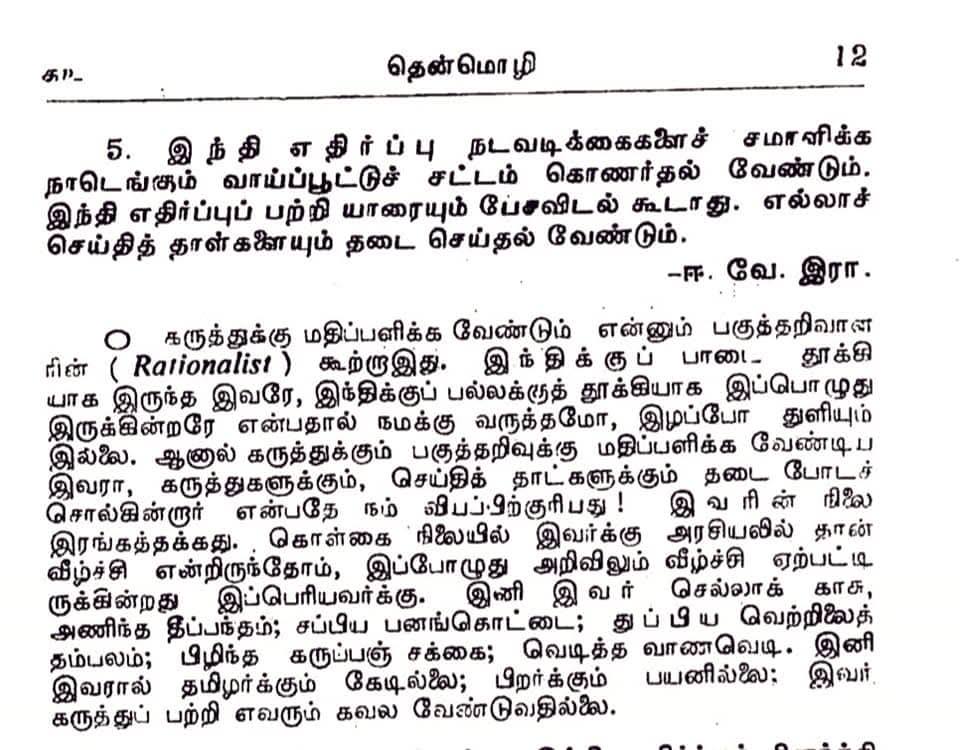
Writings from the period indicate that EVR, despite being projected in later years as the father of the anti-Hindi movement, had in fact taken positions that sharply diverged from the student-led agitation of 1965. According to material published at the time in the magazine Thenmozhi, EVR had asked, “What will be spoiled if Hindi comes? When 13 states accept it, how can you alone oppose it?”
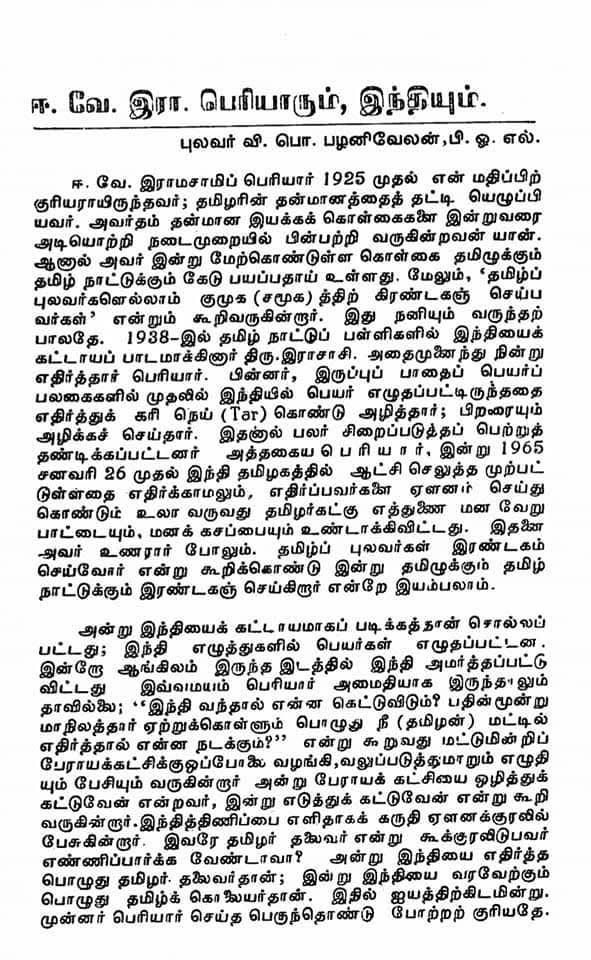
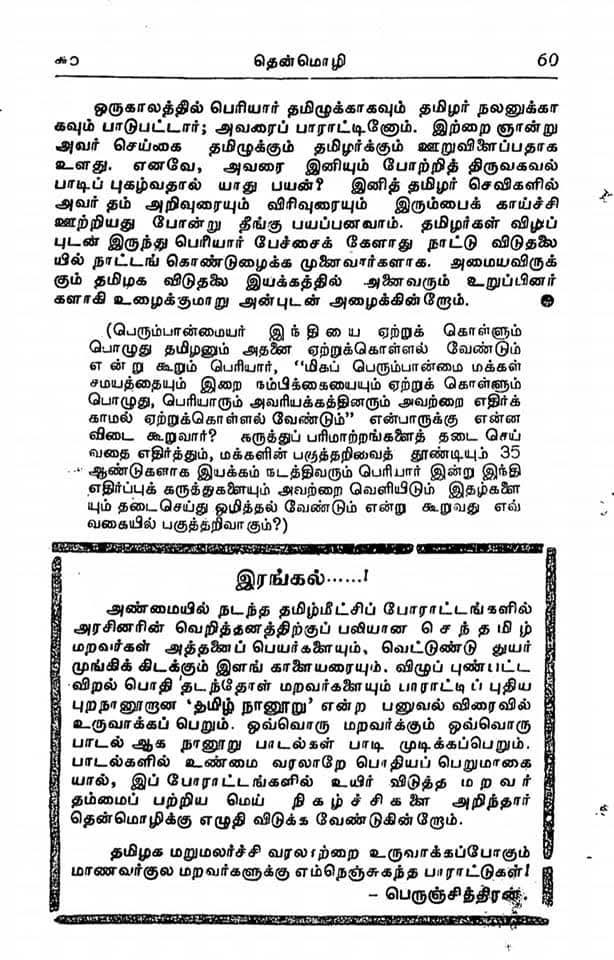
These views were strongly opposed by Tamil scholars and activists. Poet and scholar Pulavar VP Palanivelan wrote in response that “those who call Periyar the leader of the Tamil race are fools.”
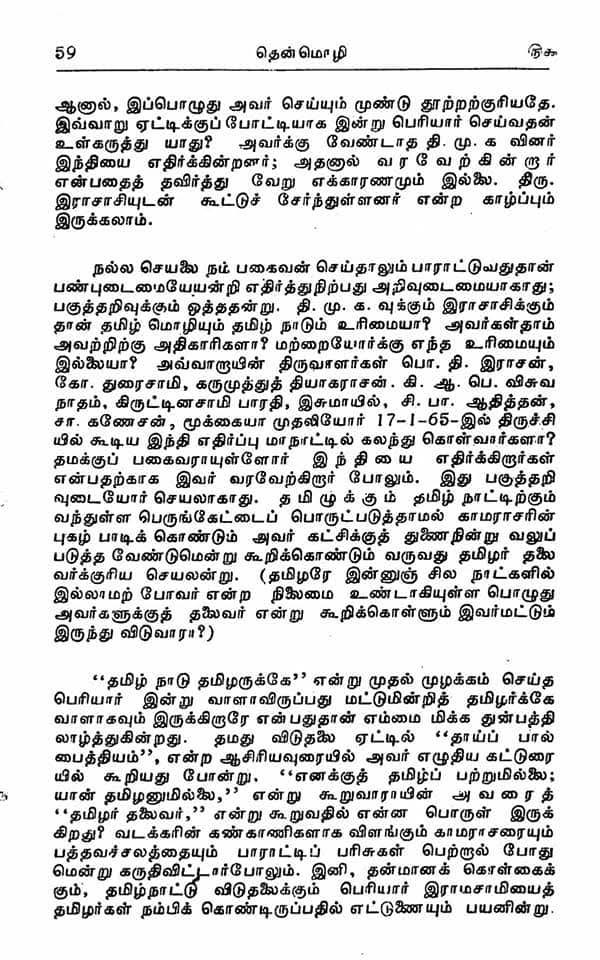
Thenmozhi, edited under the leadership of Devaneya Pavanar and Perunchithiranar, published sustained rebuttals to Periyar’s statements during the agitation.
In Nedumaran’s Kurinji Pongal Special Issue (1965), Periyar was asked about the growing student protests. He replied, “The weakness and leniency of the government are the reasons for the increase of indiscipline and hooliganism among our students.”
While former Chief Minister K Kamaraj had reportedly suggested that the agitation was seen in the North as an attempt to weaken the Congress, Periyar went further, describing it as “a hooligans’ agitation” and saying the Congress government had failed by not suppressing it.
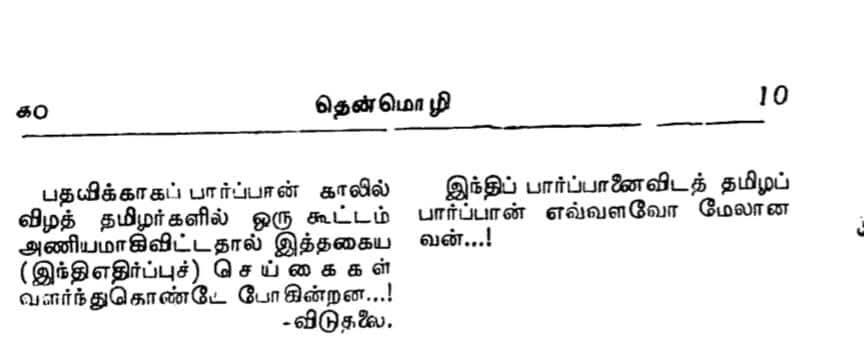
At the same time, C Rajagopalachari (Rajaji) wrote that “English alone is the path to unity” and warned that opposing Hindi would create divisive feelings. EVR, writing in Viduthalai, responded by sharply criticising the DMK, stating, “Because a crowd has got ready to fall at the feet of Brahmins for the sake of positions, such anti-Hindi activities are growing.”
Thenmozhi countered this by writing, “The Tamil Brahmin is far superior to the Hindi Brahmin,” a remark widely interpreted as accusing Periyar of aligning himself with North Indian elites rather than Tamil interests.
This exchange reportedly led to heightened tensions, after which Periyar proposed drastic measures, declaring, “Do not worry about elections. Declare both the Swatantra Party and the ‘teardrop’ (DMK) illegal and ban them. Ban all newspapers. Impose a gag law so that no one can speak about the anti-Hindi issue.”
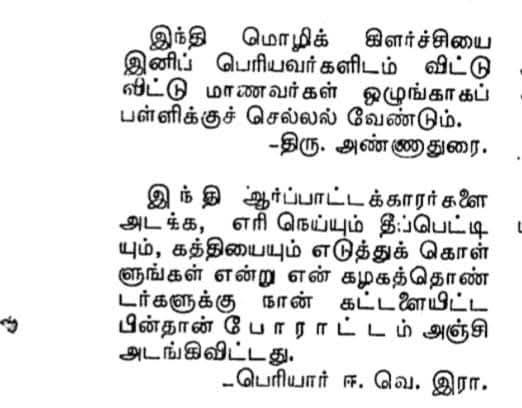
As protests intensified and turned violent, marked by police firing, student deaths, and suicides, CN Annadurai called on students to step back, stating that the agitation should be left to elders and that student violence had no connection with his party.

EVR, however, later wrote in Viduthalai (1965), “Only after I ordered Kazhagam cadres to take burning ghee, matchboxes and knives to suppress the Hindi agitators did the agitation fearfully come to an end.”
In later years, Periyar also criticised Tamil nationalist rhetoric itself. In a 1967 article in Viduthalai, he wrote, “Those who cannot make a living in any other way in our country try to survive in the name of Tamil. Their desperation is what appears as cries like ‘Tamil must be protected’, ‘I will work for Tamil’, ‘I will die for Tamil’. Other people should not get trapped and deceived by this.”
Large sections of Dravidian politics have sought to downplay or erase these aspects of EVR’s record. These writings raise questions about how the history of the anti-Hindi movement has been presented, and whether there is room today for an open and structured debate on EVR’s role during one of the most turbulent chapters in Tamil Nadu’s political history.
(This article is based on a Facebook Post By Sundararaja Cholan)
Subscribe to our channels on Telegram, WhatsApp, and Instagram and get the best stories of the day delivered to you personally.