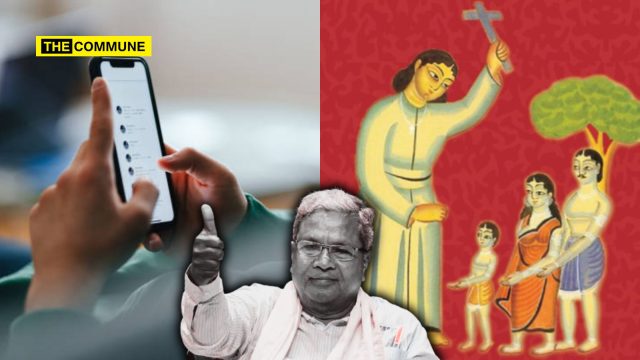
The Siddaramaiah-led Congress government tabled the Karnataka Hate Speech and Hate Crimes (Prevention and Control) Bill, 2025, in the state assembly on 8 December 2025, sparking immediate and intense controversy. While the government presented the legislation as a necessary framework to uphold “dignity,” “equality,” and “protection for all communities,” a detailed examination of the text has led to forceful accusations from critics and legal experts that the Bill is a precision-crafted instrument designed to suppress Hindu speech, festivals, and dissent under the guise of maintaining harmony.
The proposed law introduces broad and subjective definitions, unprecedented criminal liabilities for online activity, and sweeping powers for authorities, creating what opponents are calling a “digital weapon of mass destruction” aimed at the majority community.
A Sweeping Definition Of “Harm” That Criminalises Hindu Speech By Default
The Bill defines harm to include emotional, psychological, social or economic injury. This definition is deliberately vague and allows almost any Hindu assertion – religious, cultural or political to be reframed as an offence.
Hindu views on proselytisation, communal violence, doctrinal exclusivity or religious supremacism are already routinely labelled “hate-filled” or “majoritarian” in public discourse. With the Bill in place, these labels acquire criminal force. A Hindu questioning conversions could be accused of causing “emotional harm”. A Hindu highlighting violent patterns could be said to have inflicted “psychological harm”. A Hindu critiquing exclusivist creeds could be blamed for “social harm”.
The Karnataka government seems to have revived the same vague standards that led the Supreme Court to strike down Section 66A, but in an even more expansive form.
This could also lead to cross-state FIRs becoming a routine. As one scenario illustrates, a person in Delhi commenting on Islam or Christianity even within documented textual descriptions could face an FIR in Karnataka if any individual in the state claims emotional or psychological injury.
Let us take the example of former BJP spokesperson Nupur Sharma, whose life was upended after allegations of hurt sentiments – that case is a preview of how such provisions may operate in practice.
Criminalising Forwarding, Sharing And Even Unintentional Involvement
A key point of alarm is the Bill’s criminalisation of “unknowing assistance”. The term converts everyday digital behaviour into a legal minefield.
Under this clause, forwarding a WhatsApp message, sharing a news article, retweeting satire or circulating commentary could become an offence if someone alleges emotional or psychological harm. Intention becomes irrelevant; facts become irrelevant; context becomes irrelevant.
If one analyses FIR patterns, one can notice that online speech cases in recent years have largely targeted Hindus questioning conversion activities, radicalisation, demographic aggression or violent street mobilisation. Now this new Bill makes this process significantly easier and faster.
The provision seems to be creating a “digital weapon of mass prosecution aimed at the majority”.
A Mechanism That Allows Volatile Groups To Veto Hindu Festivals And Gatherings
The Bill grants District Magistrates sweeping authority to restrict gatherings, processions, loudspeakers and public events if any community raises “apprehension”. This clause seemingly hands disproportionate power to groups that threaten unrest.
One can observe the recurring tensions around Ramanavmi, Hanuman Jayanti and Ganesh processions. Under the new framework, instead of controlling those who threaten violence, authorities may simply cancel the Hindu procession.
Hence, the more volatile a group becomes, the more administrative power it gains; the more peaceful a Hindu festival is, the more vulnerable it becomes to cancellation. This is a statutory codification of Congress’ long-standing model of “peace” – a model that relies on silencing Hindus to avoid upsetting specific vote banks.
Exemption For Proselytisation – The Bill’s ‘Most Revealing’ Clause
Observers highlight a specific exemption protecting “bona fide interpretation and espousing of religious tenets”, explicitly including proselytisation. This is the single most telling provision in the Bill.
At a time when aggressive conversion campaigns in rural Karnataka have been linked to inducement, deceit and foreign-funded networks, the government has chosen not only to ignore these issues but to provide missionary activities a legal shield.
The exemption itself is proof that proselytisation generates emotional and social distress and that instead of addressing that distress, the Bill criminalises Hindu resistance to it.
This provision can be seen as giving a free hand to run conversion rackets without fear of consequence.
Immunity For Officials, Liability For Citizens
The Bill gives sweeping immunity to government officials for actions taken “in good faith”. Combined with vague definitions of harm, this creates total asymmetry: the state acts without accountability while the citizen faces limitless criminal exposure.
A police officer can book a Hindu social media user for satire or commentary without fear of consequences; an officer can restrict a Hindu procession citing “apprehension” from another community and remain protected.
This structure can be seen as producing fear-based governance, not law and order.
The Bill Will Likely Fail Any Serious Legal Test
Legal scholars opposing the Bill argue that it violates established constitutional principles. They point out that restrictions on speech must be narrowly defined, emotional or psychological harm is not grounds for restriction under Article 19(2), there must be a direct link to incitement of violence.
Critics warn of a severe chilling effect, arguing that fear of criminal complaints will push Hindus into silence long before any court evaluates the legality of the provisions.
The Bill seems to be designed less to secure convictions and more to cultivate hesitation, to make Hindus second-guess criticism of conversions, extremism or policy decisions.
Part Of A Long Ideological Pattern?
The Bill can be framed as a continuation of Congress’ historical approach to regulating speech. One can look at Nehru’s First Amendment restricting free expression, Indira Gandhi’s Emergency suppressing civil liberties, the UPA’s Section 66A disproportionately used against Hindu social media users.
Communities which riot over perceived slights are already empowered, while communities that do not resort to violence, primarily Hindus, become easier to silence.
A Potential Model For Other Congress-Influenced States?
Critics warn that if Karnataka implements this framework successfully, similar legislation may appear in other states where Hindu festivals face routine restrictions, including Tamil Nadu.
They argue that Congress has realised it can influence national discourse without controlling national law; a state-level sentiment-based policing model can deter Hindu speech across India.
The Karnataka Hate Speech and Hate Crimes (Prevention and Control) Bill, 2025 has been presented by the state government as a mechanism to promote “harmony”. However, it only comes across as a legal architecture that empowers those who threaten unrest, protects proselytisation, and converts subjective emotional discomfort into criminal liability. The Bill seems to institutionalise a hierarchy in which the state and certain communities gain sweeping protection, while Hindu speech, Hindu festivals and Hindu digital expression remain permanently exposed.
Overall, the Bill does not target hate, it targets the Hindu citizen, precisely because the Hindu community does not riot over cartoons or threaten violence over disagreement and therefore becomes the easiest constituency for the state to police.
Source: OpIndia
Subscribe to our channels on WhatsApp, Telegram, Instagram and YouTube to get the best stories of the day delivered to you personally.