


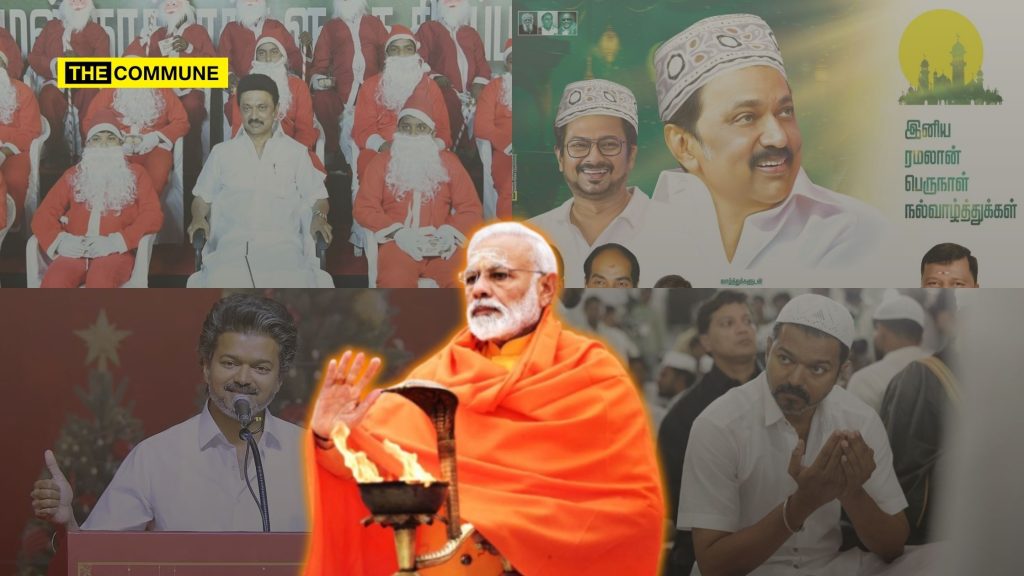
Secularism in India has been turned into a caste‑coded weapon, not a principle. When Christian clergy and minority networks openly choreograph votes for “secular” fronts, Dravidianist and Left‑liberal media call it enlightened resistance; when Hindus talk to Hindus about political power, the very same ecosystem screams “communal polarisation” and demands censorship.
Christmas As Campaign Rally, But “Not Communal”
Walk through Tamil Nadu’s Christmas events this year and you see the new template: Christmas trees, carols, and from the same stage, explicit political messaging about who minorities must back in 2026 to “save Tamil Nadu from fascism.”
Outlets dissect how Christian votes might swing between Stalin and Vijay, calmly discussing “which leader will win the Christian vote in 2026,” as if entire congregations are a negotiable bloc to be auctioned between Dravidian and TVK formations.
Pastors and “community leaders” urge Christians and Muslims to “stand with the secular front” and “keep fascists out of Tamil Nadu,” and this is reported in soft language: “minority outreach,” “confidence building,” “assurances to vulnerable communities.” There is no screaming about “religion in politics,” no prime‑time lectures on “dangerous communal consolidation.”
We saw this recently with DMK chief MK Stalin and TVK chief Vijay’s ‘Christmas’ celebration events.
Now contrast this with how the same media reacts if a Hindu religious figure so much as hints that Hindus should vote as Hindus.
One Rule For Churches, Another For Temples
When Christian pastors openly frame 2026 as a battle between “secular forces” and “fascists,” and call on their flock to vote “as a community” for one side, the media sees it as perfectly legitimate “political awareness.”
Editorials call these speeches “assertions of constitutional rights” and “minority self‑defence,” even when they are clearly religious platforms being used for electoral mobilisation.
When minority umbrella groups announce they will collectively support a “secular front,” TOI‑style headlines blandly say “Minority groups to back ‘secular’ alliance,” as if this is simply good, rational politics.
But let a Hindu priest, head of a Hindu organisation, or a pravachaka urge Hindus to vote for a party that promises to protect temples, festivals or cows, and the outrage machine detonates.
A temple priest somewhere in the country once appealed for votes for the BJP and was instantly painted as a symbol of theocratic danger; complaint letters, secular op‑eds and “this is not the India our founders envisioned” or “this is not the India I grew up in” pieces followed.
When Hindu groups in Tamil Nadu talk of consolidating devotees over issues like temple control or the Thirupparankundram/Karthigai Deepam dispute, Dravidian‑aligned media frame it as “saffron polarisation,” “Ayodhya‑isation of Tamil Nadu,” and an assault on the Dravidian model.
So, the rule is clear: church mobilisation is “secular defence”; temple mobilisation is “communal aggression.” The content is often similar, religious leaders nudging their flock towards a specific party, but the media labels flip 180 degrees based purely on which side benefits.
How Dravidianist Media Launders Communal Vote‑Bank Politics
Dravidianist outlets have built an entire vocabulary to sanitise minority vote‑bank politics while demonising Hindu consolidation.
When Christian forums declare support for one front, the language is “protecting pluralism,” “blocking majoritarianism,” or “standing with secular forces.” No one asks why religious identity is being turned into a monolithic political currency.
Coverage of minority rallies routinely emphasises “fear” and “vulnerability”: the narrative is that these communities are forced to vote as a block to survive, so their religiously framed appeals deserve empathy, not scrutiny.
Yet the same media caricatures Hindu consolidation as primitive herd behaviour. Here are some examples:
If Hindus speak of “Hindu interests,” “temple autonomy,” or “demographic concerns,” they are instantly equated with “Hindu Rashtra,” “Talibanisation,” and “majoritarian fascism,” even when their demands are about parity, having at least the same political agency that churches and mosques exercise everyday.
Dravidian leaders can stand at publicly funded Christmas events and hint that minorities must ensure a “secular government” remains in Fort St. George, and anchors nod along as if this is a neutral civic message rather than naked religious bloc‑building.
This is nothing but laundering. It normalises one set of communal appeals, those that help the Dravidian‑Left alliance, while pathologising any Hindu attempt to act like a political community.
The Pre‑Packaged BJP Villain Script
No matter what the BJP actually says on a given day, the script is pre‑written: communal, divisive, dangerous for minorities.
When the BJP talks about temple control, media frame it as a sinister plot to “saffronise institutions,” but the century‑old church‑run education and welfare network entering politics is treated as just “civil society participation.”
When BJP leaders speak to Hindu audiences about voting power, they are accused of “weaponising faith”; when minority clergy openly call for defeating the BJP from pulpits, it is defended as “speaking truth to power.”
The hypocrisy is laid bare in election cycles. Articles calmly explain how Christian votes will be “crucial to keep BJP at bay” in southern states, without once describing this as communal engineering, even though the entire premise is that one religious group must block another group’s party.
But if a BJP strategist openly says, “Hindus must unite,” that one line will be replayed endlessly as proof of a creeping theocracy.
In other words, Hindu consolidation is automatically guilty, minority consolidation is automatically virtuous. That is not secularism; that is ideological bigotry.
What Equal Secularism Would Actually Look Like
If secularism genuinely applied equally, three basic standards would hold:
Same yardstick for all religious mobilisation – Any explicit vote appeal made from a pulpit—church, mosque or temple—would be described as communal and subjected to the same scrutiny, not excused as “secular resistance” in one case and demonised in another.
Same language for bloc politics – If media can calmly discuss “the Christian vote” or “the Muslim vote,” then talking about “the Hindu vote” cannot be treated as automatically illegitimate; either all are problematic, or all are recognised as real political behaviour.
Same suspicion of state–religion nexus – When governments use state platforms, grants, or commissions to signal partisan alignment to any religious community, that should trigger alarm, whether it is a minority commission head promising votes to a ruling party or a Hindu board doing the same. The outrage cannot depend solely on which party benefits.
Until these standards are applied, what passes for “secular critique” in much of Leftist and Dravidianist media is simply a caste‑coded club: used relentlessly to beat the BJP and any Hindu voice that refuses to remain politically fragmented, while turning a blind eye. or even clapping, when churches and minority organisations play raw, overt communal politics in the name of protecting secularism
Subscribe to our channels on WhatsApp, Telegram, Instagram and YouTube to get the best stories of the day delivered to you personally.