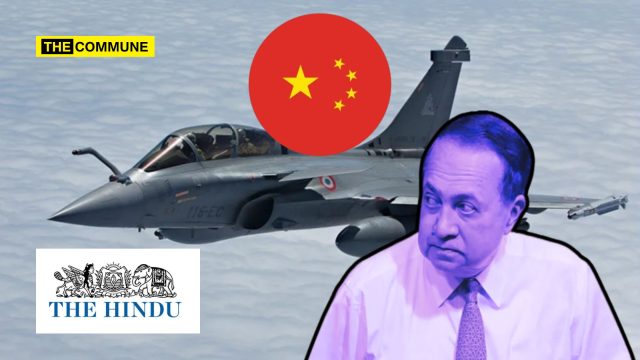
A bombshell revelation by French intelligence has exposed China’s covert operation to discredit France’s Rafale fighter jets, an important part of India’s air combat strength.
China’s Embassy Campaign Against Rafale
According to classified French intelligence reports accessed by Associated Press, Chinese defence attachés were instructed to systematically undermine the Rafale’s combat reputation following India’s Operation Sindoor against Pakistan in 2025. Beijing allegedly mobilized its diplomatic missions to:
Spread doubts about Rafale’s performance
Chinese diplomats were directed to question the jet’s combat capabilities in meetings with foreign defence officials, citing Pakistan’s unverified claims of shooting down three Rafales during the 2025 conflict.
Lobby potential buyers to abandon French jets
Multiple nations considering Rafale purchases reported unusual pressure from Chinese officials, who suggested alternative Chinese or Russian aircraft instead.
Amplify Pakistan’s false claims
Beijing’s state media extensively circulated Islamabad’s disputed assertion of downing five Indian jets (including three Rafales), despite French confirmation of only three total Indian losses (1 Rafale, 1 Sukhoi, 1 Mirage 2000).
While China dismissed these allegations as “slander,” the timing raises disturbing parallels with The Hindu’s 2019 manufactured “Rafale scam”, raising suspicions of coordinated anti-India propaganda.
Did Chinese Mouthpiece ‘The Hindu’ Manufacture Fake News On Rafale In The Past?
Following this revelation, one cannot help but think if Chinese mouthpiece, The Hindu, under N Ram in 2019, was also a part of this psychological warfare against India’s national security interests?
How N Ram Orchestrated The “Rafale Scam”
In February 2019, just months before India’s general elections, The Hindu published a doctored Defence Ministry note that had the following “features”:
Cropped out Defence Minister Manohar Parrikar’s rebuttal
The excised portion showed Parrikar calling objections an “overreaction” and clarifying that PMO/French President’s office were merely monitoring progress—standard practice for inter-government deals.
ANI accesses the then Defence Minister Manohar Parrikar’s reply to MoD dissent note on #Rafale negotiations."It appears PMO and French President office are monitoring the progress of the issue which was an outcome of the summit meeting. Para 5 appears to be an over reaction" pic.twitter.com/3dbGB9xF4Z
— ANI (@ANI) February 8, 2019
Digitally erased critical stamps and serial numbers
Forensic analysis revealed the removal of a 24 November 2015 stamp that overlapped into the text area as well as the deletion of serial numbers that would prove document sequencing. In addition to this, the “RM” (Raksha Mantri) designation that would reveal Parrikar’s response, was also cropped.
Ref: The Hindu report: pure obfuscation. Normal practice for PMO to receive calls from its counterparts in other countries. As this letter by French PM shows, the French Govt was taking full guarantee. The Indian negotiating team was okay with it once Ministry of law cleared it. pic.twitter.com/wrWFrs7vln
— Nitin A. Gokhale (@nitingokhale) February 8, 2019
Falsely claimed it was an “earlier version”
The Hindu asserted they published a preliminary draft, but the “missing” Defence Minister’s note was dated before their publication. Subsequent stamps (20 January 2016) proved later activity was deliberately hidden
The China Connection: Troubling Coincidences
The Hindu’s fake Rafale story surfaced in 2019 just as India negotiated defence deals with Egypt and Qatar—both later targeted by Chinese lobbying.
China’s alleged covert op to using China’s embassy operations is also making use of identical tactics – questioning Rafale’s performance and reliability.
Both campaigns served to undermine India’s defence credibility, benefit Chinese arms exports (J-20 fighters), empower political forces opposing military modernization.
N Ram’s Track Record
As a key petitioner in the Pegasus case and frequent critic of Modi’s defence policies, Ram’s role demands scrutiny. His 2019 article parroted Congress’ false ₹30,000 crore scam narrative despite Defence Secretary G Mohan Kumar clarifying pricing wasn’t discussed in the cited note. It also ignored critical context, i.e, the “dissenting” Deputy Secretary (Air-II) had no role in negotiations.
It also aligned with geopolitical interests seeking to stall India’s military preparedness.
Chinese Mouthpiece For A Reason
Over the years, we have consistently seen The Hindu parrot China’s line. Even recently, Suhasini Haidar, one of the editors at The Hindu, demonstrated the publication’s loyalty to China, earning praise from Yu Jing, the spokesperson for the Chinese Embassy in India, by promoting Lhasa, the religious and administrative capital of Tibet. This came when Haidar, as part of a media delegation from The Hindu, which trekked to Kailash Manasarovar in Tibet, lauded China’s developments in the region.
Follow the steps of Ms. Suhasini Haidar to witness the development of #Lhasa in #Xizang Autonomous Region, China.
Credit: @suhasinih @the_hindu pic.twitter.com/oe6bwqYDdf— Yu Jing (@ChinaSpox_India) June 26, 2025
The publication has long been recognized as a media outlet that frequently adopts positions hostile to India, while aligning itself with China’s strategic interests. Over the years, The Hindu has solidified its reputation as a consistent promoter of narratives that undermine India’s sovereignty, national security, and internal stability. Whether covering border issues, defense matters, or domestic policies, the newspaper has often echoed adversarial views that align closely with China’s geopolitical agenda.
The Commune has published a compilation of 32 documented instances where The Hindu has either directly supported China’s stance or published content critical of India’s armed forces, democratic institutions, and sovereignty, often reflecting China’s voice in its narratives.
Subscribe to our channels on Telegram, WhatsApp, and Instagram and get the best stories of the day delivered to you personally.