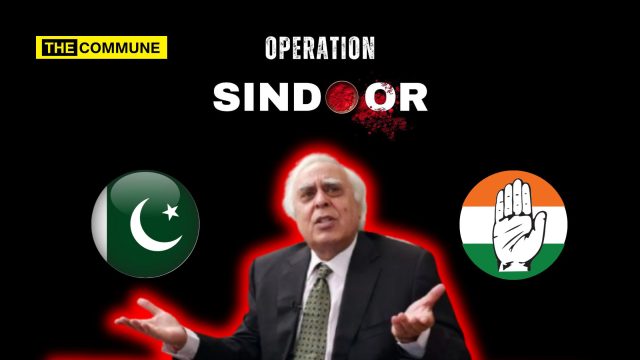
In a recent episode of Dil Se, senior Congress leader Kapil Sibal in conversation with Rajya Sabha MP Sanjay Raut, Congress MP Gaurav Gogoi, and TMC Rajya Sabha MP Sagarika Ghose, made a series of statements that not only questioned India’s security apparatus but also dangerously aligned with Pakistan’s propaganda. His remarks came at the heels of the parliamentary debate on Operation Sindoor. His statements went beyond political criticism, they undermined India’s military operations, cast doubt on our defence preparedness, and echoed Islamabad’s talking points. This article dissects Sibal’s statements to expose how they serve Pakistan’s interests more than India’s.
“How did [terrorists] manage to come 400 kilometers inside without anyone knowing?”
Sibal repeatedly insinuated that India’s security forces were incapable of stopping terrorists. He was also kept repeating this statement a few times during the conversation and it seemed as if he was trying to push Congress MP Chidambaram’s allegation that Pahalgam’s terrorists were “homegrown“.
Sibal and his panelists forget that 26/11 Mumbai terror attacks took place under Congress rule (UPA). Despite warnings from intelligence, no action was taken and the terrorists sailed undetected from Pakistan to Mumbai. Congress members like Sam Pitroda said “Hua to hua” – what happened, happened.
By framing the issue as India’s “failure” rather than Pakistan’s state-sponsored terrorism, Sibal shifts blame away from Islamabad.
“In 2014, when our government left, at that time, the total deaths of civilians and security personnel was 189. In 2016, it increased to 257. It became 357 in 2017, it became 452 in 2018, 283 in 2019, 321 in 2020, 254 in 2021. This means that terrorism increased after 2014. After 2019, it increased even more. What does this mean? That neither 370 nor Pulwama nor Balakot nor surgical strikes had any effect, did they work?”
Kapil Sibal conveniently forgets mentioning the countless bomb blasts and terror attacks that hit capital cities and smaller towns across the country.
2004
- Dhemaji School Bombing (15 August 2004) – ULFA bombed an Assam school on Independence Day, killing 18 (mostly children).
2005
- Ram Janmabhoomi Attack (5 July 2005) – Five terrorists attacked Ayodhya’s Ram temple. 5 terrorists, 1 civilian, and 3 CRPF personnel killed.
- Shramjeevi Express Blast (28 July 2005) – RDX explosion on Patna-Delhi train killed 14, injured 62.
- Delhi Serial Bombings (29 October 2005) – Diwali-eve blasts killed 67, injured 200+.
- IISc Bangalore Shooting (28 December 2005) – Gunmen attacked IISc, killing 1 professor, injuring 4.
2006
- Varanasi Bombings (7 March 2006) – Blasts near Sankat Mochan temple killed 28, injured 100+.
- Mumbai Train Bombings (11 July 2006) – Seven bombs on local trains killed 200+, injured 700+.
- Malegaon Bombings (8 September 2006) – Cemetery blasts killed 37+.
2007
- Samjhauta Express Bombings (18 February 2007) – Firebombing of Delhi-Lahore train killed 70 (mostly Pakistanis).
- Mecca Masjid Blast (18 May 2007) – Hyderabad Mosque bombing killed 9, injured 58.
- Shingar Cinema Blast (14 October 2007) – Ludhiana explosion killed 6, injured 42.
- UP Court Bombings (23 November 2007) – Six blasts in Lucknow, Varanasi, and Faizabad courts.
2008
- CRPF Camp Attack, UP (1 January 2008) – Militants killed 7 CRPF jawans.
- Jaipur Bombings (13 May 2008) – Nine bicycle bombs killed 71, injured 185.
- Bengaluru Blasts (25 July 2008) – Eight bombs killed 1, injured 8.
- Ahmedabad Bombings (26 July 2008) – Twenty bombs killed 56, injured 200.
- Delhi September Bombings (13 & 27 September 2008) – Five blasts killed 30; later market blast killed 2.
- Assam Serial Blasts (30 October 2008) – Coordinated attacks killed 88, injured 500+.
- 26/11 Mumbai Attacks (November 2008) – 10 LeT terrorists killed 166, injured 300+.
2009
- Guwahati Serial Blasts (January–April 2009) – Multiple attacks by ULFA:
- 1 January 2009: 6 killed, 67 injured before Chidambaram’s visit.
- 4 January 2009: BW militants derailed goods train in North Cachar Hills.
- 25 March 2009: Grenade attack in Tezpur injured 13.
- 31 March 2009: Motorcycle bomb in Guwahati killed 1, injured 10.
- 6 April 2009: Maligaon blast killed 6.
2010
- Pune German Bakery Bombing (13 February 2010) – Bomb killed 18, injured 60+ (including foreigners).
- Varanasi Ghat Blast (7 December 2010) – IED at Dashashwamedh Ghat killed 2-year-old, injured 25.
2011
- Mumbai Triple Blasts (13 July 2011) – Zaveri Bazaar, Opera House, Dadar attacks killed 21.
- Delhi High Court Bombing (7 September 2011) – Briefcase bomb killed 11, injured 50+.
2012
- Attack on Israeli Diplomat (13 February 2012) – Car bomb injured diplomat’s spouse.
- Pune Blasts (1 August 2012) – Four low-intensity blasts on JM Road.
2013
- Hyderabad Blasts (21 February 2013) – Twin IEDs in Dilsukhnagar killed 18, injured 130.
- Bangalore Bombing (17 April 2013) – Low-intensity blast injured 17 (12 police).
- Bodh Gaya Blasts (7 July 2013) – Nine explosions at Buddhist shrine, minor injuries.
- Patna Rally Bombings (27 October 2013) – Six bombs at Modi’s rally killed 5, injured 83.
2014
- Chennai Train Bombing (1 May 2014) – Twin blasts killed 1, injured 14.
These were the many terror attacks that took place during the UPA era. And to top it all, there was absolutely no response following the dastardly 26/11 attacks because “no response is also a response” according to Congress.
The panelists kept repeating the lie that the terrorists did not ask the tourists’ religion before gunning them down.
“I give you my opinion, why Operation Sindoor was stopped? We have 31 squadrons in our country right now. The Air Force had an operation, our sanctioned strength is 42 squadrons. And in these 31 squadrons, your Mig 21, your Mirage 2000, Mig 29 and Jaguars are all being phased out. So, in just a few months, we will be left with 29 squadrons and Pakistan has 25 squadrons. We have 522 jets. Pakistan has 450 jets and China has 1300 jets. So, this means that our defence, air force, is almost equal to them. Secondly, we have Rafale because we have one Rafale and one Su-30 MKI. Rafale is a 4.5 generation aircraft. But the aircrafts that they have are J10 and J17. China has these, so they can use them. So it is a superior aircraft or an equal aircraft. Now China is manufacturing the fifth-generation aircraft called J20. Our fifth-generation aircraft which AMCA is developing, and its production will take place in 2035, in 2028 and in 2035. By then, China will have the fifth generation and now they are developing the sixth generation. Meaning that if this fight had gone further, then certainly no one would have won. So, they would not have been able to fight. They should have raised these issues in the House – how to increase our Air Force system and I am not saying this. This was said by the Air Chief Marshal Amarpreet Singh.”
Rather than asserting India’s military superiority or strategic resolve, Sibal sounded more like a spokesperson for Rawalpindi’s narrative of Indian overreach and strategic weakness. Neither he nor the panelists lauded the military efficiency of the indigenous arms that were deployed during Operation Sindoor. Yes, we need to improve but Sibal also does not bother to mention that it was Pakistan that came begging to India to stop the war after we hit their nuclear bases.
“During the parliamentary debate, it suddenly seemed as if those three terrorists were killed during the debate so that the ruling party could claim, ‘Look, we killed them.'”
This cynical statement trivializes the lives of security personnel and paints the Indian government as manipulators, an accusation that mirrors exactly the kind of conspiracy theories promoted by Pakistan’s disinformation cells.
Kapil Sibal’s rhetoric dangerously echoes Pakistan’s propaganda on Kashmir and terrorism, consistently undermining India’s strategic position. By repeatedly questioning the competence of India’s security forces and military operations, he erodes public trust in our armed forces while ignoring Pakistan’s well-documented role in sponsoring cross-border terror. His selective outrage focuses solely on blaming the Indian government while never holding Pakistan accountable for attacks like 26/11, Pulwama, or Uri. If Sibal genuinely cared about national security, he would unequivocally condemn Pakistan’s state-sponsored terrorism, stand firmly behind our armed forces instead of casting doubt on their capabilities, and refrain from exploiting terror attacks for political gain. Until he makes these fundamental changes, his statements serve only to amplify Pakistan’s anti-India narrative rather than India’s security interests.
Subscribe to our channels on Telegram, WhatsApp, and Instagram and get the best stories of the day delivered to you personally.