The Karur crowd crush of September 2025 should have been a political funeral. 41 people died including a two‑year‑old, young couples, mothers with their daughters, crushed in three successive waves at a TVK rally where the FIR explicitly names party office‑bearers for reckless over‑mobilisation. In any textbook democracy, the leader at the centre of such a mass‑casualty disaster would face prolonged political exile, if not criminal liability. Instead, Vijay returned to the campaign trail within weeks, rebranded himself as the victim of a DMK conspiracy, and is now being reinforced by one of the most experienced organisation men in Dravidian politics. That trajectory, from culpability to consolidation, is the real story of late 2025.
The Psychology Of Absolution
What makes Karur historically unusual is not the tragedy itself; India has seen stampedes before. It is the public psychology that followed. Grieving families, on camera, said Vijay should not be blamed. Some even spoke of consoling him when he called them. His supporters instead chose to frame it as a disaster deliberately orchestrated by the DMK to curb his rise. The mental gymnastics needed to turn 40 preventable deaths at Vijay’s own rally into a storyboard of someone else’s villainy is astonishing — and, disturbingly, it seems to have worked.
This is not mere “fan loyalty.” It is a new strain of political psychology where emotional investment in a leader becomes so intense that objective culpability cannot penetrate it. The same voters who would demand resignations if a DMK or AIADMK rally killed dozens have decided, almost instinctively, that Vijay is exempt. That exemption is now a political fact, and every other actor in Tamil Nadu must reckon with it. And not every one will get this leeway or advantage.
Vijay’s Transformation: From Screen Image To Political Inevitability
Until TVK’s launch, Vijay’s “politics” was widely read as a combination of three things: his carefully crafted screen persona (the righteous outsider fighting systemic corruption), his late father S.A. Chandrasekhar’s unfulfilled ambitions, and the absence of any visible grassroots organisation or ideological framework. He is not a great orator like a Karunanidhi, Seeman or Annamalai. He doesn’t have the administrative depth, versatility or in-depth knowledge like Jayalalithaa. He has not built a grassroot cadre-based entrenched parties like how MGR or Jayalalithaa did. Vijay is seeing politics as an extension of his cinematic persona. That explains the cringeworthy, scripted and rehearsed speeches on stage and social media bytes. Everybody including this author still feel that Vijay is just all hype and no substance.
But the game changed in Karur. Vijay’s first major post‑tragedy speech was not apologetic but combative. It became an opportunity for him to make it into a DMK–TVK fight. The crowds that once saw him as a superstar now see him as a wronged leader fighting a hostile regime, an underdog – a classic victim‑to‑challenger arc that Karur, perversely, accelerated.
Yet this “inevitability” narrative has limits. TVK’s visible strength is concentrated in urban and peri‑urban belts, among first‑time voters and anti‑establishment middle‑class blocs. There is much less evidence of penetration into Dalit‑marginal constituencies that VCK, Left parties, and smaller outfits still organise at the ground level. Caste‑anchored local leadership, panchayat‑level patronage networks, and trade‑union linkages remain weak points. Treating Vijay as the “third pole that has already replaced AIADMK” is exactly the premature coronation TVK wants the ecosystem to perform.
Sengottaiyan: The Full‑Stack Organisation Man
Into this volatile moment walks K.A. Sengottaiyan, a man who spent roughly half a century inside AIADMK’s machine, from MGR’s early campaigns through Jayalalithaa’s iron rule and the post‑Jaya EPS period. His brand is not charisma but organisation: loyalty to leadership so total that he was called AIADMK’s “rubber stamp,” an iron grip over Kongu region networks, and an instinct for converting crowds, cadres, and caste equations into winnable arithmetic.
That such a man walks out after 50 years, resigns his MLA seat, gets expelled by EPS, and then crosses over to TVK, not DMK, signals several things at once:
- He believes AIADMK, as currently led, is a sinking or at least stagnating ship, incapable of offering him meaningful authority.
- He reads TVK as the only vehicle where his experience will translate into real command, not decorative posting.
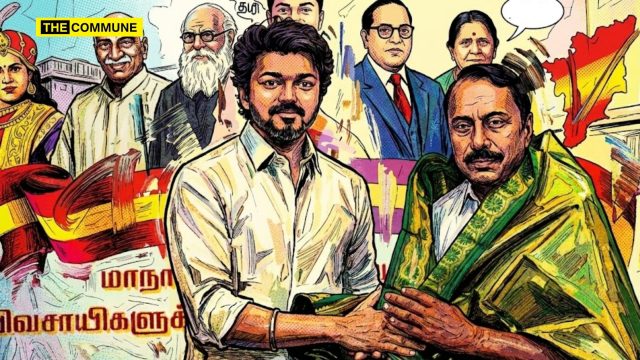
TVK has validated that reading immediately. Sengottaiyan has been made chief coordinator of the party’s executive committee and organisational secretary for the western region (Erode, Coimbatore, Nilgiris, Tiruppur), posts structurally placed alongside, not below, the general secretary and campaign general secretary. For a party dismissed as a fan club with no clarity, this is fast‑track institutionalisation: a proper chain of command, region‑wise responsibilities, and a 77‑year‑old with an MGR–Jaya pedigree supervising young aspirants.
The Double‑Edged Sword
But Sengottaiyan is not a cost‑free asset. He embodies the old Dravidian style: opaque deal‑making, top‑down discipline, and comfort with caste‑weighted arithmetic. If Vijay truly wants to present TVK as a clean break from 50 years of DMK–AIADMK cynicism, he now has to explain why his first major induction is exactly the sort of back‑room strongman his Gen‑Z supporters said they were done with.
There is also a tactical risk. By placing Sengottaiyan at the executive committee’s apex, Vijay has narrowed his own future room for course‑correction. If TVK underperforms in the Kongu belt, or if there is backlash within AIADMK‑leaning Gounder blocs against this defection, rolling back Sengottaiyan’s influence later will be politically costly and publicly embarrassing.
AIADMK’s Historic Blunder
Losing Sengottaiyan to Vijay is not just an embarrassment for Edappadi Palaniswami; it may prove to be a historic miscalculation for the entire anti‑DMK space. Until now, DMK vs TVK looked like a far-fetched rhetoric. But with Sengottaiyan’s induction it has begun crystallizing. Whether this momentum will continue to bring in other disgruntled leaders like O Paneerselvam, TTV Dhinakaran and others will determine TVK’s weight as a formidable third front. But Edappadi Palaniswami’s attempt to keep an iron grip on the party is having its effect — people are slipping away like sand through a clenched fist
AIADMK has effectively pushed a veteran like Sengottaiyan into TVK’s arms, thereby strengthening the very challenger that could, in time, cannibalise its own base.
In western Tamil Nadu especially, where caste‑driven Kongu arithmetic has long underpinned AIADMK’s strength, Sengottaiyan’s relocation offers TVK ready‑made ground networks that no fan club can build overnight. Even if TVK does not immediately convert this into dozens of seats, it can deny AIADMK easy victories, distort margins, and accelerate the fragmentation of the non‑DMK vote.
BJP’s Silent Loss
A few weeks ago, Sengottaiyan met senior BJP leaders, including Amit Shah and Nirmala Sitharaman, amid discussions that may have included a possible shift to the BJP. However, since the BJP had already finalized its alliance with Palaniswami, any move by Sengottaiyan to join BJP would have been seen as politically inappropriate and akin to poaching. Had he joined BJP before the alliance was sealed, it could have strengthened BJP’s organizational presence significantly.
But now for the BJP, this is almost a strategic dead‑end. Reports indicate that Union ministers and RSS functionaries tried to use Sengottaiyan’s anger to reshape AIADMK into a more pliable partner; those efforts failed, and once his intentions became clear, Delhi quietly backed off. In effect, Sengottaiyan’s jump helps lock BJP into a spectator role in Tamil Nadu, unless it can engineer a fresh realignment closer to polling.
DMK’s Comfort And Blind Spot
DMK’s front, meanwhile, remains numerically solid: Congress, Left, VCK, MDMK, and even Kamal’s MNM are either within or orbiting the alliance space, giving Stalin a broad “secular” shield and a narrative of stability. There are ongoing feelers to PMK, DMDK, and other caste‑based outfits to at least prevent them from becoming spearheads of a rival bloc.
But DMK’s comfort inside this stitched‑together coalition can also be a blind spot. The party’s answer to TVK so far is to sneer at its supposed lack of ideology while downplaying how post‑Karur sympathy, anti‑corruption rhetoric, and a high‑decibel social‑justice plank are reshaping youth perceptions. Each time Vijay calls DMK a “looting syndicate” or “dynasty cartel” and backs it with selective data points, he is not just firing at Stalin; he is offering disillusioned DMK‑haters an option that is neither AIADMK nor BJP. With Sengottaiyan’s entry, that option now has a spine.
The Larger Precedent: Impunity With Fan Consent
The sharper way to read Karur is not just as Vijay’s “baptism in blood” but as the normalisation of impunity with fan consent. International and national coverage emphasises three crush waves, failure of mic and spotlight systems, overcrowding beyond permitted numbers, and even TVK cadres blocking ambulances. When that chain of preventable errors ends without any serious political cost to the central figure, it signals to all future organisers of every party that such risks are survivable so long as blame can be narratively outsourced to the administration.
India still lacks a binding, justiciable framework for maximum density, exit‑to‑entry ratios, or real‑time crowd‑flow monitoring at political events, despite repeated stampedes in temples and rallies across the country. Karur is not only TVK’s sin; it is a symptom of how all parties have normalised unsafe rallies for decades. But the fact that Vijay emerged politically stronger from it, rather than diminished, sets a precedent that will embolden future recklessness across the spectrum.
Where This Trajectory Points
It is still too early to project vote‑shares or seat counts. Karur’s ghosts will follow TVK into 2026; court findings and commission reports can still reshape public memory; and organising a party is not the same as organising a fan club. Yet some trajectories are already visible:
First, Vijay has survived a moment that would have ethically destroyed many leaders and has emerged with an even more hardened, emotionally committed base.
Second, TVK has recruited one of the last “full‑stack” organisation men of Dravidian politics, giving the party a ready‑made manual in booth work, cadre discipline, and alliance negotiation.
Third, the anti‑DMK space is now splitting into 2 with being the apex of a possible third front.
If there is a single line that captures this phase, it is this: Karur did not stop Vijay’s politics; it baptised it in blood, and Sengottaiyan’s jump has now given that baptism an organisational church. Whether Tamil Nadu rewards or punishes that combination will decide not just 2026, but the post‑Dravidian balance of power itself.
Hydra is a political writer.
Subscribe to our channels on WhatsApp, Telegram, Instagram and YouTube to get the best stories of the day delivered to you personally.