Ever since a part-time, work-from-home and now a weekend politician dared to compare himself to the legendary leader and fondly called as “Puratchi Thalaivar” M.G. Ramachandran (MGR), the backlash has been swift and widespread and rightfully so. MGR wasn’t just a political icon; he was a selfless figure who stood by the people during their toughest times. His life was marked by unwavering service, and even in death, he donated all he had to support children with special needs. In his films, MGR preached morality he uplifted the dignity of labor, celebrated farmers, and respected those who toiled for society.
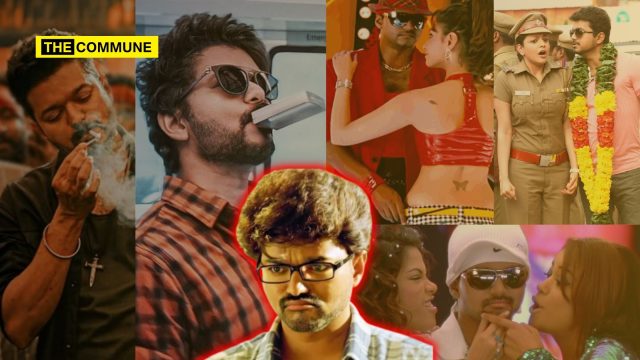
In stark contrast, actor Vijay until very recently built his on-screen persona glorifying alcoholism, smoking, and objectifying women through vulgar lyrics and suggestive scenes. To equate such a legacy with that of MGR isn’t just tone-deaf it’s an insult to the values MGR actually lived by.
Here’s why even MGR’s shadow is beyond Vijay’s reach.
Political Journey: Earned Vs. Inherited Popularity
MGR’s political entry wasn’t sudden, nor was it opportunistic. He joined the DMK under C.N. Annadurai in 1952 and spent over two decades building a credible, ground-up political career. His influence was instrumental in the party’s victories in 1957, 1962, and 1967. He won the Dindigul by-election in 1973 and eventually became Chief Minister in 1977. MGR didn’t just arrive he earned his place in Tamil Nadu’s political landscape through tireless grassroots work and ideological commitment.
In contrast, Vijay’s sudden declaration to contest for the Chief Minister’s post in 2026 reeks of ambition without groundwork. He has no proven political history, no demonstrated ideological stance, and no tangible contribution to public service. Merely invoking MGR’s name and popularity is a superficial attempt to inherit a legacy he hasn’t worked for.
Integrity & Philanthropy: Legacy Built On Sacrifice vs. Showmanship
MGR stood firmly against corruption even if it meant confronting his own party. His ousting from DMK in 1972 was the result of calling out internal corruption. He openly declared that politics must serve the people, not enrich the politicians, famously stating that those who wish to make money should do business, not politics.
His generosity wasn’t symbolic; it was transformative. Before becoming Chief Minister, he founded a free hospital and a school for the underprivileged in his mother’s name. He donated ₹75,000 to the National Defence Fund in the 1950s a sum that would be worth over ₹100 crore today. His will further cemented his selfless legacy: he donated his Ramavaram Gardens home to a school for the deaf and mute, and directed the income from his Alandur property to maintain his memorial so the government wouldn’t bear the cost.
Meanwhile, Vijay’s public image tells a different story. There are allegations of arrogance including an incident where he reportedly expelled a visiting actor Napoleon from his caravan. Unlike MGR, his political activities are allegedly financed by others, and he has fought legal battles to avoid paying taxes, notably in the Rolls Royce import duty case.
His so-called charity like distributing gifts to students in selected constituencies seems more like political theatre than genuine service. Opportunism marks his trajectory: he’s praised Karunanidhi and Jayalalithaa when it was politically convenient, even kneeling before the latter to secure the release of his film Thalaivaa. Now, he tries to hijack MGR’s legacy to gain electoral traction.
Cinema As A Tool: Social Messaging vs. Glorification of Vices
MGR used cinema not just to entertain, but to educate and uplift. He consciously avoided smoking or drinking on screen. His songs carried moral, philosophical, and social messages:
“Thungathey Thambi Thungathey” urged youth to rise and work hard.
“Thirudathe Paapa Thirudathe” warned against theft and corruption.
“Kadavul Ennum Mudhalali” praised the farmer as God’s first creation, questioning why a rich land should beg before foreign powers.
MGR’s films were a medium to instil discipline, pride in labor, and social consciousness. Even at the peak of his cinematic career in 1954, he created a school for a poor lightman’s son an initiative funded from his own pocket, not a campaign stunt. That school still operates today as a government-aided institution.
Compare this to Vijay’s cinema, In the song “Naa Ready” from Leo, he glorifies alcoholism and smoking with lyrics like “Veral Idukkula Thee Pandham Naa Yethathathan, Pathaathu Bottle Naa Kudikka Andaala Konda Cheers Adikka Cheers”. (To light a torch in the gap between my fingers (Cigarette) A bottle is not enough for me to drink. Bring the large pot to make a toast. Cheers)
The infamous “Daddy Mummy” song features suggestive lyrics promoting sexual innuendo under the guise of fun. (Daddy and mommy are not home, there is no one to stop us; shall we play a game, my love? Hey, we don’t need a playground or an umpire, and no one will lose, my love.) Such content raises questions about the values he promotes, especially among impressionable youth.
Similarly, in the film Sura, a song called ‘Thanjavoor Jilla Kaari’ featured a controversial dance sequence where Vijay is shown repeatedly pulling the actress’s pants up and down, under the guise of dance move. The dance move blatantly crossed the line of decency, reinforcing the recurring pattern of vulgarity in the portrayal of women in his films.
In yet another example, Vijay lent his voice to a song in the film Periyanna, starring his co-actor. The song, “Naan Thamatikira Style Paathu,” openly glorified smoking and drinking with lines like: “Style is style. If I smoke, it’s stylish; even if I drink rum, it’s a style. Seeing my smoking style, Dhanalakshmi fell for me; seeing my rum-drinking style, Rakkamma fell for me.” Once again, the message was clear addiction and vice were portrayed not as harmful habits, but as traits to be admired and imitated, particularly by impressionable fans.
In the film Vishnu, Vijay sang the song “Thottabetta Road Mela”, which continues his trend of objectifying women through suggestive lyrics. Lines such as, “All the lorries yield when they see me. This girl is dazed and swooning just by looking at you,” followed by Vijay singing, “Oh, seeing your sways and shakes shows you’re ‘A1’. I’m just yearning for that. Now hungry, give me a tea bun,” reduce women to objects of visual pleasure and casual desire. The song not only trivializes female representation frames lustful commentary as humour or style.
And who can forget the utterly crass moment where he shamelessly grabs Kajal Agarwal, a female cop, by the back in the film Jilla or the vulgar way in which he dances with Tamannah in Sura.
In Vijay’s film Rasigan, where he was first credited with the title “Ilayathalapathy,” and he sung the song “Bombay City” featured lyrics like, “Bombay City, dry bread, here comes a fair-skinned girl. If the red light comes here, the girl will tell good night. Just looking at her brings a fever, and naturally, an urge to pounce.” Later in another segment, “The girl, wrapped in a Kandaangi sari, is a perfect voluptuous women who is gotten caught by the Kangeyam bull.” The song was laced with double entendre and objectification, setting the tone for how women would be portrayed in many of his films that followed.
From the very beginning of his career, Vijay has consistently featured indecent depictions of women through suggestive lyrics and problematic themes.
Even in the realm of education, the difference is striking. When a lightman once brought his child to a film set, MGR noticed the boy wasn’t in school and asked why. Upon learning the family couldn’t afford education, MGR used his own money to establish a school ensuring that underprivileged children had access to learning. In stark contrast, Vijay’s CBSE school reportedly charges ₹1 lakh just for LKG admissions a figure that clearly puts it out of reach for economically weaker families.
Legacy: Living For The People vs. Leveraging Popularity
MGR remained connected to the public. His Ramavaram residence was always open, feeding thousands daily. His political image was not carefully curated it was earned through decades of consistent public service, personal sacrifice, and moral clarity.
Vijay, on the other hand, is attempting to package charisma and film fame into political capital, without any meaningful contribution to social welfare. His sudden shift from celebrity to aspiring leader is neither backed by ideology nor by public service only by convenience.
A Hollow Comparison
To compare Vijay to MGR is not only misleading it is a disservice to the legacy of one of Tamil Nadu’s most respected leaders. MGR built his identity on discipline, humility, and tireless work for the people. Vijay, at this point, appears to be emulating only the aesthetics of leadership costumes, fanfare, and slogans while lacking the essence.
If Vijay wishes to follow MGR’s path, it won’t be by invoking his name. It will require sacrifice, consistency, and an unshakable commitment to public service. Until then, such comparisons only expose the hollowness of political ambition built on borrowed greatness.