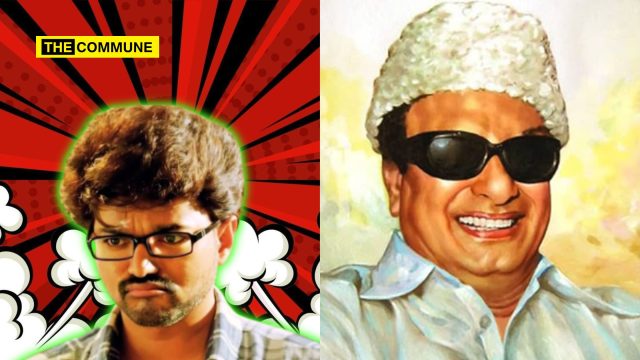
The recently concluded conference of actor-turned politician Vijay’s Tamilaga Vettri Kazhagam in Madurai attempted to position him as the “next MGR“. If one thought this was a new direction he was taking at brand and image building, think again.
If we pause to take a look at the filmography of Vijay over the past decade or so, there is a recurring pattern – where he portrays himself as a saviour of the masses as well as political rhetoric where he is positioned as the only heir of MGR – for both his cinematic and political legacy.
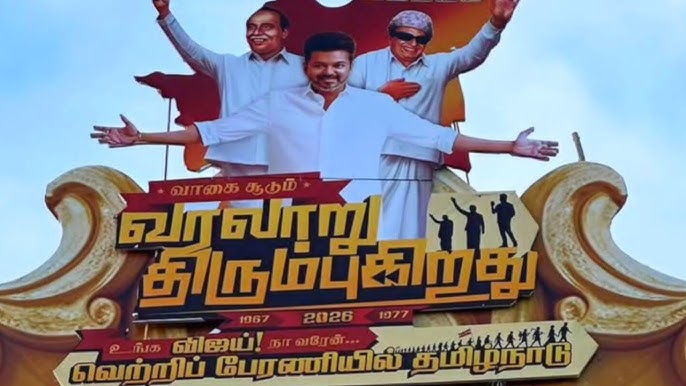
Vijay tried to reiterate this at the conference in Madurai on 21 August 2025. The massive banner on the stage had 3 photos – Vijay flanked by Annadurai and MGR on both side.
Annadurai is not just a reference to him being rooted in the Dravidian ideology but also the year 1967, the year in which DMK came to power. MGR’s reference harks back to 1977, when the AIADMK-led alliance stormed to victory in the state elections. These two years have been references in Vijay’s political speeches and press releases saying that 2026 will be a repeat of what happened in 1967 and 1977.
However, a closer analysis of history, political acumen, and ground reality reveals a stark truth – Vijay is, and can only ever be, a pale imitation, a ‘wannabe’ who fundamentally
misunderstands the very legend he seeks to emulate.
Vijay Trying To Launch Himself As Political Hero: A Look At His Filmography From 2010
Sura (2010) – While this was a forgettable film for all kinds of reasons, Vijay plays a fisherman who fights against a corrupt politician trying to take over his village’s land. It has a saviour theme because he defends the livelihood of poor fishermen against exploitation. He makes indirect political statements, focusing on corruption and social justice.
Velayudham (2011) – He plays a common man who turns into a vigilante superhero to fight crime and corruption. In this, he is strongly portrayed as a protector of the people and the film is peppered with themes of justice and empowerment of the common man.
Thuppakki (2012) – Vijay plays an army officer battling terrorists to protect the city, a social protector guarding people and city from terrorism threats. The film highlights patriotism and national security.
Thalaivaa (2013) – Vijay plays a young man who enters politics to fight social injustice and corruption. The saviour/political hero theme is very strong; he becomes a political leader fighting for the oppressed. He makes explicit political statements with added elements of leadership, social reform, and grassroots empowerment. This is when he got belt treatment from Jayalalithaa for having the title Thalaivaa – Time To Lead. Vijay had to prostrate and submit himself in servitude at Kodanadu for this film to get released. This man submitted his self-respect just so that his film could get released and he has the audacity to talk about self-respect and being a slave today.
Kaththi (2014) – In this film, he plays dual roles with one being a social activist fighting for farmers’ rights. Given the theme, it shows him standing against corporate exploitation. He makes direct political statements on corporate greed, farmer issues, and social justice.
Theri (2016) – Vijay is a former cop protecting his daughter and fighting criminals. He portrays a savior of his family with broader social justice undertones. Some social themes around corruption, women and child safety and law enforcement. Again turns to vigilantism to uphold justice.
Mersal (2017) – Vijay plays triple roles, including a doctor fighting medical corruption. The saviour image is very strong in this one as he fights for the common man’s right to healthcare. His introduction scene has an MGR song playin. The father character is shown as a “Tamil” and he stirs that sentiment too. He made explicit political statements with critiques of government policies especially GST and healthcare corruption. In a notable and controversial scene, Vijay’s character Vetri addresses the media, questioning why Singapore, which levies only 7% GST, is able to provide free healthcare to its citizens, whereas India, which levies 28% GST, cannot. He also criticizes the high GST on medicines and points out inconsistencies such as the lack of GST on liquor.
Sarkar (2018) – Vijay plays a business tycoon who returns to vote and fights political corruption. The political critiques of this film resulted in a lot of controversy. The ruling AIADMK government accused it of attacking their welfare schemes, viewing the theme against freebie culture as a direct insult. Protests led to demanded cuts in scenes and dialogues. Additionally, a character portrayed as a corrupt politician was seen as a negative depiction of V.K. Sasikala, further intensifying political backlash and legal challenges.
Bigil (2019) – This film potrayed him as as an inspiration and champion of women’s empowerment. In this film also there are mnay MGR references through songs and mannerisms.
Master (2021) – Vijay plays a professor confronting a criminal exploiting children; he is shown as the protector of the vulnerable, advocating education and justice.
Leo (2023) – Vijay plays a fiery character with strong justice-driven motives. However, the film glorified violence – something MGR would have abhorred.
The Greatest of All Time (2024) – Vijay plays a Special ATS character but sadly the film seemed to promote drinking and smoking – MGR would be rolling in his grave!
MGR’s Political Legacy
MGR’s rise in Tamil Nadu was a product of decades of political struggle, not just cinematic popularity. He built his political career through grassroots engagement, navigating complex alliances, and demonstrating deep political acumen.
Multiple Election Battles And Real Political Work
The 1967 DMK victory was a grand alliance of forces, Swatantra Party (Rajaji), Communists, Forward Bloc, Muslim League, united under the powerful oratory and intellectual heft of C.N. Annadurai and a cadre of fierce leaders like Karunanidhi. MGR’s own 1977 victory came after 15 years of rigorous political apprenticeship within the DMK. He contested three key elections before becoming Chief Minister in 1977, demonstrating his resilience and political acumen.
Unlike a star persona relying purely on fame, MGR built his political career through grassroots engagement, understanding policy, and navigating complex political alliances. His split from the DMK was not just personal but ideological, which led to the formation of the AIADMK party that dramatically shifted Tamil Nadu politics.
MGR’s victory was facilitated by his ability to unite disparate political entities, including the Congress party and various social groups, under his leadership. His political success was a combination of calculated alliances, his charisma, and a genuine connection to the aspirations of the Tamil people. This strategic coalition-building showcased MGR’s statesman-like qualities and long-term vision.
MGR was deeply respected for his sincere dedication to the welfare of the people. His background reflected a true political passion, starting from being an actor, he used his popularity responsibly to build political capital, but his commitment to politics was unwavering. His leadership inspired loyalty and mass support, which were rooted in more than just his star power.
The Depth Of Political Experience
MGR’s politics was forged in the fiery debates of the Dravidian movement. He understood policy, administration, and the grit of political organizing. In stark contrast, Vijay’s party lacks any depth. It has no seasoned spokespersons, no clear policy framework beyond vague populism, and a core support base of fans who, when asked about policy, can only chant “Thalaivar” – quiz them on basic issues with the present government or what can be rectified – you’ll hear crickets. This encapsulates the intellectual vacuum at TVK’s core.
The Substance Of The Symbol
MGR’s popularity was undeniably built on his film image, but it was cemented by a perceived authenticity and a narrative of betrayal that resonated emotionally with the masses. When he broke from the DMK, he carried an aura of a wronged hero. Vijay, however, enters a fray where he is just one among many celebrities. His attempts to spark a similar emotional wave fall flat, as he is competing not just with established parties but with the legacies of Rajinikanth, Kamal Haasan, and other stars whose fans he has alienated.
Vijay’s Political Venture: A Contrasting Reality
While MGR was a hero to everyone in the state because he carried his charisma from the silver screen to the political arena, working for the people and gaining their trust over the decades, Vijay lacking in political experience aims for the CM chair with just one election and no groundwork done by him, on his own. As mentioned above, the voter base is primarily his teenager fans who are enamoured by his onscreen persona – they are still in that bubble that believes he will carry it to the ground.
Limited Political Experience and Organizational Strength
Unlike MGR, Vijay’s political journey is in its infancy. His influence largely comes from his cinematic fame rather than a robust political network or ideology. His party and movement lack veteran politicians, credible spokespersons, or policy experts to effectively translate popularity into political power. This nascent stage of political organization makes it difficult for Vijay to sustain serious political momentum.
Celebrity Versus Political Leader
Vijay’s attempt to portray himself as a savior or messiah can largely be seen in his movies mentioned above where he plays characters who fight injustice, corruption, and inequity. These saviour roles strongly echo MGR’s cinematic legacy of championing the underdog, but they remain within the realm of fiction rather than grounded political achievements.
Mismatch In Political Substance
While Vijay’s roles and speeches promote ideals of social justice and change, there remains a lack of clear political framework and policies behind his real-world political initiatives. His public messaging is fragmented, a copy-paste job, repeats like a broken tape in the recorder and occasionally sways between populist echoes and entertainment-driven rhetoric, which contrasts starkly with MGR’s cohesive political ideology and sustained governance record.
His political statements and moves often attract skepticism regarding his ability to navigate the realpolitik of Tamil Nadu’s fiercely competitive political stage. MGR stood for a strong Tamil Nadu, despite being of Malayali origin, he stood for Tamilians and equally patriotic. However, Vijay seems to be sowing seeds of hate and secessionism right at the infancy stage of his party.
The Insurmountable Hurdles: Why TVK Is Doomed to Fail
Let’s take a look at why TVK is bound to fail. A new party thrives on alliances. MGR had them. The BJP or other smaller parties would only ally with TVK if it could transfer votes. TVK has no leverage to demand seats because its actual vote share is a big unknown. It is a party with no bargaining power.
While there is a lot of hype at the moment, we are not sure how it will be once Vijay starts canvassing full time. Will the hype translate to votes? Only time will tell. Will the traditional DMK, ADMK, BJP voters shift base – unlikely. It is only likely that the fresh batch of first-time voters who will vote for TVK.
TVK’s votebank is scattered – it is that vote of the indecisive voter, a vote that is insufficient to win seats in a first-past-the-post system. His core vote is limited to a fraction of his film’s audience, which translates to maybe one lakh votes, that is basically, electorally insignificant.
The Imitation Game is Over
Vijay’s political project is based on a fundamental misreading of history. He sees MGR’s stardom but is blind to his three decades of political grinding, his strategic mind, and the unique historical moment he captured. Vijay possesses the celebrity but none of the substance. He has the ambition but none of the alliance-building skill. He has the fans but none of the broad-based coalition needed to win.
MGR was a political phenomenon who used his stardom as a tool. Vijay is a star pretending to be a politician, using politics as an extension of his brand. The Madurai conference, with its empty boasts and lack of concrete agenda, proved this. He can mimic the words and the poses, but he can never replicate the context, the struggle, or the genuine political capital that made MGR a legend. The throne of MGR remains occupied by his legacy, and Vijay’s attempt to claim it only reveals him as a pretender, forever in the shadow of the original.
Kaathavaraayan is a political writer.
Subscribe to our channels on Telegram, WhatsApp, and Instagram and get the best stories of the day delivered to you personally.