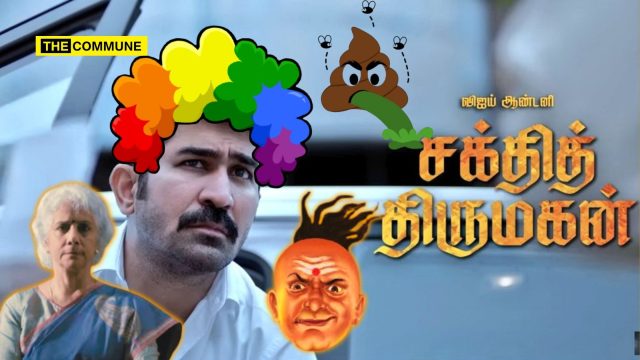
The Tamil film industry’s insidious tradition of peddling anti-Brahmin propaganda finds its latest champion in Christian actor Vijay Antony, whose 25th film “Sakthi Thirumagan” represents yet another shameless attempt to vilify the Brahmin community while masquerading as ‘progressive’ (when it is actually regressive) cinema. Directed by Arun Prabhu, the film postures as a political thriller tackling corruption and power games, but scratch a little, and it becomes clear: the entire exercise is nothing but a vehicle to peddle brahmin hate, glorify EV Ramasamy Naicker (hailed as ‘Periyar’ by his followers) and shift blame for Tamil Nadu’s rot onto the Central Government.
A Plot Built On Stereotypes, Vendetta, And Moral Bankruptcy
The film follows Kittu (Vijay Antony), a powerful broker in the Tamil Nadu Secretariat who takes on a mighty “crony capitalist,” Abhyankkar Srinivasa Swamy (named after Subramania Swamy?) but modelled explicitly after figures like Adani and Ambani. However, in a lazy and inflammatory narrative choice, the director Arun Prabhu and actor-producer Vijay Antony choose to portray him as a sloka-chanting crony capitalist, stripped of realism and stuffed into a Brahmin caricature. He is shown performing pujas for power and openly justifies crushing the weak (add a random sloka here). His ultimate goal? To become the President of India. A laughable aspiration presented as though the post is an omnipotent seat that can “change everything.” Who are the makers fooling?
The supporting cast reeks of ideological shoehorning – they highlight a so-called “Brahmin lobby” ad nauseam, with even a corrupt central minister character clearly modelled on an a woman minister who is a Brahmin – right from her facial structure to hair colour fits one person – you can take your guess. Yes, Vijay Antony and the makers want you to think of Nirmala Sitharaman. The police officer assigned to torment the hero is named Ram Pandey, another deliberate communal marker. The film’s message is not subtle: all the ills of the nation stem from a specific community, a dangerous and divisive trope that belongs in the dustbin of hatemongering, not in modern cinema.
Glorifying Criminality As A Path To Justice
The film’s morality is not just ambiguous; it is outright toxic. In a deeply problematic sequence – one of its most disturbing subplots, the “hero” Kittu’s method of obtaining justice for a rape (committed by a character pointedly identified as a Brahmin pedophile principal) and covered up as suicide/accident is to seek not legal recourse but violent revenge. He is shown coldly manipulating a young, impressionable boy, convincing him to commit murder. To make this heinous act palatable, Kittu offers the boy a payment of 50 lakhs to carry out the killing and serve the ensuing 7-year prison sentence. This is celebrated in the film as a form of “justice.” What message does this send to society? That revenge killings and minors sacrificing their lives for vendetta are justified?
The film frames this as a righteous, albeit dark, necessary evil. However, the message it sends is appalling that the legal system is irredeemable, and that the correct solution is to corrupt the youth, incentivize murder with money, and embrace vigilantism. This is a socially irresponsible narrative that could have dangerous repercussions, glorifying the very lawlessness it pretends to critique.
Kittu himself is no saint either. He is shown engaging in shady cryptocurrency trades and other unlawful activities to fund his schemes. When Kittu sells his NFT for a staggering $23.7 million and uses the proceeds to fund bombing campaigns and cyberattacks, the film presents these criminal acts as heroic endeavors. This irresponsible portrayal sends a chilling message to audiences that the ends justify the means, no matter how violent or illegal. Glorifying vigilante justice did no society no good.
The film pretends this is all noble because he is “using the rot in the system to fight the system.” In reality, it is nothing more than the glorification of breaking the law to achieve self-styled justice. The audience is left with a hero who endorses shortcuts, crime, and manipulation as legitimate tools of activism.
Hypocrisy At Its Core: EVR’s Ideology Force-Fed
The most glaring contradiction lies in the character of the EV Ramasamy Naicker following grandfather (Vaagai Chandrasekhar) who raises the hero who is abandoned at a garbage dump after his tribal mother is raped and murdered by people close to the villain (Abhyankar) and the killing covered up as suicide. The same EVR who infamously derided Tamil as a “barbaric language” is portrayed here through a character mouthing Tamil sayings and wisdom. This revisionism is breathtaking. The grandfather is shown as a noble soul, yet his method of activism is defacing public and private property with his paintings/writings – the film actually glorifies vandalism.
Vijay Antony, a professed Christian, seems to have no qualms about championing an ideology fundamentally opposed to his own faith’s tenets, as long as it serves a politically convenient narrative. The hero is shown as a believer – applies vibhuti/goes to temple, despite growing up fed with E.V. Ramasamy’s (EVR) ideology, creating a confusing and incoherent character arc that serves only to peddle the director’s agenda.
A Cinematic Failure On Every Level
The title Shakthi Thirumagan is itself a deception. One might expect a divine connection, a reference to Devi. But apart from a token birth scene, the goddess has no place. Instead, the “Shakthi” is redefined as a man molded by EVR ideology, sneering at faith while masquerading as a champion of justice.
The film is pacy, the first half shows the hero is an all-powerful influencer but things keep happening superficially and go over your head. It offers no compelling visuals or sequences to prove it. We are simply told he is powerful, a fatal flaw in screenwriting. If the first half was engaging to some extent, the second half is too quick and leaves you so confused that you lose track of what is happening.
The attempt to appear “hi-fi” with shallow mentions of Bitcoin and NFTs fails to scratch the surface, leaving audiences confused.
The heroine is utterly redundant, and Vijay Antony’s performance face has a perpetual scowl.
In the end, you don’t even remember why the hero did all what he did and what was the purpose of the film in the first place.
Tamil Cinema’s Systematic Bias
Sakthi Thirumagan is merely the latest example of Tamil cinema’s systematic bias against the Brahmin community. From hiding the Brahmin identity of heroes like Major Mukund Varadarajan in “Amaran” to creating elaborate villain characters specifically to demonize Brahmins in this film, Tamil cinema has proved that it exists only to serve the Dravidianist interests. The film industry’s tolerance for such blatant communalism while preaching tolerance elsewhere exposes the hollow nature of its progressive pretensions.
Director Arun Prabhu Purushothaman, previously known for films like “Aruvi,” has chosen to abandon artistic integrity in favor of pandering to the lowest common denominator. His decision to transform a potentially meaningful critique of corruption into a vehicle for communal hatred and vigilante violence is very telling.
The Great Tamil Nadu Whitewash
Last but not the least, the most pathetic aspect of this film is its cowardice. It is set in the corridors of the Tamil Nadu Secretariat, a hotbed of well-documented corruption and caste-based politics. Yet, the film conveniently sidesteps any meaningful critique of the state government. Instead, it redirects all blame to a nebulous “Central Government” and the “Brahmin lobby.” This is a calculated move to appease the Dravidianist political quarters while avoiding any real, relevant commentary.
Verdict
Sakthi Thirumagan is not just a bad film; it’s a toxic sh*t film. It seems to be a film that was made to launder money – that which the hero does in the film. It uses the platform of cinema to spread communal hatred, glorify criminal vigilantism, and push Dravidianist political propaganda. By making this film, Vijay Antony and director Arun Prabhu have revealed their true intent: that they have jumped into the septic tank of Dravidianist propaganda and willfully scapegoat the Brahmin community, peddle lies as need be.
Hydra is a political writer.
Subscribe to our channels on Telegram, WhatsApp, and Instagram and get the best stories of the day delivered to you personally.