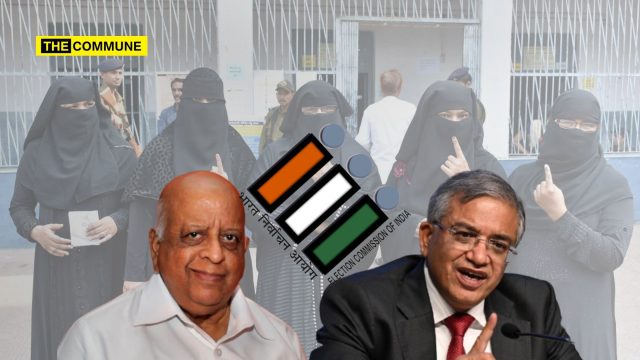
A directive from the Election Commission of India (ECI) concerning the identification of burqa-clad women at polling stations has become a flashpoint in Bihar’s political discourse, with the ruling alliance and opposition parties offering sharply contrasting interpretations of the measure.
The instructions to polling officials, which mandate proper verification of purdahnasheen (veiled) women voters to prevent impersonation, have been strongly criticized by the opposition RJD-Congress alliance. Leaders have labeled the move “undemocratic,” arguing it singles out a specific community.
A Long-Standing Provision, Not a New Rule
Contrary to claims that the directive is novel, historical records show the ECI has been concerned with this specific aspect of the electoral process for decades. The current debate echoes a 1994 directive issued by the Election Commission under then Chief Election Commissioner T. N. Seshan.
In Order No. 576/11/ESO24/94-J.S.II, dated 21 October 1994, the Commission recognised that in certain regions, particularly among purdahnasheen women, social and religious customs limited female voter turnout.
Citing Articles 325 and 326 of the Constitution, which guarantee equal voting rights regardless of religion, caste, or sex, the order called for special arrangements to ensure that purdah-observing women could exercise their franchise without hesitation.
It directed that:
Lady polling officers must be appointed in areas with significant numbers of purdah-observing women.
Private enclosures or curtained spaces be set up inside polling stations for discreet voter identification.
Separate queues and facilities be provided to maintain privacy and respect religious sensitivities.
Despite these detailed provisions, election observers acknowledge that implementation has remained patchy over the decades. Many polling stations still lack designated spaces or female staff for secure identification, forcing ad hoc arrangements that vary from state to state.
Burqa & Fake Voting — Why this Meltdown from the Opposition?
The issue of verifying Purdahnasheen (Burqa Wearing Women) voters isn’t new, it traces back to the time of Congressi Agent T. N. Seshan
In fact, a 1994 Election Commission Order had already called for stricter checks… pic.twitter.com/lcTDg454Ks
— Rishi Bagree (@rishibagree) October 16, 2025
Officials argue that impersonation and fake voting can undermine democratic credibility, but critics contend that such measures “risk alienating sections of women voters” by creating discomfort or distrust in the process.
Integrity vs. Vote Bank Politics
The vehement opposition from the RJD and Congress is more about protecting a political strategy. The procedure itself is designed to be respectful and private, using female officials to facilitate voting, not prevent it. The core of the issue is not the burqa itself, but the fundamental principle that every voter must be verified to prevent a single person from voting multiple times while disguised.
The opposition’s meltdown suggests that their concern lies not with the dignity of voters, but with the integrity of the voter roll. By opposing a basic anti-fraud measure that has been on the books for 30 years, the RJD and Congress are signaling that their electoral calculations rely on a system where verification is not fully enforced. The controversy has little to do with culture and everything to do with a political ecosystem that has historically benefited from blurred lines in electoral accountability. The ECI’s move simply enforces a rule that should be beyond debate: that every legitimate vote must be protected, and every voter must be who they say they are.
Subscribe to our channels on Telegram, WhatsApp, and Instagram and get the best stories of the day delivered to you personally.