


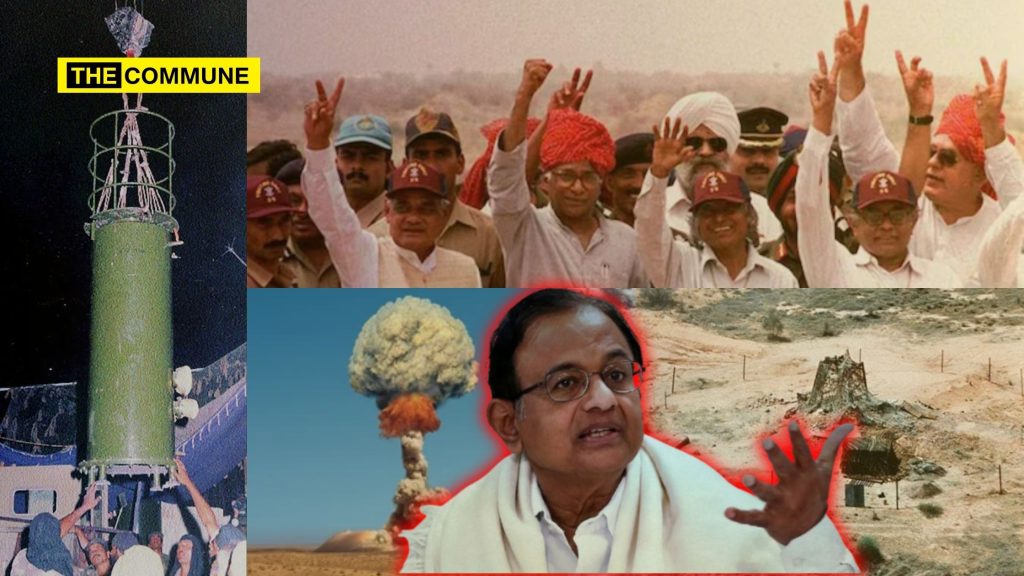
On 11 and 13 May 1998, India made history under the leadership of Prime Minister Atal Bihari Vajpayee by successfully conducting nuclear tests in Pokhran, Rajasthan. The event marked India’s formal emergence as a nuclear weapons state. However, interestingly, not everyone in Parliament welcomed the move. The Congress, especially, was totally against this move.
In a session in Parliament, Congress MP P Chidambaram makes a near half-hour speech urging the NDA government to “abjure weaponization”. He also said there was a “cynical manipulative agenda behind this testing”.
Let’s take a deeper look at his statements in Parliament.
“Vanity Project” and “Cynical Agenda”
In perhaps his harshest criticism, Chidambaram accused the Vajpayee government of triggering a dangerous arms race for electoral gains. He said, “India would have incurred an unbearable cost just to satisfy the vanity of a political party which is a quiet part after the election.”
He went on to suggest that the nuclear tests were a “cynical” ploy to generate nationalist sentiment before elections, not a well-thought-out defense strategy.
Congress Opposed Weaponization, Not Just Timing
While Congress claimed to support the scientific achievements behind the Pokhran tests, Chidambaram made it crystal clear that they opposed the weaponization of India’s nuclear capability. He said, “We are opposed to weaponization, we are opposed to building a nuclear arsenal, we are opposed to inducting nuclear weapons, we are opposed to taking India into an arms race.”
This is not a disagreement over process or transparency; this is a categorical rejection of the national security direction India chose under the Vajpayee government.
Fearmongering About Arms Race
Chidambaram argued that the tests would push India into a perilous arms race with Pakistan and China, claiming that, “You have made both your major neighbours sworn enemies as a result of what you did… and what will they do? They will acquire air defense systems… missiles… and even seek a nuclear umbrella.”
He likened India’s decision to the Cold War’s “Star Wars” arms race, ignoring that India was merely asserting its sovereignty in a volatile neighbourhood, not initiating global hegemony. He said, “You have made both your major neighbors sworn enemies as a result of what you did on lemons and the 13th of May and what will they do they will acquire air defense systems as a scientist can see some of your scientists think that we can get over their air different systems which means they will acquire air different systems which can get over your missiles which can get over your current air defense systems they will acquire surface-to-air missiles they will acquire air-to-air missiles they may even ask superpowers to provide them a nuclear umbrella and then what will you do you will then acquire missiles which can get over their new air defense systems precisely the kind of arms race which Mark the core this is precisely the scenario of Star Wars which the world debunked and criticized and condemned what you are doing in this South Asian theater is a smaller version of the Star Wars in which Russia Soviet Union and the U.S engaged for 30 years and which invited the condemnation of the whole world.”
Claimed 1974 Tests Different From 1998
Trying to prove that the nuclear tests under Indira Gandhi were different, Chidambaram said, “We don’t make a bomb and keep it the basement. Mr Jagmohan asked Mr Natwar Singh what was the difference between 1974 and 1998? The difference was this, Indira Gandhi tested, she did not utter the word weaponization’ you tested and before the mushroom cloud died down, your ministers were talking about weaponization, about mounting warheads and missiles, about an unfinished agenda, about Hot Pursuit, about a fourth War.”
Accusations of “Invented Threats”
Chidambaram even went as far as to accuse the Vajpayee government of manufacturing threats from China. He said, “China was no threat on the 18th of March, China was no threat on the 19th of March, China was no threat on the 8th of April, China was no threat on the 11th or the 13th of May, you have invented a threat in China”
He also said, “China was no threat to India; the last war with China was fought 36 years ago and the circumstances under which that War began and concluded are still surrounded in controversy; the last war with Pakistan was fought 27 years ago.”
This statement has not aged well. Today, with Chinese incursions in Galwan, Doklam, and the PLA’s military buildup in Arunachal Pradesh, Chidambaram’s dismissive tone about the China threat appears dangerously naïve. Additionally, Pakistani soldiers and militants infiltrated into Kashmir (beyond LoC) in 1999 and today, we have the ongoing Operation Sindoor apart from many other terrorist attacks that have been ably aided by the Pakistani Army.
He further said, “Weaponization, induction of this weapon into the Armed Forces, mounting weapons and missiles and aircraft developing missiles to deliver it into enemy territory, these are very serious subjects on which I do not believe your government has a mandate to take a unilateral decision.”
Undermining Strategic Autonomy
Rather than applauding India’s assertion of sovereignty in an unequal global nuclear order, Chidambaram argued, “Possessing nuclear weapons is simply inconsistent with the moral authority that India had acquired over the last 30 years to tell the world that our goal is a nuclear weapon-free state; if you’re seriously a weapon-free world, I urge you I most humbly urge you abjure weaponization until there is a full and proper debate in this country and this parliament of the need to acquire nuclear weapons and to induct them into the Armed Forces it is simply inconsistent it cuts at the very root of our commitment to a nuclear weapon-free state to acquire a whole arsenal of nuclear weapons.”
The Congress position ignored India’s decades-long struggle for recognition as a legitimate nuclear power and instead clung to abstract moralism, a luxury most sovereign nations, especially those surrounded by hostile neighbours, cannot afford.
Congress Wanted Delay, Not Deterrence
Chidambaram claimed that the government had “violated” its own promise of conducting a Strategic Defence Review before any nuclear decision. He mocked the decision to proceed with testing just weeks after Vajpayee assumed power, insinuating that politics and not national interest drove the decision. He said, “You have not discovered a new threat; you invented one.”
Yet, the need for credible deterrence wasn’t new. India had kept the nuclear option open since 1974, and the regional environment post-1998 vindicated Vajpayee’s urgency.
Congress Favoured Signing the CTBT
Chidambaram said he felt betrayed that the opposition was not taken into confidence with regard to the tests. He said, “My fear is that from this point of time this government can take one of three roads. One is a road to a local limited War and I think there are people in this government who would actively canvas to travel down that road. The other is the road to sign the CTBT, there are statements by a number of people including the principal secretary to the prime minister that we are willing to negotiate and accept aspects of the CTBT. I think we should have a full-scale debate on the meaning of that statement. The CTBT is not open to negotiation, it is only open to signature; 149 countries have already signed, and you can sign it up to September ’99. It does not provide for negotiation and who will you negotiate with, who was offered to negotiate CTBT with you. So, the second Road therefore means the road which France and China took; do a few tests acquire some political advantage and quietly sign the CTBT which means all the carefully constructed arguments of the last five years that we will not sign the CTBT will lie in a shambles. The Third Road is a road to elections. Since I do not believe that you have the courage to take us to a war and since I do not believe that you have the skills to negotiate a CTBT, I’m afraid you are cynically taking us to the road to an election. We’re not afraid, we’re only sad, if that is your real agenda say so.”
This would have permanently capped India’s nuclear posture and denied it a credible deterrent — a decision that would have severely impacted India’s long-term strategic parity with China.
A Divisive Stand
Perhaps the most telling line of Chidambaram’s speech was his closing remark, “For the first time in India’s history, India’s foreign policy and nuclear policy, which hitherto enjoyed unprecedented consensus, stand fractured.”
That fracture was caused by the Congress party, not by the tests. By refusing to rise above partisan calculations, Congress broke ranks on one of the most significant moments in India’s post-independence history.
The 1998 Pokhran tests were not just a technological triumph — they were a moment of civilizational assertion. In opposing them, the Congress Party revealed its discomfort with strong nationalist posturing and its preference for global approval over sovereign assertion.
Today, when many Congress leaders attempt to claim credit for India’s nuclear capabilities or wrap themselves in the tricolor of nationalism, their 1998 record speaks otherwise.
Did you know that former PM Rajiv Gandhi championed the cause of nuclear disarmament?
At a time when China had become a nuclear power and Pakistan was stealthily advancing its nuclear weapons programme with covert international support, Rajiv Gandhi chose to champion global nuclear disarmament.
In 1988, he presented an Action Plan for a Nuclear-Weapons-Free and Non-Violent World Order at the United Nations General Assembly. While idealistic in tone, the plan was seen by many as disconnected from India’s strategic necessities amid an increasingly hostile neighborhood.
“India remains convinced that its security would be strengthened in a nuclear weapon free and non-violent world order,” the plan stated. “We are prepared to negotiate a global No-First-Use treaty… Our proposal for a Convention banning the use of nuclear weapons remains on the table.”
While India’s moral commitment to non-proliferation was commendable, this disarmament push during an era of nuclear arms build-up in both China and Pakistan signaled strategic naïveté rather than pragmatic leadership. Critics say such posturing weakened India’s bargaining position and gave adversaries room to maneuver. Critics argue this emboldened Islamabad’s asymmetric warfare, culminating in Kargil (1999) and 26/11 (2008).
Subscribe to our channels on Telegram, WhatsApp, and Instagram and get the best stories of the day delivered to you personally.