


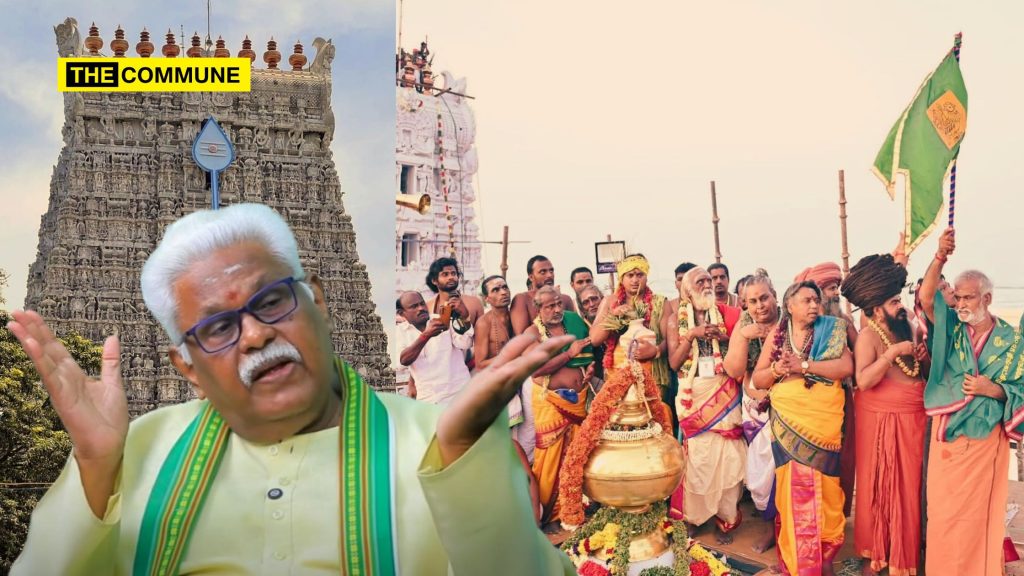
Suki Sivam, a self-styled Tamil orator, writer, and self-proclaimed scholar known for subtly intertwining Dravidianist ideology into his spiritual talks, has once again attempted to revive the Aryan-Dravidian divide theory through misleading religious interpretations in a recent interview on a private channel.
In the interview, he made the baseless claim that Vaidikas (adherents of Vedic traditions) are not respected within the rituals conducted by Sivachariyars (practitioners of Agamic traditions). However, this assertion is clearly contradicted by the reality both traditions have historically coexisted and were present during recent temple consecration ceremonies. But facts seem to be of little concern to Sivam, who went on to claim that the two groups “dis-respect each other.”
In an attempt to validate his claim, he distorted the history bending over backwards to align his explanation with the divisive ideology he subtly promotes.
“What does ‘Kudamuzhaku’ mean? That is, a Sivachariyar performs that ritual in a particular method. If you think even deeper, Vaidikas do not have respect for these Agamas. The Vaidika tradition, which is the Vedic tradition, does not respect the ritualistic tradition of the Sivachariyars. Today, everyone just comes together for a show on the surface. Why is this not respected? Because, for them, God has no form. He can only be invoked in the sacrificial fire (Yagna Agni). Once he appears in the sacrificial fire, offerings and oblations must be given to him, and then he will depart. He does not have a temple or a specific place of his own. They might feel bad if told, but Vaidikas are immigrants from outside, so they do not have land. Those who do not have land do not have temples. Those who do not have temples do not have idols. Those who do not have idols do not have idol worship. Is this the history?” he asks.
Then, Suki Sivam went on to claim that there is an ‘ego’ in some (indirectly brahmins) who assert vegetarianism as superior, and that they look down upon non-vegetarian food, especially in the context of temple worship.
What was even more audacious was that, with the same breath he used to praise the Sivachariyars, Suki Sivam went on to accuse them of being casteist and oppressive. He said, “Shall I tell you something else? Shall I tell you why Sivachariyars are now saying, ‘we don’t want JC and DCs, free all temples? It’s not about some grand Hindu religious principle. It is nothing like that. The JC (Joint Commissioner) and DC (Deputy Commissioner) can come from Scheduled Castes. They can come from the Most Backward Classes. Now, they (Sivachariyars) can’t bear it. Because in the temple, they have to answer to that person, understand? A person from an oppressed community has come and sat as a JC. He will say, ‘call that Sivachariyar’ and say, ‘Come here!’ They have to come. He’ll say, ‘I’ll suspend you, understand? Don’t try these things with me, I’ll ruin you.’ How can they tolerate this, sir? For so long, the very people we were intimidating are now coming and sitting above as boss. So, saving the Hindu religion isn’t important here; prestige is what’s important.”
In the interview, he further alleged that temple pontiffs and heads remain silent out of fear of political leaders, as many of them are entangled in land and property misuse cases. He also claimed that Hinduism is being overshadowed by Vedic dominance, implying that the authentic Tamil spiritual tradition is being systematically erased. His opposition to this so-called ‘Vedic supremacy’ has, unsurprisingly, drawn strong backlash from Hindutva groups.
Toward the end of the interview, when asked about Tamil Nadu Governor RN Ravi’s remarks portraying Tiruvalluvar and Vallalar as pioneers of Sanatana Dharma, Suki Sivam mocked at the idea and dismissed the Governor’s intent and painted, saying, “It would be better if everything was Sanatana. You’re saying everything in this world is Sanatana. Sanatana means old, what else? So, there’s nothing terribly wrong with that word. They want to make it ‘Vedic culture,’ but they don’t have the courage to say it. They go for the word ‘Sanatana’ because if they say ‘Vedic culture,’ others will come for a fight. If you truly ask what their agenda is, it’s Vedic culture, and within Vedic culture, it’s the supremacy of Vaidika (Brahminical) traditions, and when Vaidika comes, it inherently implies the superiority of one caste based on lineage that is the ultimate aim. Instead of speaking the truth directly, they are touching their nose in various roundabout ways.”
He added, “Calling him a Sanatani is pure stubbornness. It’s a stubborn thing for you to say. I’ll stubbornly put up a picture of Thiruvalluvar with stripes (thiruneetru pattai)! Well, I don’t know if he had sacred ash (Thiruneeru) on his forehead otherwise wouldn’t he have written a chapter on it like Gnanasambandar or someone similar, he would have sung a hymn about sacred ash, right? Not just that, Saivism has so many brand ambassadors like Sambandar, Manikkavasagar, and Thirunavukkarasar. He (Thiruvalluvar) doesn’t need to be added here. He was an independent thinker. The Sangam period, and before that, the Tamil way of life that simply relied on nature, then the mixing with North Aryans, and the resulting change in religious thought – the Thirukkural emerged during this time when all these influences were forming. Therefore, it will have a little bit of everything. The ancient, the intermediate, and then a bit of the thought from the Vedic culture – all will be present in the Thirukkural. Based on that, they now say he was a Muslim. They say he was a Christian. They can say whatever they want. But doesn’t that prove he wasn’t any of those? Anyone can say anything, right?”
Subscribe to our channels on Telegram, WhatsApp, and Instagram and get the best stories of the day delivered to you personally.