


In a shocking revelation, the decades-long activities of USAID-funded World Vision International (WVI) in India have come under scrutiny, exposing a well-orchestrated campaign of religious conversion and subversion of Hinduism. With over $2 billion in funding from USAID, World Vision India received hundreds of crores annually to carry out its operations, which, despite its humanitarian façade, were deeply rooted in Christian evangelism and conversion.
The Modi government’s decision in 2024 to revoke World Vision India’s Foreign Contribution Regulation Act (FCRA) license marked a significant blow to the organization’s conversion activities. However, the roots of this controversial entity trace back to 1951, when it first established its presence in India, thanks to the tacit approval of then-Prime Minister Jawaharlal Nehru.
The Origins Of World Vision: A Conversion Agenda
World Vision International was founded in 1950 by Bob Pierce, an American evangelist who began his mission in China. Pierce’s journey into evangelism started in 1947 when he preached at a school in China, leading to the conversion of a young girl named White Jade. After her family disowned her, Pierce provided financial support, an act that became the foundation of World Vision.
However, the organization’s origins reveal a darker truth. According to the book Religion in Philanthropic Organisations, edited by Thomas J. Davis, Pierce’s mission was not merely humanitarian but deeply evangelical. During his 1947 visit to China, Pierce converted 17,000 people to Christianity, including minors, through what can only be described as predatory proselytization.
World Vision’s website sanitizes this history, portraying Pierce as a benevolent figure who gave his last $5 to help an abandoned child. However, the reality is that Pierce’s mission was to spread Christianity, particularly in Asia, and his organization became a vehicle for converting vulnerable populations, including Hindus in India.
World Vision In India: A 70-Year Legacy Of Conversion
World Vision India was established in 1951, with its first office opening in Kolkata in 1958. Over the decades, it received billions of dollars from USAID, funneling hundreds of crores annually into India. While it presented itself as a humanitarian organization focused on child welfare, its primary objective was religious conversion.
Bob Pierce’s travels to India in the 1950s reveal a concerted effort to convert Hindus and Sikhs. In a letter dated February 1953, Pierce described his activities in Calcutta, where he preached to Indian students and facilitated conversions. By 1956, Pierce had set his sights on India as a key target for evangelism, with the tacit approval of Indian leaders.
Nehru’s Meeting With Evangelists: A Turning Point
In 1956, Bob Pierce and Billy Graham, another prominent American evangelist, met with Prime Minister Jawaharlal Nehru. This meeting, documented in Graham’s autobiography Just As I Am, marked a pivotal moment in India’s history.

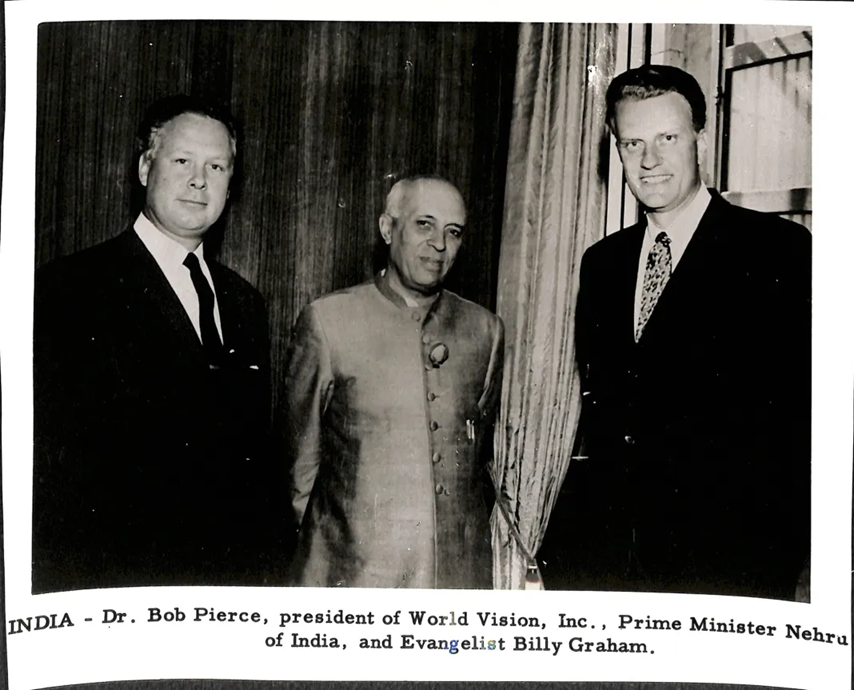
During the meeting, Nehru expressed no opposition to Christian missionary work, stating that he had no issue with their activities as long as they avoided politics. This tacit approval from India’s first Prime Minister opened the floodgates for organizations like World Vision to operate freely in the country.
Billy Graham, who was closely aligned with US foreign policy goals, had been sent to India with the explicit mandate of countering Soviet influence during the Cold War. His evangelistic crusades, which saw thousands of Hindus converting to Christianity, were not merely religious endeavors but also tools of American diplomacy.
Graham’s 1956 trip to India, funded and supported by the US government, saw him preaching to massive crowds in cities like Bombay, Madras, and Delhi. In his autobiography, Graham recounts how he distributed thousands of Bibles and facilitated the conversion of thousands of Hindus, including children.
Indira Gandhi’s Role: Continuing The Legacy
The legacy of enabling Christian evangelism in India continued under Prime Minister Indira Gandhi. In 1972, Billy Graham returned to India, this time with a specific focus on Nagaland. Despite the region’s instability, the Indian government granted Graham unprecedented access, including police protection, government accommodation, and even helicopters for travel.

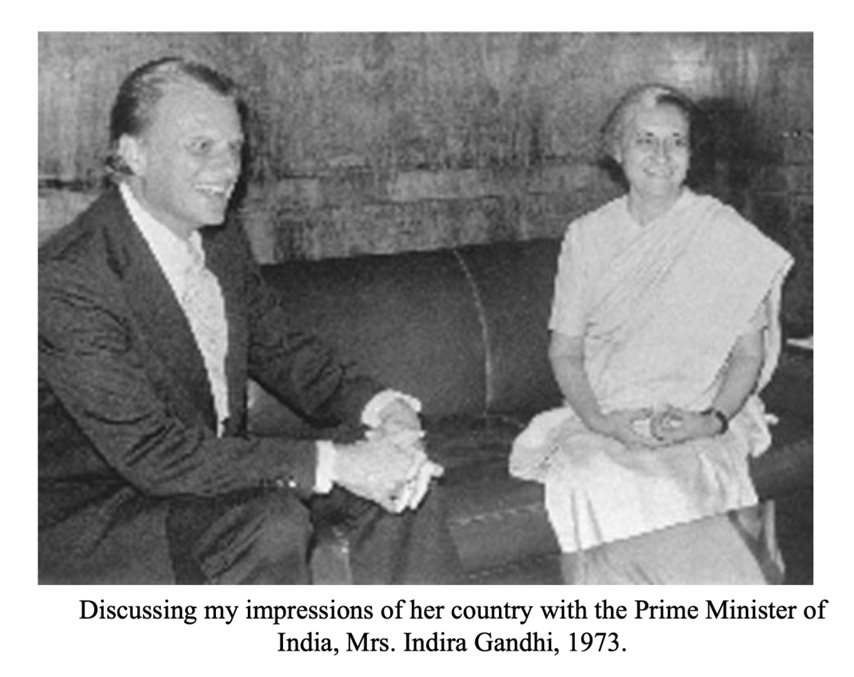
Graham’s visit to Nagaland, where he preached to over 500,000 people, was facilitated by the Reverend Longri Ao and other church leaders associated with the World Council of Churches (WCC). The WCC, a trusted partner of World Vision, has long been accused of funding anti-India activities and promoting religious conversion.
Indira Gandhi’s government went out of its way to support Graham’s mission, even as foreign visitors were typically barred from entering Nagaland due to security concerns. This level of support underscores the extent to which Indian leaders enabled the activities of evangelical organizations.
The Modi Government’s Intervention
In 2024, the Modi government took decisive action against World Vision India by revoking its FCRA license, effectively cutting off its foreign funding. This move was hailed by many as a long-overdue step to curb the organization’s conversion activities.
However, the damage had already been done. For over 70 years, World Vision operated with impunity, converting countless Hindus, particularly women and children, under the guise of humanitarian work. Its activities were not only a threat to India’s cultural and religious fabric but also a tool of foreign influence, with USAID and the US deep state playing a central role.
The story of World Vision in India is a stark reminder of how foreign-funded organizations can exploit vulnerable populations for religious and political gains. With the tacit approval of leaders like Nehru and Indira Gandhi, World Vision and other evangelical groups were able to carry out their agenda for decades, leaving a lasting impact on India’s social and religious landscape.
(With inputs from OpIndia)
Subscribe to our channels on Telegram, WhatsApp, and Instagram and get the best stories of the day delivered to you personally.