


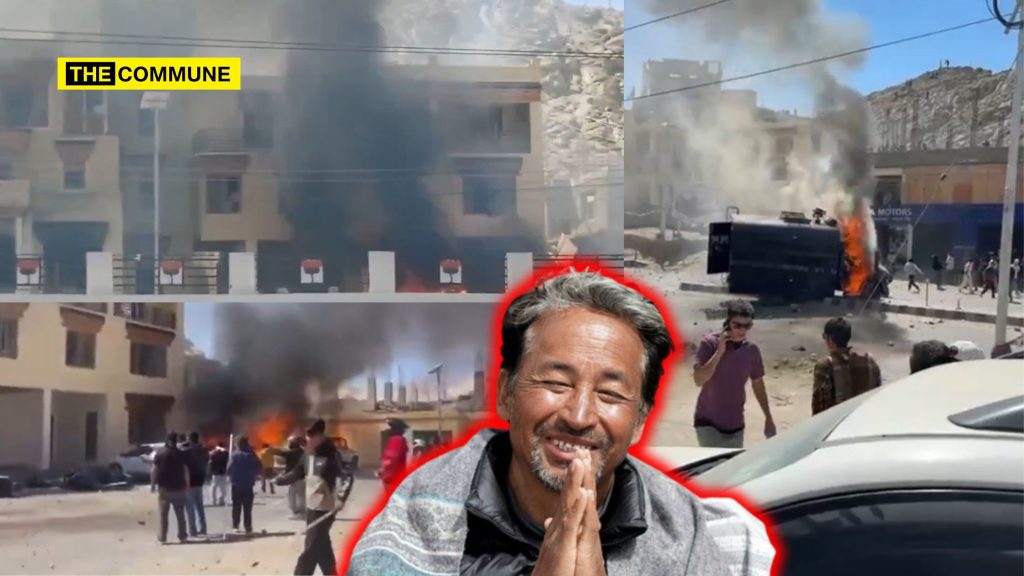
The recent violent protests in Ladakh have captured national attention, not just for the unrest itself but for the broader questions they raise about development, governance, and strategic security. What may appear as a local agitation for greater autonomy and protections is, on closer inspection, part of a complex interplay of political, environmental, and geopolitical factors that demand careful analysis.
The Protest and Its Roots
The immediate trigger for the protests is a demand to include Ladakh under the Sixth Schedule of the Indian Constitution, which would grant the Union Territory greater autonomy over local governance, taxation, and judicial powers. Protesters argue that such powers are necessary to preserve the region’s unique culture, language, and fragile environment.
Many observers, however, question the choice of the Sixth Schedule rather than the Fifth Schedule. The Fifth Schedule applies to most tribal areas in Central and Southern India and allows local councils to advise on development planning in coordination with the state governor. The Sixth Schedule, which currently covers tribal regions in the Northeast, provides far greater powers, including the ability to execute development projects independently, collect taxes, and manage judicial functions. Granting Sixth Schedule status to Ladakh would thus represent a significant legal and constitutional shift, requiring an amendment.
This legal nuance is critical. Critics argue that if implemented, Sixth Schedule powers could slow down critical infrastructure projects in the region, such as highways, tunnels, and airstrips—projects vital for both local development and national security in this border-sensitive area.
Selective Protest: Who Is Involved?
It is important to note that not all residents of Ladakh are participating in or supporting these protests. Analysts have described the movement as driven by a select group of activists (you know who they are) who have used environmental and cultural concerns to amplify their visibility. These activists claim that India’s development projects are harming Ladakh’s delicate ecology. Yet, similar or even larger-scale projects by China in neighboring regions such as Aksai Chin, Western Tibet, and Xinjiang have not provoked comparable protests.
Over the past few years, China has developed extensive infrastructure in these areas, including strategic highways, airstrips, and military bases, releasing millions of tons of carbon dioxide into the environment in the process. Local observers note the irony: while Chinese development was largely ignored, Indian development in the same ecologically sensitive region is being framed as environmentally destructive. Was the environment not fragile then?
A Strategic Laboratory?
Some analysts have described Ladakh as a “laboratory” for protest tactics. Observers note parallels with developments in Nepal, where protests were reportedly organized under the guise of legal or judicial issues to engineer a regime change. In Ladakh, the protests are framed as environmental and cultural advocacy, but they may serve broader strategic objectives, including testing protest methodologies that could later be applied elsewhere in India.
These tactics include:
- Street protests – visibly mobilizing citizens on emotive issues like language, culture, and ecology.
- Media campaigns – amplifying narratives of ecological damage and the insensitivity of the government.
- Intellectual framing – engaging think tanks, podcasts, and debates to sustain the narrative at a national level.
The careful orchestration of these campaigns suggests that the unrest is not entirely spontaneous but part of a wider, planned strategy.
Geopolitical Dimensions
The protests also have significant geopolitical implications. Analysts point to the role of China’s United Front Work Department, a specialized branch of its Ministry of State Security tasked with shaping foreign narratives and obstructing strategic projects abroad.
According to experts, the department employs a two-pronged approach:
Aggressive media posture – using public statements, renaming of places, and symbolic gestures to influence perceptions. For example, China has repeatedly claimed Arunachal Pradesh as part of South Tibet in international discourse.
Obstructionist campaigns – framing Indian development projects in Ladakh and Kashmir as environmentally destructive, thereby creating delays or resistance at local and national levels.
This strategy aligns with China’s broader objective of maintaining a strategic edge in the Himalayan region by slowing India’s infrastructure parity, particularly in border-sensitive areas.
Development vs Ecology
The protests spotlight a deeper tension between development and ecological concerns. ‘Activists’ like Sonam Wangchuk argue that India’s projects in Ladakh threaten fragile ecosystems and tribal cultures. Yet environmental arguments are selectively applied, as similar large-scale Chinese projects in the region received little to no pushback.
Experts note that climate change and environmental degradation are global commons problems. Industrialization in other parts of the world has contributed far more to atmospheric carbon dioxide than localized development in India. Despite this, India’s projects in Ladakh are criticized, demonstrating the selective framing used in the protest narrative.
Political Implications
Domestically, the protests intersect with ongoing political struggles. Analysts note that the Congress party and certain local actors may be using the unrest to challenge the ruling BJP, weaken public perception of Prime Minister Narendra Modi, and create a broader narrative of governmental insensitivity. We already saw that despite the mob being of an older age group, Congress and supporting handles on social media called it “Gen Z protest” after Wangchuk blamed them for the arson and violence.
While the majority of Ladakh’s population is not involved, a small, vocal ‘activist’ group has been able to attract significant attention, making use of national media and social media platforms.
The Ladakh protests can thus be seen as part of a larger pattern: attempts to create street-level unrest, amplify grievances via media, and frame the narrative in ways that slow down government initiatives. This pattern has parallels with previous campaigns, including protests around the Citizenship Amendment Act (CAA) and other socio-political movements in India.
This comes exactly a week after Rahul Gandhi called on the youth, students, and Gen Z to “save the Constitution, protect democracy, and stop vote theft,” effectively encouraging them to mobilize politically against the government. By framing the youth as defenders of democracy, he positions them to take direct action, which can be interpreted as instigating unrest. His remarks echo regional examples like Nepal, where youth-led movements spiraled into protests and chaos, suggesting a potential blueprint for similar disruption in India. Critics argue that his message is less about safeguarding democracy and more about stirring dissent among young people against the current government, with Rahul himself cast as a guiding figure.
Looking Ahead
While the immediate unrest may have calmed, observers warn that the real work of shaping narratives is only beginning. Intellectual discourse, media debates, and online campaigns are expected to continue framing India’s development as ecologically insensitive, potentially creating long-term obstacles for projects in Ladakh and similar regions.
The protests highlight the need for citizens, policymakers, and analysts to critically assess the motivations behind movements. Not every demonstration is purely local; some may be influenced by broader political or geopolitical agendas. Understanding these layers is crucial, especially in regions like Ladakh, which are simultaneously ecologically fragile, strategically vital, and historically marginalized.
Subscribe to our channels on Telegram, WhatsApp, and Instagram and get the best stories of the day delivered to you personally.