


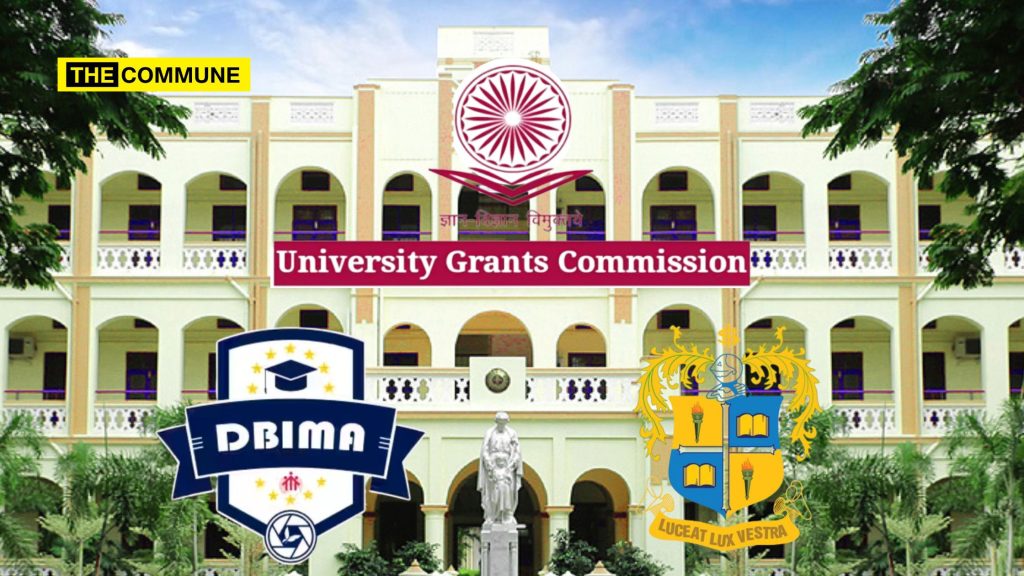
The University Grants Commission (UGC) has issued a stern warning to students, higher education institutions, and EdTech companies against forming or promoting academic collaborations with unapproved foreign entities. The Commission cautioned that degrees and diplomas awarded through such unauthorized arrangements will not be recognized and may result in strict punitive action.
This strong advisory follows growing concerns and complaints regarding Loyola College, Chennai’s contentious partnership with Don Bosco International Media Academy (DBIMA), Paris. Legal Rights Protection Forum (LRPF), a legal advocacy group, lodged formal complaints with the UGC, Ministry of Education, and the University of Madras, alleging that Loyola was conducting an unauthorized diploma program in filmmaking in association with DBIMA. The program, according to the complaint, violates key higher education regulations and could jeopardize the visa and academic standing of Indian students abroad.
On 22 July 2025, the UGC reiterated its position through an official statement referencing its earlier notification dated 12 December 2023. The statement reminded stakeholders about the regulatory framework governing academic collaborations, specifically the UGC’s 2022 and 2023 regulations concerning joint and dual degrees, twinning arrangements, and foreign campus operations.
“It has been observed that many HEls/colleges have entered into collaborative agreements/arrangements with foreign-based educational institutions/providers not recognized by the Commission and have been facilitating the issuance of degrees to the students enrolled in those institutions/college from such foreign-based educational institutions/educational providers. Similarly, some EdTech companies are also giving advertisements in newspapers/social media/television ete. offering degree and diploma programmes in Online modes in association with some foreign universities/institutions. Therefore, it is reiterated that any such kind of collaboration/ arrangement is not recognized by the University Grants Commission and accordingly, the degrees issued subsequent to such collaboration/ arrangement are also not recognized by the Commission. Action will be taken against all the defaulting HEls and EdTech companies under applicable laws/rules/regulations. Students/general public are once again advised to exercise due caution and are made aware that such courses/programmes/degrees do not have UGC recognition and that they would be doing at their own risk and consequences.” the UGC said.
📢 UGC Updates
UGC warns students and institutions against collaborations with foreign-based education providers and EdTech companies that are not recognised by the Commission. Degrees obtained through such arrangements are not valid and may result in strict action.
🔗 Read the… pic.twitter.com/4AW4YtPsss
— UGC INDIA (@ugc_india) July 27, 2025
Allegations of Fraud and Misconduct Rock Loyola College and Don Bosco Academy
In a blistering email addressed to the CEO of Don Bosco International Media Academy (DBIMA), Paris, Joseph Kennedy a distinguished alumnus of both Loyola College, Chennai, and Don Bosco institutions has leveled serious accusations of academic malpractice, ethical misconduct, and deliberate concealment surrounding an unauthorized “Diploma in Filmmaking (AI), France.”
Kennedy, widely recognized for his 2022 campaign that led the University Grants Commission (UGC) to reject Loyola College’s bid for university status, has once again publicly challenged his former institution. His latest allegation targets a joint diploma program between Loyola and DBIMA Paris, which he claims violates educational norms and misleads students under the guise of a “dual certification” allowing project completion in France.
Despite the program being heavily promoted, including by DBIMA’s CEO Fr. John Paul Swaminathan, an RTI response from the University of Madras Loyola’s affiliating university confirms that the filmmaking diploma has not received formal approval, rendering it illegitimate under Indian regulations.
“Loyola College has a history of entering into unauthorized international collaborations without proper regulatory clearance,” Kennedy stated, citing his detailed 41-page submission to the UGC, titled “Loyola College, Chennai is at a Dangerous Inflection Point.”
The controversy takes a darker turn with the involvement of actor John Vijay, featured in promotional materials for the program alongside Fr. Swaminathan. Vijay has faced multiple accusations of sexual harassment, including during the 2018 and 2024 waves of India’s #MeToo movement. Despite these public allegations widely reported in outlets like Hindustan Times and India Today the institution continued to associate with him, a move Kennedy calls “deeply unethical and morally indefensible.”
“When a faith-based college promotes someone with a record of sexual misconduct, it sends a dangerous signal,” Kennedy emphasized.
In his email, Kennedy clarified that he is not inviting dialogue but publicly distancing himself from what he described as a “morally bankrupt” operation.
“If DBIMA continues its collaboration with Loyola, it does so fully aware that it is endorsing an academically unapproved and ethically compromised program.”
This development emerges amid increasing scrutiny of Catholic educational institutions in India, especially those run by Jesuit orders, many of which face criticism for administrative opacity, abuse cover-ups, and commercializing education under the guise of religious values.
Silence from DBIMA and Loyola, Escalating Regulatory Heat
As of now, neither DBIMA Paris nor Loyola College has issued any public statement addressing the allegations. However, sources within the University of Madras suggest further regulatory measures may be initiated if the program continues despite lacking approval.
Meanwhile, the University of Madras with over 130 affiliated colleges has come under fire for sidestepping its responsibilities. Instead of providing clear answers to an RTI filed by Kennedy, now an activist with Ending Clergy Abuse (ECA) India, the university redirected the request to Loyola itself raising concerns about its oversight mechanisms.
Kennedy’s RTI sought clarification on the academic legitimacy of the filmmaking diploma, the nature of correspondence between Loyola and the university, and possible violations of affiliation norms. Yet, the university effectively washed its hands of the matter.
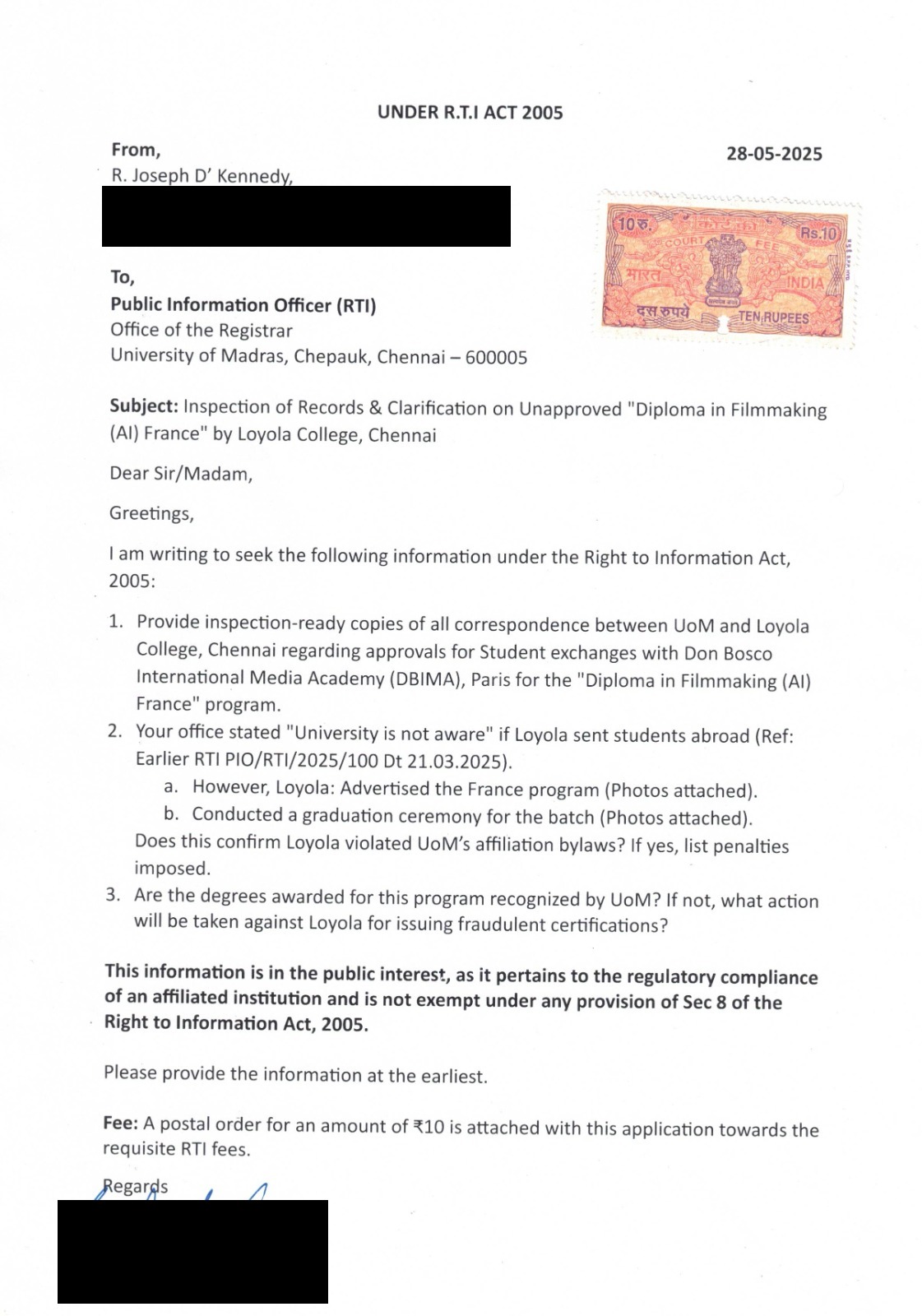

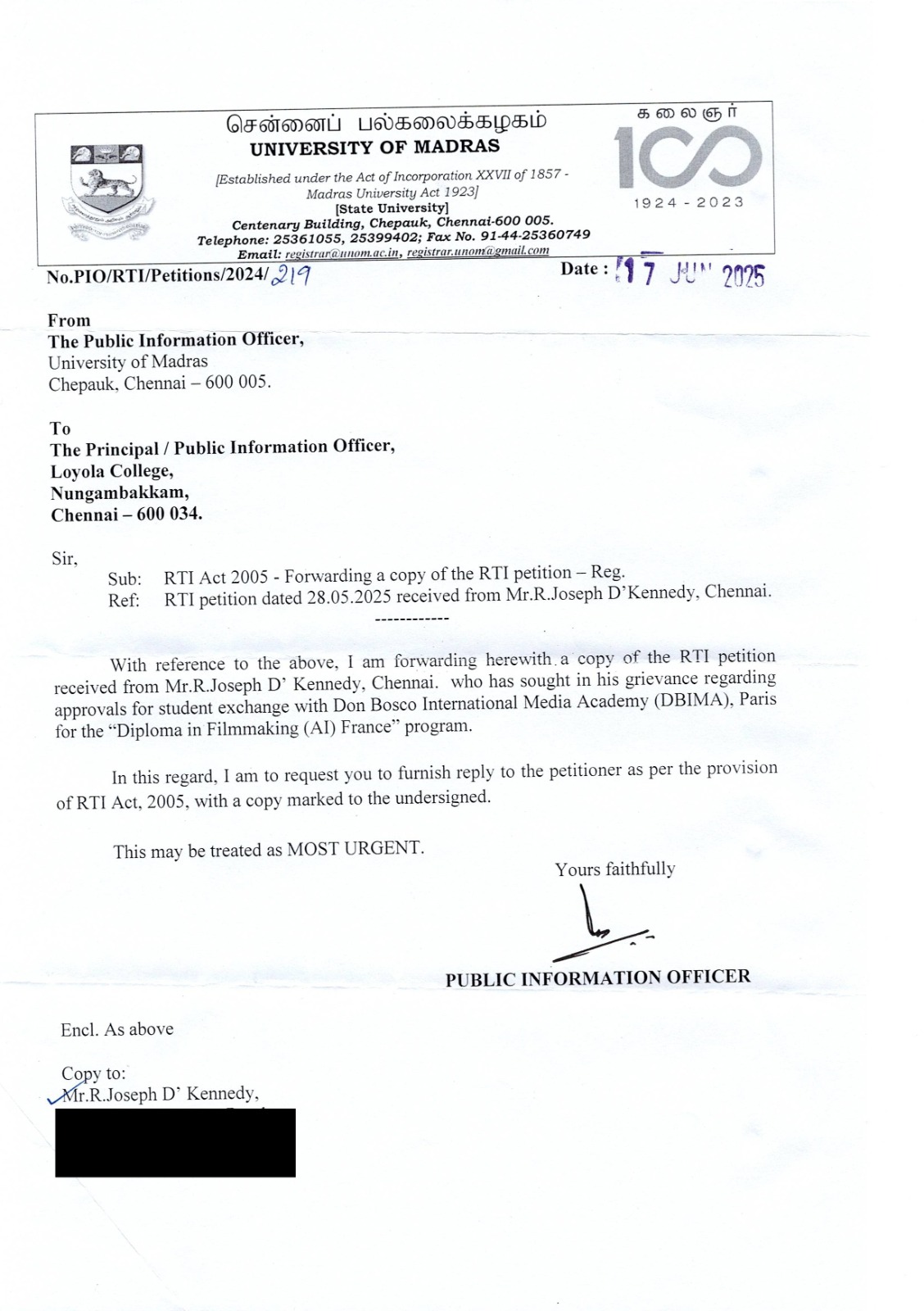

“Asking Loyola to investigate itself is a complete abdication of responsibility,” Kennedy said. “It’s an institutional failure that threatens both student welfare and public trust in higher education.”
A Glamorous Facade, Misleading Promotions
Despite lacking regulatory clearance, Loyola conducted a graduation ceremony for students of the disputed diploma course. The event featured prominent figures from the Tamil film industry, including cinematographer P.C. Sreeram, actor Arya, veteran actor Nassar, and editor Lenin lending undue credibility to a program that may not meet legal or academic standards.


Kennedy expressed outrage over this deceptive promotion, “This goes beyond administrative negligence it’s willful deception. Students are spending lakhs for a qualification that may have no standing.”
He further criticized DBIMA’s apparent lack of due diligence before partnering with Loyola, asserting that the Salesian institution must not repeat the mistakes made during the DBPPA Egmore abuse scandal a case Kennedy claims was buried under a culture of silence and image management.
“If DBIMA finds this alliance has been built on false pretenses, it must immediately revoke certifications and publicly admit its role in misleading students.”
Human Rights Implications and Public Accountability
Adding weight to the controversy, the National Human Rights Commission (NHRC) has acknowledged a complaint from the Legal Rights Protection Forum (LRPF), citing potential violations of students’ rights. The complaint points out that unsuspecting students paid substantial fees for a program lacking both recognition and legal legitimacy potentially compromising their futures, especially if they sought international opportunities.
In parallel, Loyola’s evasive handling of RTI inquiries has amplified public criticism. The college failed to respond within the 30-day timeframe mandated by the RTI Act and, when it eventually replied, declined to share meaningful information dismissing the request as not being in the “public interest.”
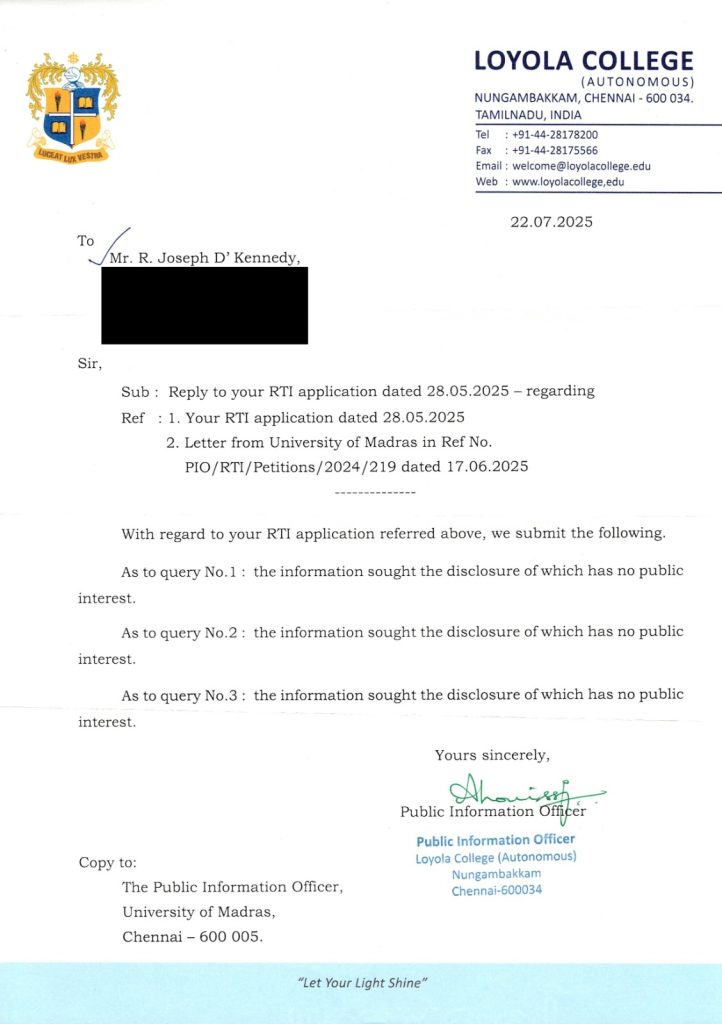

Kennedy was incredulous, “Loyola acts like it’s above scrutiny. They held high-profile MoU events, issued press releases, but now claim there’s no public interest in disclosing program details? That’s absurd.”
A Second Batch Amid the Scandal
Despite legal scrutiny and media coverage, Loyola appears to be pushing forward with a second batch of the same filmmaking diploma, further alarming watchdogs and regulatory authorities. Kennedy warns that this brazen move points to institutional impunity enabled by systemic regulatory failure.
“This isn’t just about Jesuit overreach anymore it’s about a crumbling framework of academic governance. Officials at the University of Madras appear to be complicit by remaining passive.”
The unfolding scandal has exposed serious cracks in India’s higher education oversight particularly the ease with which private and autonomous colleges can bypass approval processes while using foreign branding to attract students. There are growing calls for the UGC and the University of Madras to take immediate and decisive action against Loyola College, restore regulatory credibility, and ensure that similar breaches do not recur.
Subscribe to our channels on Telegram, WhatsApp, and Instagram and get the best stories of the day delivered to you personally.