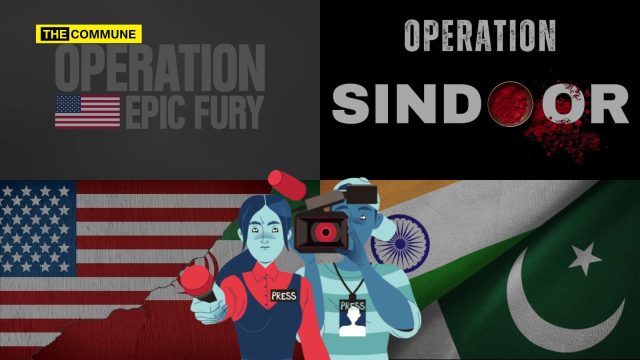
There is a hierarchy in global journalism. It is unspoken, never acknowledged in editors’ notes, and never examined in the self-congratulatory press freedom indexes these outlets sponsor and celebrate. But it operates with remarkable consistency. At the top sits America, whose military claims are scrutinised, questioned, challenged and fact-checked with institutional rigour. Near the bottom sits India, whose official denials are ignored, whose military’s statements are treated as spin, and whose adversary’s unverified claims are granted the same evidentiary weight as sworn testimony.
Operation Sindoor and Operation Epic Fury, read together, expose this hierarchy with surgical clarity.
Exhibit One: Pakistan Claimed, Western Media Published
When Pakistan announced in May 2025 that it had shot down five Indian fighter jets including three Rafales using Chinese J-10C aircraft, it produced no cockpit video, no radar data, no wreckage with verifiable serial numbers, no captured Indian pilot, and no independently verified physical evidence of any kind. What it had was a government press conference, a war to justify to its own public, and a geopolitical incentive to humiliate India’s purchase of French Rafale jets in front of the world.
Reuters ran it. Citing “two US officials” – unnamed, unverifiable, unaccountable, it reported that Pakistan had shot down “at least two Indian military aircraft,” one of them a Rafale. The Washington Post cited an “unidentified French expert” to float the same claim. CNN amplified Pakistani defence sources. The New York Times declared India had “lost aircraft” while no Indian official had confirmed any such thing. Al Jazeera then devoted multi-week editorial analysis to asking “why did India lose jets to Pakistani fire?” treating Pakistani propaganda as an established baseline for inquiry.
What did India’s official position say during those critical first days? Air Marshal AK Bharti acknowledged at a press conference that “losses are part of combat”, standard wartime operational security language but explicitly declined to divulge specifics during active hostilities. India did not say zero losses. It said: classified, active conflict, all pilots are home. That is what every NATO country’s military communications doctrine prescribes in identical situations.
It did not matter. Pakistan had claimed. Anonymous officials had whispered. The story was too useful to wait for facts.
Exhibit Two: America Lost Actual Aircraft, And The World Moved On
In March 2026, three US Air Force F-15E Strike Eagles were shot down over Kuwait during Operation Epic Fury. CENTCOM confirmed this officially, on the record, in a published press release, with full details. No anonymous sources needed. No enemy country’s claim required. America’s own military said: we lost three jets, friendly fire, crews are safe.
Reuters filed one brief wire report. Washington Post ran one story. New York Times published one news brief.
No follow-up investigation. No editorial asking “why did America lose jets?” No multi-week Al Jazeera analysis of US Air Force tactical failures. No anonymous Indian or Iranian officials being given prominent space to speculate about American military incompetence. A confirmed, on-record, three-aircraft loss by the world’s most powerful military generated less sustained coverage than an unconfirmed, enemy-sourced, zero-evidence claim about Indian losses.
Exhibit Three: The Fact-Checking That Only Flows One Way
When Trump claimed during Operation Epic Fury that Iran possessed Tomahawk missiles, PBS, NYT’s Bellingcat unit and PolitiFact mobilised within hours. Expert weapons analysts were quoted. Footage was independently reviewed. The White House was pressed twice. A formal fact-check verdict was issued: False. That is journalism functioning as it should.
When Pakistan released footage claiming to show a downed Indian Rafale, the BBC’s initial instinct was to question whether the Indian government’s denials were credible – not to question whether Pakistan’s claim was fabricated. When India’s PIB Fact Check unit published detailed debunking of Pakistani AI-generated videos falsely attributing statements to retired Indian generals about Rafale losses, it received a fraction of the amplification that the original Pakistani claims had generated. Pakistan’s propaganda was news. India’s rebuttal was a footnote.
The French Navy subsequently exposed Pakistani media claims as containing fabricated quotes and wrong names entirely. Retired Indian officers demonstrated on record that Pakistan had been running an industrialised disinformation operation. India’s Defence Secretary categorically denied Rafale losses: “Absolutely not correct.”
By then, the global narrative had already been written in Pakistan’s favour, by Western newsrooms.
What This Actually Means
This is not a story about media bias as an abstract concept. This is about consequence. When Western outlets repeatedly amplified unverified Pakistani claims about Indian Rafale losses, they handed Pakistan’s diplomatic establishment a ready-made narrative for international forums. They gave France’s arms export competitors ammunition. They seeded doubt about Indian military capability in the minds of potential defence partners. They did, in effect, the work that Pakistan’s information warfare apparatus could not have done alone.
All of it was built on anonymous sources, enemy government claims, and zero verified physical evidence.
Meanwhile, when America’s own military confirmed on the record that it had lost three aircraft in a friendly fire incident during an active war, the same outlets treated it as a one-day news brief and went back to covering Trump’s press conferences.
The two-tier press is not a conspiracy theory. It is a documented, dateable, retrievable pattern of editorial choices that consistently apply rigour to American claims and credulity to Indian adversaries’ claims. The next time Reuters, WaPo or NYT lecture the world about journalism standards and the importance of fact-checking, someone should put these two stories side by side and ask them to explain the difference. Most likely, they will not have an answer.
Subscribe to our channels on WhatsApp, Telegram, Instagram and YouTube to get the best stories of the day delivered to you personally.