


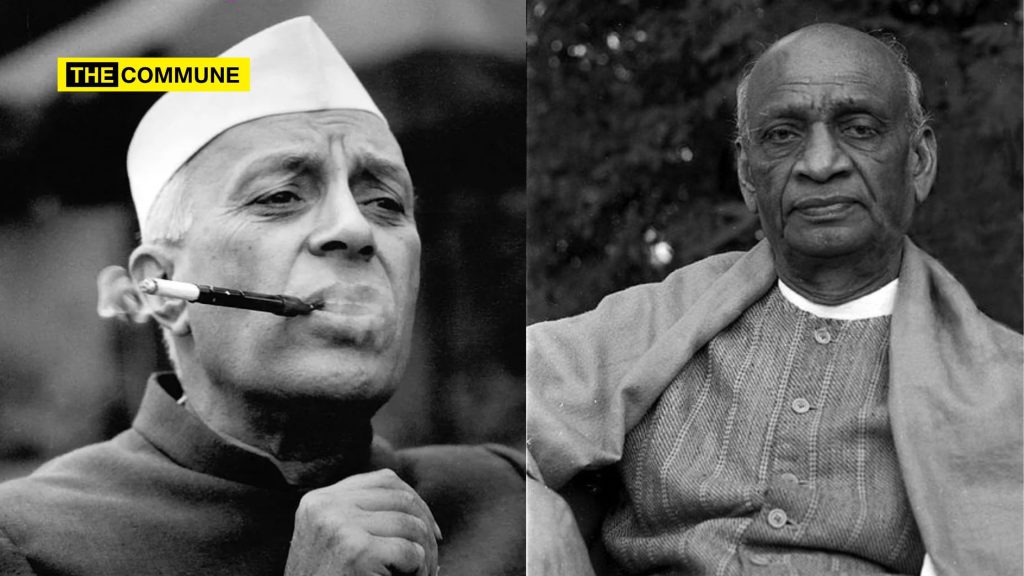
The period immediately following India’s independence was defined by the monumental task of nation-building, a process guided by two towering figures with profoundly different philosophies: Sardar Vallabhbhai Patel and Jawaharlal Nehru.
As India’s first Deputy Prime Minister and Home Minister, Patel was a pragmatic realist, fiercely focused on national integration, internal security, and a strong, centralized state. In contrast, Prime Minister Nehru was an idealist, championing socialist economics and a foreign policy based on internationalism.
This report details eight major conflicts between them from 1946 to 1950, highlighting how their contrasting visions shaped the nascent republic and how Patel’s more decisive approach was often overruled, with long-term consequences for the nation.
#1 The 1946 Congress Presidential Election
In May 1946, the first major conflict occurred over the election for the Congress President, a post that would lead to becoming the first Prime Minister. Despite 12 out of 15 Pradesh Congress Committees nominating Sardar Patel for the presidency, Mahatma Gandhi expressed his preference for Jawaharlal Nehru. Out of respect for Gandhi’s wishes, Patel voluntarily withdrew his candidacy, clearing the path for Nehru. This decision, while ensuring party unity, established Nehru as the paramount leader and set the stage for their future disagreements, with Patel’s supporters often viewing it as a missed opportunity for a more pragmatic leadership from the very inception of independent India.
#2 The Kashmir Issue
October 1947 onwards, the integration of Jammu & Kashmir became a critical point of contention. While both leaders agreed to send troops after the Maharaja’s accession, Patel advocated for swift, decisive military action to secure the entire state. He strongly disagreed with Nehru’s decision to take the issue to the United Nations in January 1948, arguing it internationalized a domestic matter and weakened India’s position. Patel believed a firm military stance could have resolved the issue more conclusively. His frustration was evident when he later remarked that “Kashmir is insoluble,” highlighting the consequences of what he saw as Nehru’s hesitant and idealistic approach.
#3 Perceptions of the China Threat
In November 1950, following China’s invasion of Tibet, Sardar Patel wrote a comprehensive memo to Nehru in November 1950, warning him of a new threat from the North. Patel expressed deep suspicion of China’s intentions, advocating for a fortified border and a tough, realistic foreign policy. Nehru, however, dismissed these warnings as “unnecessary suspicion,” believing that Communist China could be a peaceful ally. He pursued a policy of appeasement and idealism, famously championing “Hindi-Chini Bhai-Bhai,” which ultimately proved disastrous in the 1962 Sino-Indian War, validating Patel’s foresight.
#4 Administration of the North-East
In 1950, a significant administrative conflict arose over Nehru’s policy to place the North-East Frontier Agency (NEFA) under the purview of the Ministry of External Affairs. Patel vehemently opposed this, arguing that it would psychologically and administratively isolate the region from the rest of India. He warned that treating the region as a foreign entity would have adverse consequences. His fears were later realized as the policy made it easier for secessionist elements and missionaries to propagate that the region was not an integral part of India, creating long-term challenges for national integration.
#5 Internal Party Democracy
Again in 1950, Sardar Patel was a staunch advocate for a disciplined and democratic Congress party. In 1948, he had pushed for a constitutional amendment to prohibit internal party factions with separate membership, which led to the ouster of the Congress Socialist Party (CSP), a group Nehru was close to. The conflict climaxed in the 1950 Congress Presidential election. Patel supported Purushottam Das Tandon, while Nehru backed J.B. Kripalani. When Tandon won despite Nehru’s open opposition and threats to resign, it was a major political victory for Patel, underscoring the deep rift over control of the party’s organization and ideology.
#6 Military Action in Hyderabad
In September 1948, the integration of the princely state of Hyderabad was a critical test of India’s resolve. Patel, describing Hyderabad as an “ulcer in the belly of India,” pushed for immediate military action (Operation Polo) against the Nizam and his brutal Razakar militia to quell violence and secure integration. Nehru, preoccupied with India’s international image and the potential for UN intervention, favored a prolonged diplomatic approach. Patel’s persistence eventually led to a swift military operation in September 1948, which successfully integrated the state, demonstrating the effectiveness of his firm, security-first approach over Nehru’s caution.
#7 Divergent Economic Visions
Between 1947 and 1950, Nehru and Patel held drastically different economic visions. Nehru was a committed socialist who envisioned the “elimination of profit” and established a Soviet-style Planning Commission to control the economy. Patel, however, believed capitalism could be “purged of its hideousness” and denied the inevitability of class struggle. He had faith in Indian industrialists and argued for a balanced approach that encouraged private enterprise alongside social welfare. Patel was instrumental in tempering Nehru’s socialist resolutions within the Congress, advocating for a mixed economy that would not stifle private initiative.
#8 The Socialist Pattern Resolution
Although Sardar Patel passed away in 1950, the ideological conflict over economics continued. In the 1955 Avadi session, Nehru successfully passed a resolution committing the Congress to a “socialist pattern of society.” This was a direct implementation of Nehru’s vision and a move away from Patel’s beliefs. Patel had consistently acted as a brake on Nehru’s socialist agenda during his lifetime, purging such language from official documents. The Avadi resolution marked the culmination of Nehru’s economic philosophy, which came to define India’s policy for decades, ultimately sidelining Patel’s advocacy for a more enterprise-friendly economy.
Subscribe to our channels on WhatsApp, Telegram, Instagram and YouTube to get the best stories of the day delivered to you personally.