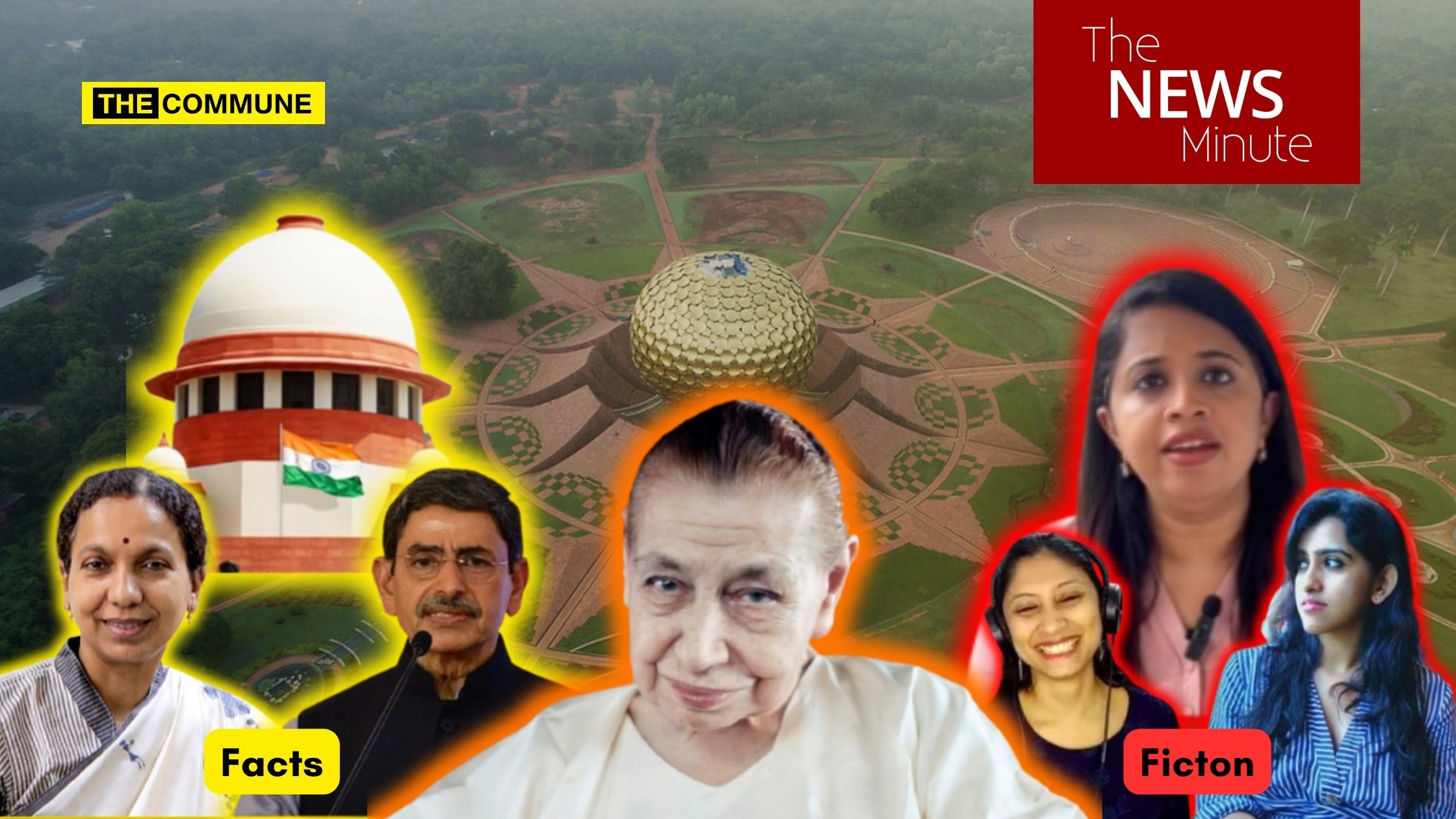
On 17 March 2025, the Supreme Court of India delivered a landmark verdict (Auroville Foundation v. Natasha Storey and related cases), dismissing allegations of mismanagement, environmental violations, and political interference in Auroville. The judgment explicitly termed many claims as “ill-motivated litigation” by a small group of residents opposing development of the township.
This article reveals the factual inaccuracies, unsubstantiated claims, and ignored legal realities that the The News Minute’s (TNM) so-called two-part ‘investigation‘ won’t tell you.
The Supreme Court’s March 2025 verdict in Auroville Foundation v. Natasha Storey established critical factual findings that directly contradict several allegations made in The News Minute’s articles.
Auroville’s Stand
The Auroville Foundation, governed by the Auroville Foundation Act, 1988, appealed against Madras High Court orders that undermined its statutory authority. The case traces Auroville’s history since its 1968 inception by the Divine Mother, whose Galaxy Plan envisioned a 50,000-resident spiritual township. Despite this, progress stalled post-1973 due to mismanagement, prompting Supreme Court intervention in SP Mittal v. Union of India (1983), which upheld central oversight.
The Foundation asserts that the Governing Board (GB) holds exclusive powers under Sections 6, 7, 11, and 17 of the Act to implement the 1999 Master Plan (approved by residents and the Union government). However, a faction led by Hemant Lamba and others disrupted governance by:
- Illegally occupying the Working Committee’s office (FIR 134/2022 for trespass, data theft).
- Challenging GB orders like the Auroville Town Development Council (ATDC) reconstitution.
- Delaying the Register of Residents update since 2005, enabling vested interests to control land.
The Foundation argues that the Residents’ Assembly (RA) has only advisory roles (Section 19), yet the Single Judge erroneously expanded RA’s powers beyond statutory limits. The First Bench stayed this order, noting judicial overreach.
Key Developments:
- 13.10.2022: HC dismissed Natasha Storey’s petition, reaffirming GB’s supremacy.
- 07.12.2022: GB issued a corrigendum clarifying its authority under the Act.
The Foundation seeks to quash the Single Judge’s order, emphasizing that non-compliance with the Master Plan and frivolous litigation by a minority hinder Auroville’s growth as envisioned by its founders.
Now let us take a look at the allegations made by The News Minute in its articles and video.
Allegation: “BJP-RSS Quiet Takeover Of Auroville”
One of TNM’s central claims was that the BJP government engineered a “quiet takeover” of Auroville by appointing figures allegedly aligned with the RSS, including IAS officer Jayanti Ravi as Secretary, and Tamil Nadu Governor RN Ravi and Puducherry LG K. Kailashnathan to the Governing Board.
The Truth?
First, regarding governance, the Court unambiguously affirmed the statutory authority of Auroville’s Governing Board (GB) under Section 11(3) of the Auroville Foundation Act, 1988. Justice Bela Trivedi’s judgment states: “The general superintendence, direction and management of the affairs of the Foundation shall vest in the Governing Board which is empowered to exercise all the powers and discharge all the functions which may be exercised or discharged by the Foundation.” This legal framework predates the current administration by decades, having been established during Congress-led governments.
The Court emphasized that previous boards included Congress appointees like Karan Singh.
How TNM Claims BJP & RSS Are Involved?
The article reads, “In its bid to gain a stronger foothold in Tamil Nadu, the Bharatiya Janata Party (BJP) has been seeking a cultural icon to rally around. Past attempts to appropriate Tamil poets Thiruvalluvar and Subramania Bharati faced intense pushback. Now, the party seems to have found a more fitting figure in Aurobindo Ghosh, whose blend of nationalism and spirituality aligns well with its ideological narrative.”
Here’s more, “Aurobindo’s political philosophy, rooted in religious nationalism, which provides an ideal ideological foundation for the BJP’s brand of politics.”
So, what’s The News Minute’s problem here? That Shri Aurobindo was a nationalist who spearheaded a Hindu revivalist movement? Shri Aurobindo anyway doesn’t fit in their secular scheme of things and is someone who can never be appropriated by the leftist-Dravidianist ecosystem.
Here’s even more: “The BJP needs a cultural icon in Tamil Nadu, someone around whose historical footprint they can make inroads. And Aurobindo Ghosh seems like a perfect fit. Although the RSS completes 100 years this year, their appeal has been still limited to traditional bases. So appropriating other leaders helps them expand the party’s appeal while reshaping historical memory. For example, appropriating Subhas Chandra Bose with his nationalism serves as a contrast to the Congress’ legacy of freedom struggle. Sardar Vallabhbhai Patel’s co-opting serves to reduce Jawaharlal Nehru’s significance in the formation of independent India. Even claiming Ambedkar, the BJP has sought to bolster its Dalit outreach, despite his strong critiques of Brahmanical Hinduism.”
Co-Opting Shri Aurobindo!
TNM’s attempt to paint Sri Aurobindo as a victim of “co-option” by the BJP-RSS in their first installment is not only disingenuous but laughably shallow. Shri Aurobindo’s own writings speak louder than any political spin. He explicitly equated Sanatana Dharma with Indian nationalism and envisioned a united India rooted in spiritual awakening. These aren’t quotes cherry-picked by today’s ‘right wing‘—they’re Shri Aurobindo’s core beliefs, long before any modern party emerged. To now frame this as “appropriation” simply because contemporary political figures resonate with his vision is intellectually lazy.
It’s especially ironic that TNM tries to distance Shri Aurobindo from the very ideals he espoused—unity, dharma, and spiritual nationalism—by suggesting that acknowledging them is somehow sinister. If the RSS or BJP cites his legacy, it’s not a hijacking; it’s alignment. Shri Aurobindo’s vision of an Akhand Bharat and rejection of the Partition wasn’t a political stunt—it was his lifelong conviction. That doesn’t make him anyone’s “tool”; it makes him timeless. TNM’s narrative reeks of ideological insecurity. When history doesn’t fit their preferred frame, they don’t engage with it—they accuse others of theft.
As for the claim on “RSS involvement”, there is no evidence of it nor was it presented in court. The “Hindutva agenda” claim relies on the TNM’s subjective interpretations of cultural events (e.g., Ramayana exhibitions in Bharat Nivas) and the alleged leanings of the members of the GB.
Allegation: “Forced Galaxy Plan Implementation & Environmental Destruction”
TNM claims that the administration bulldozed forests, felled 900+ trees, and ignored eco-concerns to fast-track the Crown Road project. Additionally, they state that the residents alleged the “Mother’s vision” was distorted.
The Truth?
The Master Plan (approved in 2001) mandates infrastructure development, including the Crown Road. The Supreme Court noted,
“The Master Plan was approved by the Governing Board and the Residents’ Assembly of the Appellant Foundation in 1999. The said 1999 Master Plan was further approved by the Competent Authority- the Town and Country Planning Organisation (TCPO), Ministry of Urban Development, on 15.02.2001 under the Model Town and Country Planning Act. The said Master Plan was notified on 16.08.2010 and published in the Gazette on 28.08.2010.”
The court further noted, “It appears that some disgruntled residents of Auroville, instead of cooperating the Governing Board of the Foundation in the implementation of the said legally approved Master Plan and in carrying out the development work of Auroville as per the said Master Plan envisioned by the “Mother,” started causing obstructions by filing the Petitions in the High Court of Judicature at Madras one after the other, dragging the Appellant-Foundation into unnecessary litigations.”
Additionally, the Division Bench dismissed the writ petition through a detailed order dated 7 June 2022, citing grounds of maintainability and an inordinate delay of over 12 years in challenging the Gazette Notification issued on 28 August 2010.
Overturning a Madras High Court judgment, the bench of Justices Trivedi and Varale clarified that the Residents’ Assembly’s role is purely advisory under the Auroville Foundation Act. The Court criticized “disgruntled” residents for obstructing development through litigation and imposed ₹50,000 costs on petitioner Natasha Storey.
It must be noted that this process provided multiple opportunities for resident input over a 12-year period prior to finalization.
Auroville Vs NGT
The Auroville Foundation challenged the National Green Tribunal (NGT)’s order directing the creation of a “proper township plan” and environmental clearance (EC) for Auroville, arguing it exceeds NGT’s jurisdiction and ignores statutory approvals. Here are some of the key arguments against the NGT.
Master Plan Legally Valid & Pre-Existing
- Auroville’s development follows the 1968 Galaxy Plan and 1971/1972 Master Plans by the Divine Mother and architect Roger Anger. The 1999 Master Plan, approved by the Residents’ Assembly and Union Ministries (2001), is a formalized update.
- NGT cannot mandate a new plan without first declaring the existing one invalid—a legal overreach.
No EC Required Under EIA 2006
- Construction began in 1968, predating the EIA Notification (2006), which applies prospectively. MoEF’s affidavit confirmed EC is unnecessary, but NGT ignored this expert opinion.
- Supreme Court precedent (PV Krishnamoorthy, 2021) holds EC applies only to new projects, not ongoing ones.
Limitation & Jurisdictional Issues
- The original plea concerned tree felling, but NGT later introduced EC/township issues via an unrecorded rejoinder affidavit, violating natural justice.
- NGT lacks authority to review Master Plans—its mandate is limited to environmental disputes (Sterlite Industries case, 2019).
Statutory Override
- The Auroville Foundation Act, 1988 (Section 27) superseded state planning laws. NGT’s order to create a “proper township plan” conflicts with this central statute.
The NGT order was ultra vires, ignores settled law, and disrupts Auroville’s 50-year development under a legally sanctioned plan. The Foundation seeks quashing of the directive to uphold statutory autonomy.
The NGT initially halted construction (2021) but later permitted it after finding: “The Tribunal, on the question as to whether the area in question was a Forest, held that it could not be treated as a Forest, as in none of the Government documents produced, it was treated as Forest, and admittedly it was man-made plantation of some species. The Tribunal therefore held that it would not come under the definition of “Forest” for the purposes of obtaining clearance under the Forest (Conservation) Act, 1980.”
The SC overturned NGT’s remaining restrictions, calling them “beyond jurisdiction.”
Case Against Hemant Lamba
The Auroville Foundation filed a petition in the Madras High Court in May 2022 seeking urgent action (No. 134/2022), where a group of individuals illegally seized the Working Committee’s office, tampered with records, and stole confidential data. The accused, including Hemant Lamba and Sauro Mezzetti, allegedly broke into the office on May 13, 2022, changed locks, deleted critical files, and misused official letterheads—actions that violate multiple sections of the IPC and IT Act.
Despite FIRs and complaints, the Auroville Police delayed filing a chargesheet for over a year. The Foundation requested the court to direct the police to include additional charges (Sections 34, 120B, 379 IPC and 66B, 84C IT Act) and expedite the investigation within three months.
The accused also created an unauthorized email domain (auroville.services) to impersonate the Working Committee, spreading misinformation and damaging Auroville’s reputation. The Foundation warned that such lawlessness threatened the governance of this statutory body, established by Parliament in 1988 to uphold Sri Aurobindo and the Mother’s vision.
Allegation: “Land Scams & Undervaluation”
TNM’s report accused the Governing Board of causing a ₹240 crore loss through unequal land swaps (1 acre for 1.4 acres) involving AuroOrchard, and claimed that 1,054 acres were exchanged, jeopardizing farms and forests.
It is noteworthy that land management falls within the Governing Board’s purview under the Auroville Foundation Act. Objections raised by residents were deemed procedural rather than substantive.
Moreover, the “investigation” by TNM has no supporting audit reports, FIRs, or legal documentation to back its claims of a land scam. Allegations were based largely on anonymous sources or unverified resident statements.
It is noteworthy that anti-BJP and self-styled ‘activist’, Dravidianist supporter Piyush Manush also peddled the same allegations about land swaps a few months ago and he did not produce any supporting documents to make his case.
One must note that if some such allegations are being made by a person of such credibility and if it is further propagated by the likes of TNM, readers and observers must take it all with a kilogram of salt!
Allegation: “Visa Threats & Suppression Of Dissent”
TNM also reported that the administration used visa cancellations to suppress dissent and targeted foreign critics such as Serge “Satprem” Maïni, director of the Auroville Earth Institute. There are allegations that residents’ visa was cancelled for ‘protesting’.
It must be noted that visa recommendation authority has rested with the Foundation since 1991, under Rule 12 of the Auroville Foundation Rules.
Protests by foreign nationals are violations of visa norms and authorities have every right to cancel visas as necessary.
Allegation: “Marginalization Of Tamils & Sanskrit Imposition”
Another point in TNM’s reporting was the alleged marginalization of Tamil residents and an imposed preference for Sanskrit over Tamil.
This is a totally unfounded claim, since Tamils comprise around 20% of Auroville’s population, many of whom hold administrative roles. There is no evidence of exclusion.
Cultural programs at Bharat Nivas, cited by TNM, have consistently included diverse Indian traditions. Events have ranged from Christian choral performances (December 2022) to Islamic calligraphy exhibitions (March 2023), as documented in the Foundation’s event records.
Court Rebukes Pattern Of Litigation
The ruling’s strongest language came in the court order, where the Court stated, “It appears that some disgruntled residents of Auroville, instead of cooperating the Governing Board of the Foundation in the implementation of the said legally approved Master Plan and in carrying out the development work of Auroville as per the said Master Plan envisioned by the “Mother,” started causing obstructions by filing the Petitions in the High Court of Judicature at Madras one after the other, dragging the Appellant-Foundation into unnecessary litigations.”
The order further said, From the above array of litigations, it is explicitly clear that a small group of disgruntled residents of Auroville, who instead of supporting and cooperating the Governing Body of Appellant-Foundation, in implementing the approved Master Plan and developing Auroville as envisioned by the “Mother,” kept themselves busy by filing the litigations one after the other, and causing obstructions in the smooth implementation of the Master Plan.”
The order further warned, “The party invoking extraordinary jurisdiction of the High Court under Article 226 of the Constitution of India must come with clean hands and disclose all correct and material facts in his Writ Petition. If it is brought to the notice of the Court that the petition has been guilty of suppression of material and relevant facts or has not come with clean hands, such conduct must be seriously viewed by the courts as the abuse of process of law and the petition must be dismissed on that ground alone without entering into the merits of the matter.”
The factual record now shows that what was framed as a “takeover” was in fact the lawful implementation of a 24-year-old development plan, while allegations of malfeasance crumbled under evidentiary scrutiny. This leaves Auroville’s future where the Court determined it belongs – in the hands of its duly constituted Governing Board, implementing the long-approved vision for the township’s development.
A Case Of Activism vs. Administration Fanned By The News Minute?
The TNM investigation omitted key legal realities:
- The Residents’ Assembly had decades to shape the Master Plan but failed to reach consensus.
- There is no evidence of illegal land grabs, RSS control, or eco-violations.
- The “federal enclave” theory is speculative—Auroville has always been under Central governance.
While dissent is valid, the Supreme Court’s verdict confirms that Auroville’s administration acted within the law. The TNM’s narrative, as always, relies heavily on activist rhetoric over verifiable facts.
Irony in Neutrality: TNM Relies On DMK Voice To Critique BJP’s Role In Auroville
In the News Minute’s (TNM) video report “Chaos, Conflict and Hindutva: What is Happening in Auroville?”, a striking irony emerges when TNM brings in a DMK functionary – Gayatri Srikanth, the State Convener of DMK Puducherry’s Women’s Wing, to substantiate its claims of a BJP-led ideological and administrative takeover of Auroville.
She parrots the same lies that TNM has been peddling, she said, “The Government of India is also allocating several crores of rupees for the development of Auroville. Whereas very few less number of people are residing over there. But you see 10+ IPS, IFS, lot many civil service people are been working in Auroville, where they are trying to make it as a union territory with special powers with RSS ideologies, slowly built with their own conventions, their own satsangs and all those things. This is continuously happening with a lot of ideologies which enhances is their extension of Akhand Bharat.”
This inclusion is ironic because DMK, a political party with its own strong anti-Hindu, bordering on anti-national/secessionist ideological stance and a history of central-state tensions, is presented as a neutral voice of concern rather than a political counterweight. The video uses this DMK figure to critique the Union government’s involvement in Auroville, portraying it as an imposition of “RSS ideology” and central authority, while sidestepping the DMK’s political motivations or vested interest in opposing the BJP.
By amplifying a DMK voice and not including more of what the other side has to say, TNM’s portrayal appears less like balanced journalism and more like a partisan narrative and activism. This undermines the documentary’s claim to neutrality, especially in a report that criticizes alleged ideological bias.
.
Last Word
If anyone is encroaching on this land, it’s the illegal foreign settlers occupying it without authorization. Will it be possible for an Indian to carve out enclaves or squat on a property like how the so-called “Aurovillians” are laying claim to the land?
Their outrage isn’t truly about the environment — it’s about the fear of losing control over land they have no legal right to. Just think about it: could an Indian go to a European country or the United States, settle illegally, and then demand ownership of large swathes of land simply because they’ve been there for some time? Of course not. Having been defeated in the highest court of the land, the losing side is now attempting to twist the facts through a calculated media campaign aimed at misleading the public.
Maybe it is time TNM rebrand themselves as ‘activists’ or ‘mouthpieces’ of political parties, leftist organizations and vested interests – that will make them more credible than claiming to be ‘journalists’.
Subscribe to our channels on Telegram, WhatsApp, and Instagram and get the best stories of the day delivered to you personally.