


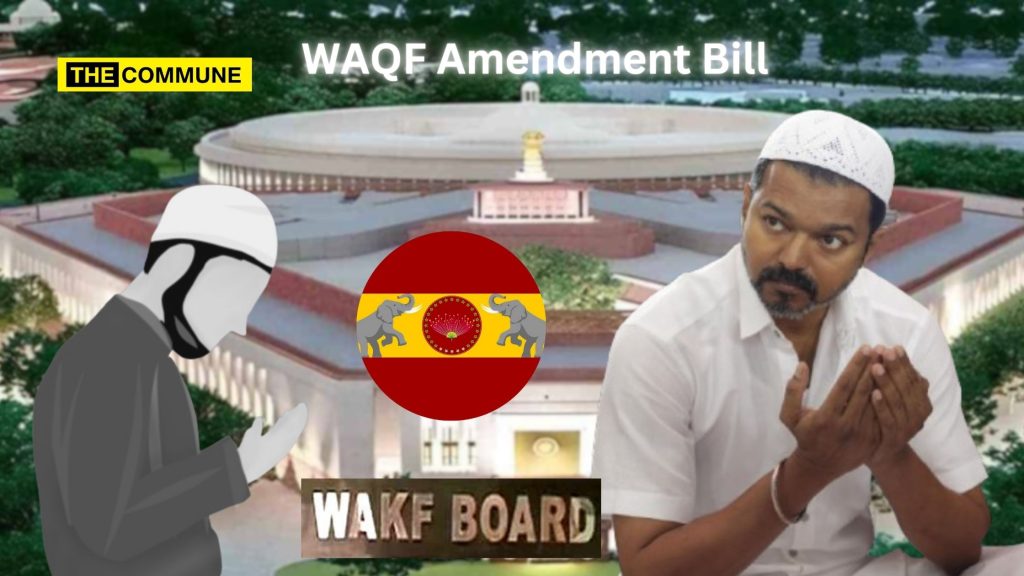
In an effort to appeal to the Muslim vote bank, following the example set by the DMK, part-time politician and leader of Tamilaga Vettri Kazhagam (TVK), Vijay, has announced a state-wide protest on 4 April 2025, calling for the repeal of the Waqf (Amendment) Bill, 2025. This move follows the passage of the Waqf (Amendment) Bill in the Lok Sabha during the early hours of 3 April 2025, after a marathon 12-hour debate.
In this regard, the party has announced protests across all districts of the state. Reports suggest that Vijay, the part-time politician, has instructed district secretaries to coordinate and manage the demonstrations effectively. This announcement follows remarks made by Tamil Nadu Chief Minister MK Stalin in the Assembly, where he stated that the DMK would challenge the Bill in the Supreme Court.
On 3 April 2025, TVK chief Vijay, in a statement on his social media X account, stated, “The Union Government should withdraw the anti-democratic Waqf Amendment Bill! The dignity of the Indian Constitution must be upheld!
- The Waqf Amendment Bill passed by the BJP government in the Lok Sabha has once again raised concerns about the fundamental principles of secular Indian democracy and the dignity of the Constitution.
- The ruling BJP government in the Union has enacted the Waqf Board Amendment Bill, continuing a troubling trend that continues to undermine the Constitution.
- The Indian Constitution recognizes the fundamental right of all Muslim brotherhood in India to follow their religious and cultural practices through Muslim personal laws.
- The Waqf Board Act is deeply intertwined with the theological and socio-economic aspects of Muslim life. It is a key component of Muslim personal law.
- What else is the demolition of the Waqf Board Act if not a direct assault on the promises made to minorities by our Constitution and the leaders of our country?
- What else is the majoritarian and divisive politics pursued by the BJP government if not a psychological attack that keeps our Muslim brothers in a perpetual state of constant insecurity and fear?
- Throughout history, we have seen that rulers who pass laws that undermine social harmony with the support of coalition parties, simply because they have the power to rule, often face the consequences through the people’s revolution.
- The ruling party at the Union is presenting the hollow argument that “This amendment is for the benefit of the Muslim minority, but opposition parties are misleading them.”
- If, as the BJP government claims, this is a law to protect the interests of Muslims, why don’t they have a single Muslim representative to even introduce it?
- Why aren’t there enough Muslim members in the democratic assembly to discuss it?
- This is the worst majoritarian politics that the BJP government has established today.
- All opposition parties and democratic forces in India are opposing this amendment bill. They are unanimously condemning the action of the Union government.
- The Joint Parliamentary Committee formed to consider this bill. The opposition members in the joint committee have accused it of ‘unusual, for the first time in history, rejecting the recommendations.’ This is nothing but the tyrannical power of the BJP government.
- Resolutions have been passed in the states of Tamil Nadu, Kerala, and Karnataka urging the withdrawal of the Waqf Amendment Bill. The Tamilaga Vettri Kazhagam has also passed a resolution in its general committee emphasizing the same idea.
- Tamilaga Vettri Kazhagam strongly condemns the Union BJP government, which has rejected all the democratic values of our country and, with the help of its majoritarian dominance, has taken up stance against the Muslim brotherhood.
- In order to listen to the entire democratic voices of the country, Tamilaga Vettri Kazhagam insists that this anti-democratic amendment bill should be withdrawn immediately.
If the Union BJP government does not take action, Tamilaga Vettri Kazhagam will stand in solidarity with the Muslim brothers and join their fight for the Waqf Rights Act.”
— TVK Vijay (@TVKVijayHQ) April 3, 2025
On contrary to part time politician Vijay, Parliament has passed the Waqf (Amendment) Bill, 2025, with the Rajya Sabha approving it and the Upper House approved the Bill with 128 members voting in favor and 95 members voting against it, following a 12-hour debate. The Lok Sabha had already passed the Bill earlier.
The Waqf (Amendment) Bill 2025 aims to streamline the management of Waqf properties by including provisions to safeguard heritage sites and promote social welfare. The legislation seeks to enhance transparency in property management, improve coordination between Waqf Boards and local authorities, and protect the rights of stakeholders. Additionally, the Bill aims to improve the economic and social status of Muslim women, particularly widows and divorced women. One of the key objectives is to make the Waqf Board more inclusive, ensuring representation from various Muslim sects for better governance and decision-making. The Bill also seeks to establish a secular, transparent, and accountable system for Waqf administration.
During the debate, Minority Affairs Minister Kiren Rijiju responded by emphasizing that the legislation would benefit millions of poor Muslims and stated that it would not harm any Muslim community. He clarified that the Bill does not interfere with Waqf properties and that the government is committed to the vision of “Sabka Saath, Sabka Vikas” (Together with All, Development for All). Rijiju also mentioned that poor and Pasmanda Muslims had urged him to support the Bill. He assured that the government had considered the views of Members of Parliament in the Joint Parliamentary Committee, incorporating their suggestions into the Bill. He further noted that the Central Waqf Council would consist of 22 members, including ex-officio members, with no more than four non-Muslim members. The Waqf Board would have eleven members, of whom only three would be non-Muslims.
Earlier, while introducing the Bill, the Minority Affairs Minister highlighted that it had been brought after detailed consultations with stakeholders and the Joint Parliamentary Committee. He appealed to opposition parties to support the Bill.
Additionally, Parliament approved the Mussalman Wakf (Repeal) Bill, 2025, which repeals the Mussalman Wakf Act of 1923, with the Rajya Sabha giving its approval. The Lok Sabha had already passed the Bill.
Why Is The Waqf (Amendment) Act necessary?
- In 2020, the Tamil Nadu Waqf Board claimed ownership of the entire Balasamudram Municipality in Dindigul district, asserting that their records indicate the area spans 389 acres. Due to ongoing legal disputes, this claim has left approximately 10,000 residents in limbo, as they can now not sell their ancestral properties.
- In September 2022, the Tamil Nadu Waqf Board claimed ownership of the entire Thiruchendurai village in Tiruchirapalli, including temple lands, sparking significant concern among residents. This claim emerged when local farmer Rajagopal was required to obtain a No Objection Certificate from the Waqf Board to register his land sale, despite having proper revenue documents. The claim was recently debated in parliament, including over the 1,500-year-old Manendiyavalli Sametha Chandrasekhara Swamy temple. The Tamil Nadu Registration Department has acknowledged issues with encroachments and disputed properties but struggled to justify the Waqf Board’s claims over temple lands.
- In 2023, the Tamil Nadu Waqf Board asserted ownership over land allocated to 73 Scheduled Caste families in Anganakaundan Puthur, Erode District. The Tamil Nadu government provided this land in 1980 after a flood, and since then, it has been their home for 40 years. The Waqf Board’s claim has caused significant challenges, including transferring land titles, registering deeds, and obtaining loans.
- In January 2023, the DMK government wrongly reclassified 57 acres of agricultural land in Veppur village, Ranipet District, as Waqf Board property. This land, which Hindu families had farmed for decades, was abruptly claimed by the Waqf Board without proper notice or due process, causing considerable distress among the affected farmers.
- On 11 August 2024, former Tamil Nadu Waqf Board President Abdul Rahman claimed that the Peyazhwar Temple in Mylapore, Chennai, which is allegedly situated on land claimed by the Kutchery Road Mosque.
- In January 2025, residents of Min Nagar in Kanchipuram district faced challenges after the Tamil Nadu Waqf Board claimed 2.43 acres of land they’ve lived on for over 40 years. The Kanchipuram Registrar’s Office confirmed the claim, hindering property registrations. The land was purchased in 1982 by employees of the Kanchipuram Electric City Office.
Subscribe to our channels on Telegram, WhatsApp, and Instagram and get the best stories of the day delivered to you personally.